Berlin
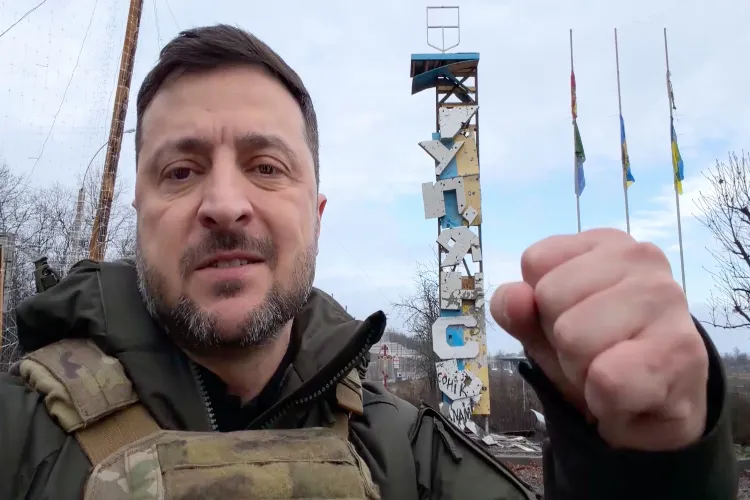
Ukrainian President Volodymyr Zelenskyy and senior United States envoys arrived in Berlin on Sunday for fresh diplomatic engagements aimed at exploring pathways to end the war in Ukraine, even as Kyiv and Moscow remain deeply divided over the contours of any potential peace agreement.
Zelenskyy said a series of discussions involving Ukrainian, American and European representatives are scheduled in the German capital. He confirmed that he would personally meet US President Donald Trump’s special envoy, Steve Witkoff, along with Trump’s son-in-law Jared Kushner, who are part of Washington’s ongoing diplomatic efforts.
In audio remarks shared with journalists via a WhatsApp group, Zelenskyy stressed that Ukraine requires robust security guarantees from both the United States and European allies—assurances he said should mirror those enjoyed by NATO members. His comments came amid continued resistance from Washington and some European capitals to Ukraine’s bid for full NATO membership.
“Such guarantees are necessary to prevent a renewed phase of Russian aggression,” Zelenskyy said, describing them as a concession already made by Kyiv. He underlined that any assurances must be legally binding and backed by the US Congress.
Zelenskyy added that he was awaiting feedback from Ukrainian officials following talks between Ukrainian and US military representatives in Stuttgart. He also said separate meetings were planned with German Chancellor Friedrich Merz and potentially other European leaders later in the day. According to Zelenskyy, Washington has yet to formally respond to Kyiv’s most recent peace proposals.
The US has spent months attempting to bridge the positions of both sides as President Trump pushes for a rapid resolution to the conflict, expressing frustration over repeated delays. However, progress has been hampered by fundamental disagreements, particularly over territory in eastern Ukraine, including the largely Russian-occupied Donetsk region.
Key disagreements remain unresolved
One of Moscow’s central demands for ending the war is Ukraine’s withdrawal from the remaining areas of the Donetsk region still under Kyiv’s control—a condition Zelenskyy once again rejected on Sunday.
He said US interlocutors had suggested the possibility of Ukraine pulling back from Donetsk and establishing a demilitarised free economic zone there, an idea he dismissed as impractical and unfair.
“Who would govern such a zone?” Zelenskyy asked. “If Ukrainian forces pull back five or ten kilometres, why wouldn’t Russian forces be required to withdraw by the same distance deeper into occupied territory?”
Describing the matter as extremely sensitive, Zelenskyy reiterated Ukraine’s preference for freezing positions along the current line of contact. “A fair and realistic option today is that everyone remains where they are,” he said.
Russia’s foreign policy adviser Yuri Ushakov told the newspaper Kommersant that Russian police and National Guard units would remain in parts of Donetsk even if a demilitarised arrangement were introduced under a future peace plan.
Ushakov cautioned that negotiations could be protracted, arguing that US proposals initially accommodating Russian concerns had been diluted by changes pushed by Ukraine and its European supporters. In remarks aired Sunday on Russian state television, he said Moscow expects to raise strong objections to what he described as non-constructive contributions from Kyiv and Europe.
He added that territorial issues were a central topic during recent meetings between Witkoff, Kushner and Russian President Vladimir Putin earlier this month, noting that US officials were fully aware of Russia’s stance.
German Chancellor Friedrich Merz, a key figure in Europe’s support for Ukraine alongside French President Emmanuel Macron and UK Prime Minister Keir Starmer, warned on Saturday that Europe could no longer rely on decades of what he called “Pax Americana.” Speaking at a party conference in Munich, Merz said Putin’s objective was to redraw Europe’s borders and reassert dominance reminiscent of the Soviet era.
“If Ukraine falls, he will not stop,” Merz warned. The Kremlin has repeatedly denied any intention to restore the Soviet Union or threaten NATO countries.
Continued aerial attacks on both sides
As diplomatic efforts continued, fighting on the ground showed no sign of easing. Ukraine’s air force said Russia launched ballistic missiles and 138 attack drones overnight. According to Ukrainian officials, 110 of these were intercepted or destroyed, though strikes were recorded at six locations.
Zelenskyy said hundreds of thousands of households across southern, eastern and northeastern Ukraine were still without electricity following recent large-scale attacks, with restoration work ongoing. He said Russia had launched more than 1,500 strike drones, nearly 900 guided bombs and 46 missiles of various types against Ukraine over the past week alone.
“Ukraine wants peace on just terms, and we are prepared to engage constructively,” Zelenskyy said. “These days will be filled with diplomacy, and it is crucial that it delivers tangible results.”
Russia’s Defence Ministry said its air defences intercepted 235 Ukrainian drones between late Saturday and early Sunday.
In Russia’s Belgorod region, a drone strike injured a man and set a house on fire in the village of Yasnye Zori, Governor Vyacheslav Gladkov said. Ukrainian drones also hit an oil storage facility in Uryupinsk in the Volgograd region, causing a fire, according to regional Governor Andrei Bocharov.
ALSO READ: Begum Sultan Amiruddin asked for banning polygamy and triple talaq in 1930s
Meanwhile, in the Krasnodar region, authorities reported that Ukrainian drones targeted the town of Afipsky, home to an oil refinery. While explosions shattered windows in nearby residential buildings, officials said the refinery itself was not damaged.









.webp "Former Ambassador to Iran Dinkar P Srivastava")
.webp "Diwali (Representational Image)")