New Delhi
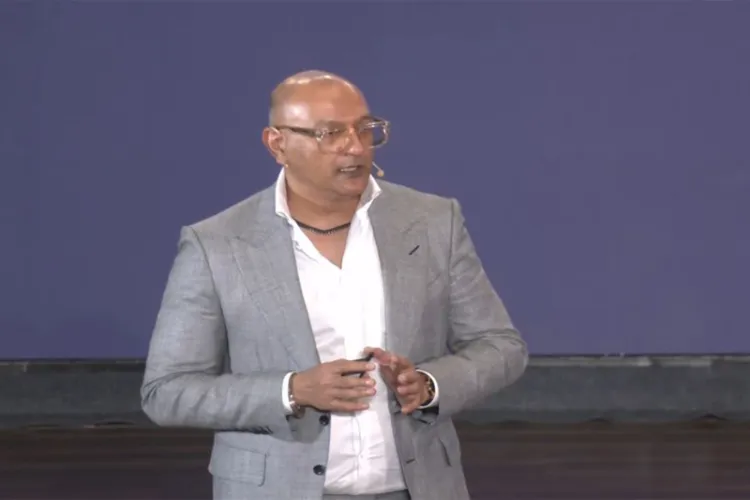
Artificial Intelligence (AI) is fundamentally reshaping software development, innovation cycles, and societal assumptions, while infrastructure constraints, a widening context gap, and a trust deficit could impede AI's progress, said Cisco President Jeetu Patel on Friday.
While speaking at the India AI Impact Summit 2026, Jeetu Patel said AI has "completely changed and flipped" the modern software development process.
Patel identified three major constraints that could slow AI adoption and advancement. "The first is infrastructure. There's just not enough power, compute, and network bandwidth in the world. Infrastructure is oxygen for AI," he remarked, pointing to limitations in memory capacity and data centre build-outs.
"The second constraint is the context gap," he said, and compared AI agents operating without adequate context to an emergency room doctor treating an unresponsive patient without medical history or charts. "An agent without context is still going to make decisions, but those decisions might not be the kind of decisions we want," he said.
To bridge this gap, Patel underscored the need to connect AI models with proprietary enterprise data and rapidly growing machine data, such as logs, metrics, events, and traces. He noted that "55 per cent of the growth of data in the world is going to be machine data," especially as AI agents operate continuously.
The third constraint, Patel said, is the trust deficit. He warned that the primary risk is no longer AI delivering incorrect answers, but AI taking "the wrong action," which could have far more serious consequences. He called for stronger safeguards against threats such as jailbreaking, prompt injection, tool abuse, and data poisoning.
He revealed that Cisco has already launched its first product "100 per cent built and coded with AI, where there was no human writing a single line of code." Patel said this shift could compress the traditional exponential innovation curve into what "almost feels like a vertical line," significantly accelerating the rate of technological change.
However, he noted that the absorption rate of technology by institutions and society is lagging behind the pace of innovation. Highlighting a "big mindset shift," Patel stressed that AI systems should no longer be viewed merely as productivity tools but as "augmented teammates" capable of working "on behalf of humans, for humans."
He argued that organisations must transition from a "human-in-every-loop" model to one where "AI is in every loop."
Patel emphasised the importance of runtime governance, stating that governance must evolve from static documentation to dynamic guardrails embedded into AI systems as they operate. "Governance is no longer a document. It's going to be a runtime implementation," he said.
Describing Cisco's strategy, Patel said the company is building AI-era networks, context-enrichment solutions, and security frameworks, supported by end-to-end observability "from GPU utilisation to model performance, apps, and agents."
READ MORE: Uttarakhand: Rohit Prakash pleads for Muslim keeping shops open till late
Calling AI a tremendous opportunity for India, Patel cited the country's young talent pool, digital public infrastructure such as Aadhaar and Unified Payments Interface, and its scale advantage.
"AI works best with scale. When you have the most amount of data," he said. Patel expressed optimism about AI's potential to address global challenges, including disease, poverty, and education gaps, while reiterating the need for collective efforts to ensure AI remains "safe and secure." "We are so grateful to be partnering with India in this journey ahead," he added.