 Shankar Kumar
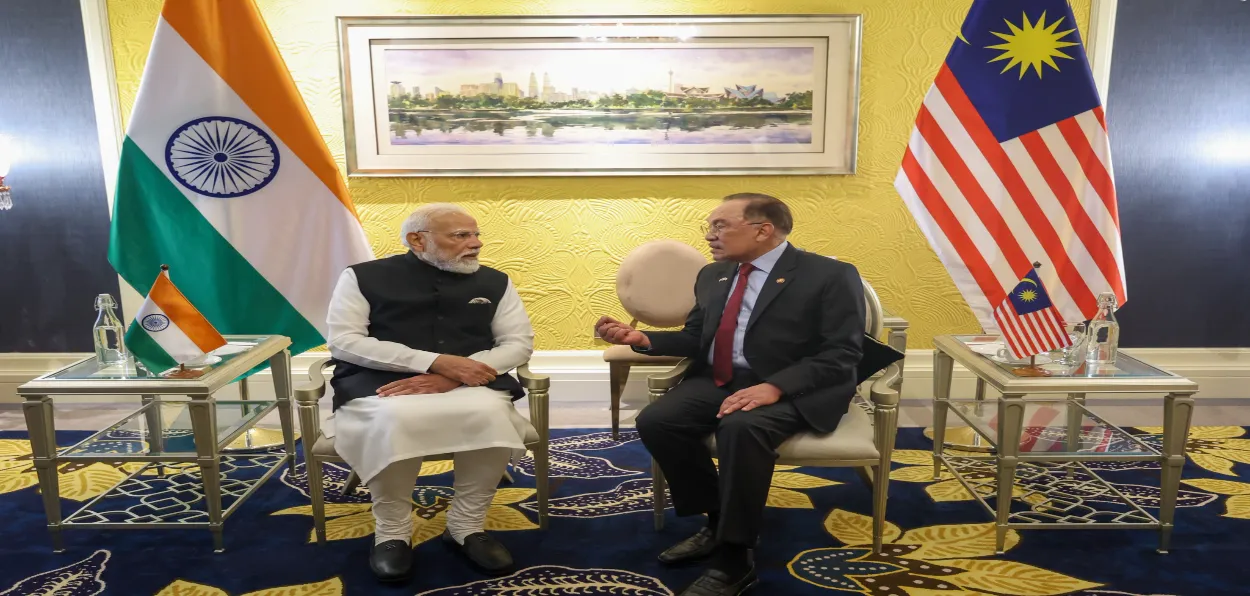
Prime Minister Narendra Modi has just concluded his two-day visit to Malaysia. The visit assumes significance since the far-east Asian country is fast turning into a global semiconductor hub and using the global chip supply chain disruptions as an opportunity. Ranked sixth globally in semiconductor exports, the sector contributes around 25 % to Malaysia's gross domestic product (GDP).
India, which has emerged as a significant player in the global semiconductor race, exchanged notes with Malaysia to strengthen cooperation in semiconductor manufacturing. This was done to formalise government-to-government alignment in the sector, which is expected to grow from $500 billion currently to $1 trillion by 2030.
Significantly, collaboration is already ongoing between the IIT Madras Global and the Advanced Semiconductor Academy of Malaysia (ASEM) in the field of semiconductors. Under this initiative, both these institutes are facilitating academic exchanges, faculty mobility, education and skilling of students with a focus on semiconductors and semiconductor design.
Besides, there is industry-level coordination between the Indian Electronics and Semiconductor Association and the Malaysian Semiconductor Association. Such developments suggest that India-Malaysian semiconductor cooperation is oriented towards structured engagement, basically in technology collaboration and
Malaysia is not the only Muslim-majority country with which India has strengthened relations in the critical technology sector; there are several countries in the Gulf region and Africa that are deepening cooperation with New Delhi to advance their shared interests in semiconductors and digital technologies.
In the case of the India-UAE relationship, even though energy cooperation remains the central pillar of bilateral ties, technology and innovation are increasingly emerging as defining pillars of cooperation between the two countries.
🚨 US semiconductor major KLA announces ₹3,600 crore investment in Tamil Nadu, plans to create 4,000 jobs.
— India Plus (@india_plus_) February 18, 2026
follow @india_plus_ pic.twitter.com/9UQcmDf6CJ
A joint statement issued by India and the UAE, during the then Crown Prince of Abu Dhabi, Sheikh Mohammed Bin Zayed Al Nahyan’s visit on January 24-26, 2017, said: “The Indian side thanked the UAE side for its interest in the proposal for establishing a semiconductor fabrication facility in India.”
Nine years later, the UAE signed a letter of intent with India on its participation in the development of a special investment region in Dholera in Gujarat, which is likely to emerge as a semiconductor manufacturing hub in a few years.
The two countries, under strategic agreements, are collaborating on digital infrastructure. The UAE is supporting India’s semiconductor manufacturing and design quest. It is also cooperating with New Delhi in setting up a supercomputing cluster and in augmenting data centre capacity.
Saudi Arabia, which is heavily investing in developing local semiconductor manufacturing capabilities under its ‘Vision 20230,’ is engaged with India in electronic manufacturing, digitisation, innovation, and emerging technologies such as Artificial Intelligence (AI), Internet of Things (IoT), Robots, Cloud Computing and Blockchain.
In addition to diversifying its economy by investing in talent, infrastructure, Artificial Intelligence and emerging technologies, Saudi Arabia is prioritising the development of homegrown capabilities in chip design and manufacturing.
During Prime Minister Narendra Modi’s visit to Riyadh on April 22, 2025, a joint statement issued by the two countries said, “Both sides underscored the importance of cooperation in technology, including in new and emerging domains such as Artificial Intelligence, cybersecurity, semiconductors, etc.”
In the fast-changing global situation, Saudi Arabia, an oil-dependent country, does not want to fall behind as advanced technologies such as semiconductors are increasingly becoming central to economic growth and strategic competitiveness.
This is also true with Qatar, which aims to shift its economy away from oil and natural gas to knowledge-based industries under its National Vision 2030. The largest supplier of Liquefied Natural Gas (LNG) to India, accounting for over 40% of the country’s total LNG imports from across the world, Qatar is investing its sovereign wealth into the AI and semiconductor sectors.
Supercomputer
Its semiconductor manufacturing market currently stands at $110 million. On February 18, 2025, speaking at the inaugural session of the India-Qatar Business Forum in New Delhi, Minister of Commerce and Industry Piyush Goyal said terms of trade are changing, “evolving from energy trade to emerging technologies like artificial intelligence, Internet of Things (IoT), quantum computing, semiconductors, etc.” He was referring to the expanding basket of India-Qatar bilateral engagement on the trade and investment front.
Yet the steady expansion of bilateral engagement is more pronounced between India and Kuwait. The two countries, which elevated their relationship to a strategic partnership during the visit of Prime Minister Modi in 2024, expressed their interest in deepening collaboration in emerging technologies, semiconductors and artificial intelligence.
This commitment was markedly clear in the India-Kuwait joint statement issued during Prime Minister Modi’s visit to the Gulf country on December 22, 2024. “The two sides expressed interest in pursuing deeper collaboration in the area of technology, including emerging technologies, semiconductors and artificial intelligence,” the India-Kuwait joint statement noted.
In Bahrain, Chennai-based Polymatech is establishing a semiconductor manufacturing facility. For this, the tech company has committed to invest $16 million. However, amongst GCC countries, there is a common understanding that economies built on oil and gas must evolve into knowledge-driven powerhouses.
They have started converting such thoughts by implementing them on the ground. At the same time, India, with its abundant skilled workforce and growing reputation as a global technology powerhouse, is increasingly positioning itself as a serious player in critical technologies, including semiconductors.
Union Minister @AshwiniVaishnaw launched Qualcomm’s 2nm semiconductor chip today, marking a milestone in advanced chip design and showcasing India’s growing role in global engineering operations. @PIB_India @MIB_India #Semiconductors #TechInnovation #MakeInIndia pic.twitter.com/LlZqWg3Rfa
— DD News (@DDNewslive) February 7, 2026
The ongoing collaboration between India and GCC countries in areas such as advanced manufacturing, digital innovation and supply chain resilience signals a convergence of strategic interests that could reshape the technological landscape of the wider region.
Since the establishment of a strategic partnership between India and Egypt in 2023, the two countries have been enhancing their partnership in areas such as startups, fintech, artificial intelligence and semiconductors.
Egypt has a long history in microelectronics and semiconductor design. With a strong base of engineers, research centres and startups, it is looking to scale up its capabilities by collaborating with countries like India and attracting investments into the technology sector.
From Southeast Asia to the Gulf and Africa, India’s semiconductor and digital diplomacy is acquiring strategic depth. What was once largely oil and gas-driven engagement with countries such as the UAE, Saudi Arabia, Qatar and Kuwait is now increasingly evolving into partnerships anchored in advanced manufacturing, artificial intelligence and chip design.
ALSO READ: India’s Arab pivot: Why it matters more than ever
India’s cooperation with Malaysia and Egypt reflects a shared recognition that semiconductors and emerging technologies will define economic resilience and strategic autonomy in the decades ahead.











.webp "UAE Deputy PM Hamdan bin Mohammed with Flydubai pilot Captain Smit Machchhar in hospital")