




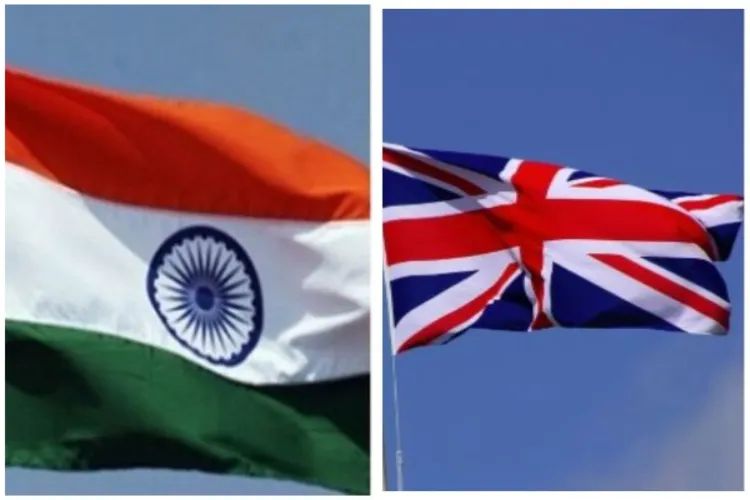
London
The UK government on Tuesday underscored its “first mover advantage” in securing a free trade agreement with India ahead of the European Union, telling Parliament that Britain’s deal had effectively become a reference point for Brussels’ own negotiations with New Delhi.
The remarks came during a House of Commons debate on the India-UK Comprehensive Economic and Trade Agreement (CETA), where Opposition Conservatives criticised the pact, arguing that a stronger agreement could have been achieved with one of the world’s fastest-growing major economies.
Andrew Griffith, the shadow secretary of state for business and trade, said the UK needed a trade deal with “real bite” to revive growth.
“Instead of a vindaloo of a deal, the Prime Minister came back with a bag of soggy poppadoms,” he remarked.
Responding on behalf of the Labour government, Minister of State for Business and Trade Chris Bryant defended the agreement, calling it a “momentous achievement” that goes beyond India’s previous trade commitments.
“On services, the way this deal has been transacted has the backing of the Federation of Small Businesses, HSBC, Standard Chartered, EY, TheCityUK and Revolut,” Bryant said. “I don’t think they see it as soggy poppadoms at all — they see it as a fine tandoori.”
Citing official data, Bryant told MPs that bilateral trade between India and the UK stood at £47.2 billion last year, a rise of 15 per cent year-on-year, making India Britain’s tenth-largest trading partner.
“India has the fastest growth rate in the G20 and is on track to become the world’s third-largest economy by 2029,” he said, adding that by 2050 India would have over 250 million high-income consumers. Import demand is projected to rise to £2.8 trillion by mid-century, while foreign direct investment into India could reach £1 trillion by 2033 if current trends continue.
Bryant said the trade deal, signed during Prime Minister Narendra Modi’s visit to the UK last year, is expected to add £4.8 billion to Britain’s GDP, increase wages by £2.2 billion and boost bilateral trade by £25.5 billion annually by 2040.
Under the agreement, India will eliminate tariffs on 90 per cent of tariff lines, covering 92 per cent of current UK exports. This would deliver immediate tariff savings of £400 million a year for the UK, rising to £900 million after a decade, with average Indian tariffs falling from 15 per cent to 3 per cent.
“Imitation is the sincerest form of flattery,” Bryant said, welcoming the EU’s political agreement on its own India FTA. “It appears the UK deal was used as a baseline, but the UK retains the first mover advantage.”
He expressed hope that the agreement would enter into force before the end of summer, allowing British businesses to benefit from reduced tariffs this year, while EU ratification could take longer. He added that only the UK has secured access to India’s £38-billion federal procurement market.
The recently signed Double Contributions Convention (DCC), which prevents temporary workers from paying social security contributions in both countries, drew criticism from some opposition MPs. Bryant rejected the concerns, saying the provision would not disadvantage British workers or make it cheaper to hire Indian labour.
“This applies to highly skilled workers employed temporarily by Indian companies, who will continue paying contributions in their home country rather than duplicating them in the UK,” he said.
Bryant acknowledged that the government would have preferred to conclude a bilateral investment treaty alongside the trade pact, but said the UK remains open to initiating that process whenever India is ready.
READ MORE: Khan Sir’s affordable hospital in Patna becomes lifeline for poor
The agreement, signed by Prime Ministers Narendra Modi and Keir Starmer in July last year, is currently undergoing parliamentary scrutiny, including debates in both Houses and committee reviews, before it can be implemented in the coming months.










.webp "Union Home Minister Amit Shah")
.webp "Union Minister of Parliamentary Affairs Kiren Rijiju")
.webp)

.webp)

_(1).webp)