New York
India has asked the United Nations Security Council (UNSC) to adopt a practical, balanced approach while dealing with the Taliban, stressing that international engagement should reward constructive behaviour rather than depend solely on sanctions.
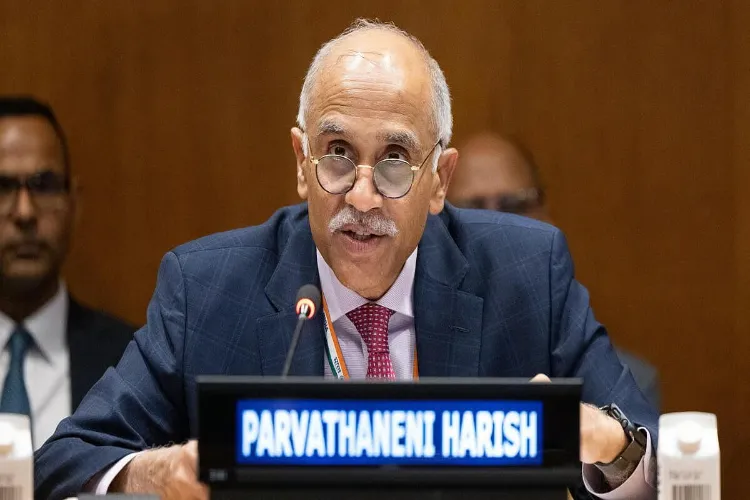
India’s Permanent Representative to the UN, Ambassador Harish Parvathaneni, delivered the remarks during a UNSC session reviewing the situation in Afghanistan.
Congratulating Slovenia on assuming the Council presidency, the envoy thanked UN officials and civil society briefers, noting that India’s approach toward Afghanistan is shaped by deep historical and civilisational bonds.
“India deeply values its civilizational relationship and centuries-old ties of friendship, and this legacy continues to guide our engagement with the people of Afghanistan,” he said.
He reiterated India’s longstanding support for peace and stability in Afghanistan and underlined New Delhi’s active participation in regional deliberations, including the Doha Working Group. According to him, coordinated regional and international efforts are crucial at this juncture.
Ambassador Parvathaneni highlighted India’s over 500 development projects across Afghan provinces. Following recent talks with Afghan Foreign Minister Amir Khan Muttaqi in New Delhi, India has agreed to enhance cooperation in priority sectors such as healthcare, public infrastructure and capacity-building. New Delhi continues to partner with UN agencies in food security, health, education and sports.
“As agreed during Foreign Minister Muttaqi’s visit, India will scale up development cooperation in healthcare, infrastructure and capacity-building. We remain engaged with UN agencies in critical areas, including health, food security, education, and sports. The visit of Minister Azizi to India further advanced cooperation on connectivity, trade facilitation and market access,” he said.
He outlined ongoing health initiatives funded by India, such as a Thalassemia Centre and Diagnostic Centre in Kabul, a new heating system for the Indira Gandhi Institute of Child Health, and a 30-bed hospital in Bagrami. India will also construct an Oncology Centre, a Trauma Centre and five maternity clinics. He added that 75 Afghans have received prosthetic limbs, and medical support continues for those travelling to India for treatment. India also handed over twenty ambulances during Muttaqi’s visit.
India was among the first responders after recent earthquakes in Afghanistan and continues to help rebuild destroyed homes. Its humanitarian aid also includes food grains, school materials, disaster relief supplies and assistance for refugees forcibly repatriated to Afghanistan.
Citing the UN Secretary-General’s report, Ambassador Parvathaneni flagged major humanitarian concerns. He noted that the forced return of more than 2 million Afghans this year has increased Afghanistan’s population by nearly 6 per cent, creating severe pressure on shelter, food and reintegration efforts.
He criticised Pakistan for recent border tensions, noting that the closure of key crossings disrupted trade, displaced families and caused significant financial losses during the fruit harvest season. He cautioned that no country should “weaponise trade and transit vulnerabilities” against a landlocked state.
Expressing concern over airstrikes in Afghanistan, he condemned civilian casualties, including those of women, children and athletes. He also denounced what he termed “trade and transit terrorism” that obstructs Afghanistan’s access to markets, calling it contrary to WTO rules and the UN Charter. He reaffirmed India’s support for Afghanistan’s sovereignty, territorial integrity and independence.
India continues to monitor the evolving security environment. The envoy urged the global community to ensure that UN-designated terrorist organisations — including ISIL, Al-Qaida, Lashkar-e-Taiba and Jaish-e-Mohammed — are prevented from operating from Afghan soil.
Calling for a more effective global approach, Ambassador Parvathaneni said India supports a “pragmatic and incentive-based” engagement with the Taliban. He argued that punitive measures alone have delivered little progress over the past four-and-a-half years and that more nuanced strategies are needed to ensure real benefits for the Afghan population.
“India calls for pragmatic engagement with the Taliban. A coherent policy should encourage positive steps. A focus only on punitive measures will simply perpetuate the ‘business as usual’ approach that we have witnessed for more than four years,” he said.
ALSO READ: NASA astronaut Pettit delights Muslims with his unique picture of Kaba
He concluded by reaffirming India’s long-term commitment to Afghanistan’s development. He noted that the restoration of India’s Technical Mission in Kabul to a full Embassy reflects this intent. India, he said, will continue working with all stakeholders on development assistance, humanitarian support and capacity-building aligned with the needs of Afghan society.







.webp)
.webp)