New Delhi
In Parliament, words often mean far more than their everyday usage suggests. During the ongoing Budget Session, several expressions frequently heard in the House — such as “yield”, “leave of the House”, “authentication”, “well” or “zero hour” — carry precise procedural meanings that can puzzle those unfamiliar with parliamentary practice.
For instance, “yield” has nothing to do with returns or crops, “leave of the House” does not mean stepping out, there is no water in Parliament’s “well”, and “zero hour” has no connection with midnight. Even “authentication” is far more formal than simply self-attesting a document.
As debates intensify, MPs have been seen agreeing — or refusing — to yield the floor, demanding authentication of documents cited in speeches, or moving into the well of the House in protest. Despite disruptions, however, no division has yet been called during the session.
Here is a simplified guide to some of the most commonly used parliamentary terms:
Authentication
When a member quotes from a document during proceedings, they must formally authenticate it by submitting the document in writing to the Speaker or placing it on the Table of the House. By doing so, the MP certifies the accuracy of the quoted material and takes responsibility for its contents.
The presiding officer may then permit or disallow its use. If an authenticated document is later found to be incorrect or misleading, the government can initiate further action.
Table of the House
Located in front of the Secretary-General’s desk in both Houses, the Table of the House is where official documents — Bills, reports, statements and papers — are formally laid.
Beyond the chamber, the Table Office of either House serves as the authoritative record of what has been officially tabled during proceedings.
Well
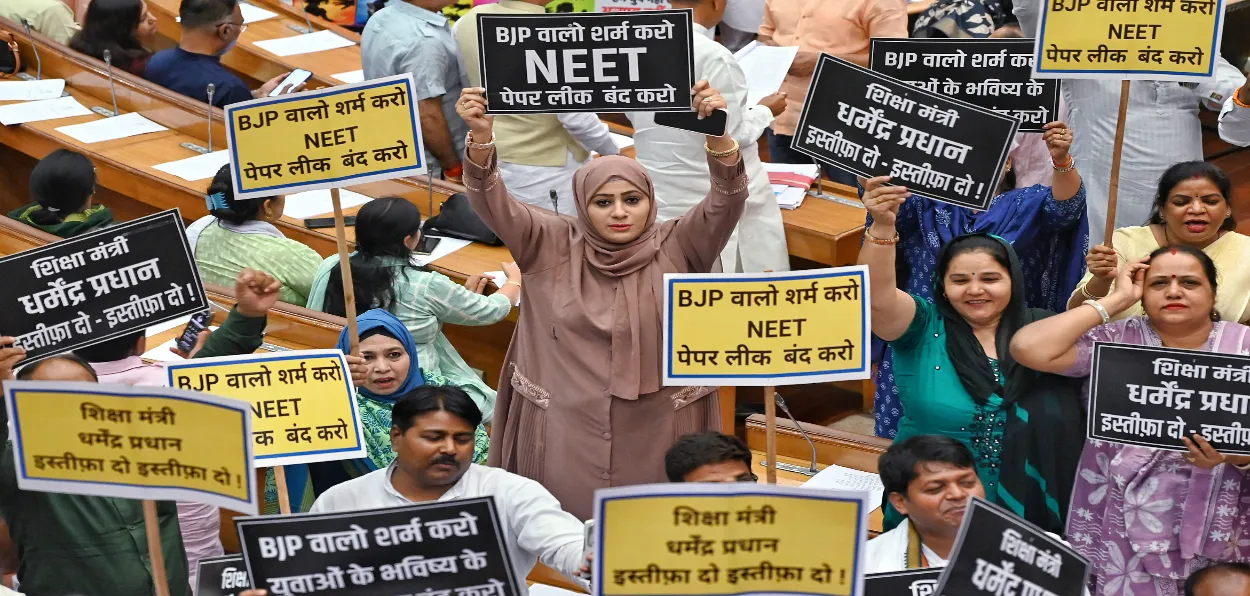
The “well” refers to the open space between the rows of members’ seats and the Chair occupied by the Speaker in the Lok Sabha or the Chairman in the Rajya Sabha. Opposition members often enter this area to stage protests, although such actions are considered disorderly.
Speaker
The Speaker is the chief presiding authority of the Lok Sabha and is elected from among its members by a majority of those present and voting. Within the House, the Speaker’s authority is final and binding, and their rulings are not subject to debate.
Leave of the House
This term denotes formal permission granted by the House to an MP to move or withdraw a motion. A member must first obtain the Speaker’s permission, rise in their seat, and then seek the leave of the House.
Once granted, a motion cannot be withdrawn without the House’s consent.
Yield
To “yield” or “yield the floor” means that a member speaking agrees to pause and allow another member to intervene. Yielding helps accommodate interruptions in an orderly way.
However, a member may refuse to yield unless the interruption is to raise a point of order or has the Chair’s approval.
Point of Order
A point of order allows any member to draw the presiding officer’s attention to a perceived breach of parliamentary rules or conventions. The member interrupts proceedings by formally invoking a point of order and must specify the rule under which the objection is raised.
The Chair has complete discretion to accept or reject the point.
Reply
During debates on the Union Budget, Bills or the President’s Address, multiple MPs speak based on time allocations. However, not all speeches are considered “replies”.
Only the concluding speech — delivered by the relevant minister in the case of Bills or the Budget, and by the Prime Minister in debates on the President’s Address or a no-confidence motion — is officially termed a reply.
Zero Hour
Zero Hour is a uniquely Indian parliamentary practice introduced in the early years after Independence. It allows MPs to raise urgent matters of public importance without prior notice.
Though it typically begins around noon and lasts until the lunch adjournment, the timing is flexible and has varied on several occasions.
Division
A division is called when members challenge the result of a voice vote and demand a formal count. Once ordered by the Chair, non-members are cleared from the lobbies and electric bells ring across the Parliament complex to alert MPs.
After the bells stop, entry and exit points are sealed and votes are recorded and counted to determine the outcome.
READ MORE: Khan Sir’s affordable hospital in Patna becomes lifeline for poor
Together, these terms form the working language of Parliament — a vocabulary that governs how debates are conducted, decisions are made, and order is maintained in the world’s largest democracy.










.webp "Representational image")
.webp)