New Delhi
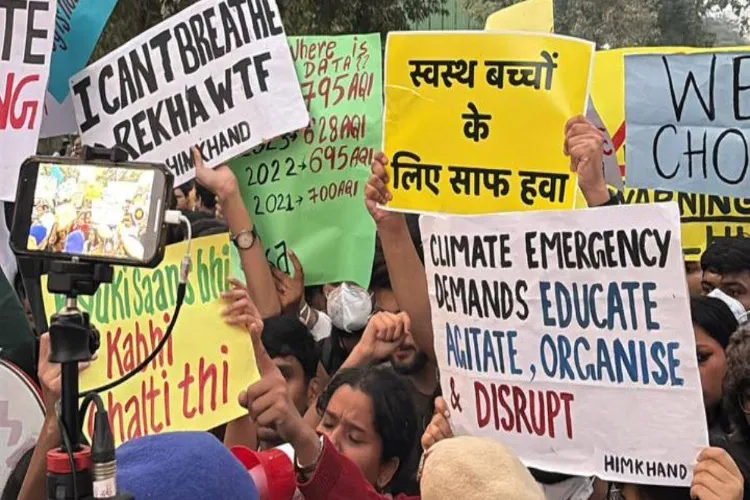
As Delhi continues to struggle with persistently “very poor” air quality, students and citizens converged at Jantar Mantar on Wednesday to demand immediate measures to ensure clean air for residents of the capital.
Participants included university students from Delhi University, Jawaharlal Nehru University and Jamia Millia Islamia, along with members of the National Students’ Union of India (NSUI). Protesters carried posters calling for decisive action, with messages such as “Clean air is a fundamental right,” “Delhiites deserve AQI below 50” and “Everyone has the right to breathe.” A number of local singers also performed to motivate the gathering.
Neha, a 26-year-old protester, accused authorities of failing to take responsibility.
“With the BJP in power at the Centre and the MCD, there is no one left to blame. Reports even suggest AQI manipulation, yet the air quality remains in the very poor category. What is the actual AQI? We’ll continue raising our voice until real measures are taken — this is about our fundamental right,” she said.
Delhi has remained stuck in the “very poor” to “severe” air quality range since Diwali. Under CPCB guidelines, an AQI of 301–400 falls under “very poor” and 401–500 is considered “severe.”
The pollution emergency has now become a subject of scrutiny in both Parliament and the Supreme Court. On Monday, the apex court observed that Delhi-NCR’s air pollution should not be dismissed as a seasonal, recurring pattern and ordered that the matter be heard twice every month to track short-term and long-term responses. Chief Justice Surya Kant, sitting alongside Justice Joymalya Bagchi, also noted that stubble burning may not be the sole cause of the crisis, pointing out that skies remained clear even during periods of continued stubble burning during the COVID lockdown.
The issue was also raised in the Rajya Sabha, where YSRCP MP Ayodhya Rami Reddy Alla called Delhi’s escalating pollution a public health emergency. Citing data that nearly 1 in 7 residents is at risk of premature death due to toxic air, he said more than 17,000 deaths in the city last year were attributed to pollution. Drawing parallels to Visakhapatnam, where PM10 levels increased by 32.7% over seven years, he criticised the slow pace of implementation under the National Clean Air Programme.
ALSO READ: Syed Nawaz Miftahi illuminates the world of the blind
“Unchecked air pollution costs India more than 3% of its GDP every year,” the MP said, calling for stronger political will, accurate AQI reporting, public awareness and real-time governance.



.webp "Representational Image")










_(1).webp)