 Saquib Salim
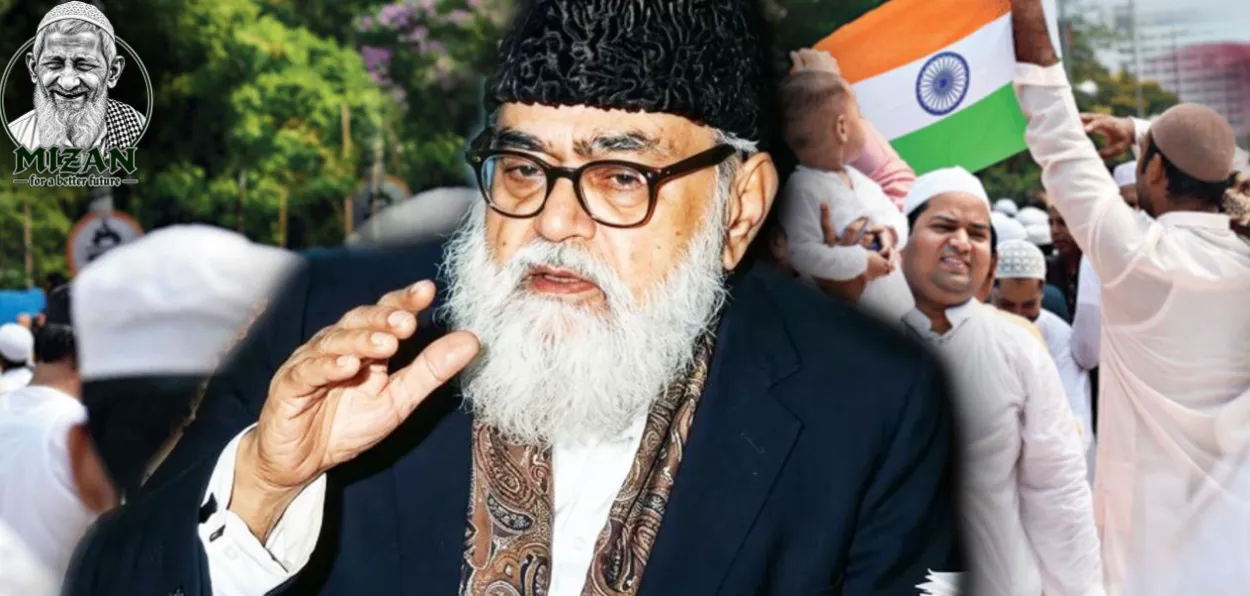
“Certainly. I should have no objection even if the Muslims of India are treated in that form of Government as shudras and malishes and Manu’s laws are applied to them, depriving them of all share in the Government and the rights of a citizen.” This statement by Maulana Syed Abul A'la Maududi recorded in the Justice Munir Commission report in 1953 was the first instance when I was curious about Maududi’s political ideas vis a vis Indian Muslims.
Justice Munir, the Chief Justice of Pakistan, led an inquiry into anti-Ahmadi riots in 1953 and noted, “The ideology of the Jama’at-i-Islami is perfectly simple. It aims at the establishment of the sovereignty of Allah throughout the world which, in other words, means the establishment of a religio-political system which the Jama’at calls Islam. For the achievement of this ideal it believes not only in propaganda but in the acquisition of political control by constitutional means and where feasible by force. A Government which is not based on the Jama’at’s conception, as where it is based on the conception of a nation, is, according to Maulana Amin Ahsan Islahi, a Satanic Government, and according to Maulana Abul Ala Maudoodi himself kufr, all persons taking part in such Government, whether as administrators or otherwise, or willingly submitting to such system being sinners.”
Maududi was a journalist born in Aurangabad in 1903, who founded the Jamaat-e-Islami in 1941. Later, he became the chief ideologue behind Pakistan's demand for an Islamic constitution.
Maududi’s foundation of a theory of the state can be understood by reading Al Jihad Fil Islam and The Islamic Law and the Constitution.
By reading these two books today, nearly a century after they were written, one can understand why Maududi's vision of politics, argued carefully and consistently within its own logic, simply cannot be reconciled with either the Constitution of India or the world in the 21st century.
The starting point was simple. Sovereignty belongs to God, and to God alone.
"Islam admits of no sovereignty except that of God and, consequently, does not recognise any Law-giver other than Him," Maududi writes in The Islamic Law and the Constitution. Since God alone is sovereign, no parliament and no consensus of citizens can make or amend laws.
.jpeg)
In the same book, he writes, "A state established based on God's de Jure sovereignty cannot legislate in contravention of the Qur'an and the Sunnah even if the consensus of its people demands it."
Maududi invented a new phrase for the arrangement he wanted, calling it not democracy but theo-democracy. He writes, “If I were permitted to coin a new term, I would describe this system of government as a “theo-democracy”, that is to say a divine democratic government, because under it the Muslims have been given a limited popular sovereignty under the suzerainty of God…. it is a theocracy in the sense that where an explicit command of God or His Prophet already exists, no Muslim leader or legislature, or any religious scholar can form on independent judgment, not even all the Muslims of the world put together, have any right to make the least alteration in it.”
Set this beside the opening line of the Indian Constitution. "We, the people of India, having solemnly resolved to constitute India into a sovereign socialist secular democratic republic and to secure to all its citizens."
India's republic, or for that matter any of the modern nations, does not derive its authority from any scripture. It derives it from the people themselves, of every faith and of none, through a Parliament that can be voted out and a constitution that can be amended by their elected representatives. So, the power to make or amend laws is invested in the people.
Maududi's theory begins by denying this possibility. He called for an ideological state, one in which, "the State shall be based not on geographical, racial, linguistic or any other materialistic concepts, but on the principles and ideals of Islamic ideology."
A state built on the ideology of one religion, sincerely held though it may be, has no room in a country of a billion and a half citizens who worship in a thousand different ways.
In The Islamic Law and the Constitution, he sets out, with legal precision, exactly what non-Muslims may and may not do inside his Islamic state. Maududi writes, "The non-Muslims cannot occupy key posts, posts from where the ideological policy of the state can be influenced, but they can occupy general administrative posts and can act in the services of the state.”
.jpeg)
The head of state, "would necessarily be a Muslim." A convention of Ulema that Maududi himself organised in Karachi in January 1951 resolved that "the Head of the State shall always be a male Muslim in whose piety, learning and soundness of judgment the people or their elected representatives have confidence."
Try to imagine such a clause in the constitution of any nation in modern times where the highest office is limited to a particular gender, religion or race.
Maududi's idea of Zimmi, the protected but permanently subordinate non-Muslim who pays jizya for living under Muslim rule, has no equivalent and can have none in a republic where a Muslim has served as President and as Chief Justice, precisely because the Constitution recognises no citizen as higher or lower based on faith.
War, Maududi writes, may be waged against the People of the Book "until they pay the tribute readily, being brought low," and jizya, he explains, "is the tax levied on conquered non-Muslims who become protégés of the Muslim State." A world of sovereign nations, bound together by the United Nations Charter and equal before international law whatever the God their citizens pray to, has already rejected the civilisational hierarchy of believer and tribute payer that Maududi built into his politics.
Maududi reserved his sharpest words for the Indian civilisation. In Al Jihad Fil Islam Maududi devotes an entire chapter to a comparative study of religion and war, and it is here that his politics cut deepest against India's shared fabric.
Quoting the Vedas at length, he concludes that "the Aryans regarded their enemies as devils in the shape of men and evil spirits," and of the caste system he writes flatly, "none can deny that the stratification of humanity, in accordance with Hindu religion, is based on racism and not on anything else."
Whatever one thinks of caste, and Ambedkar said far harsher things about it while chairing the committee that drafted India's Constitution, Maududi was not writing to build bridges with his Hindu neighbours. He was writing to prove that Hindus and Muslims belonged to two civilisations too different to share one government.
It is worth remembering that Maulana Abul Kalam Azad and Maulana Hussain Ahmad Madani, scholars every bit as grounded in the Quran and Hadith as Maududi, reached the opposite conclusion, insisting that qaum and millat were not the same thing and that Hindus and Muslims formed one Indian nation. The Constituent Assembly sided with Azad and Madani, when it decided that every citizen, whatever their faith, would vote in the same constituency for the same representative.
There is a final, almost ironic proof of how unworkable Maududi's blueprint has turned out to be, and it comes from his own organisation. The Jamaat-e-Islami Hind, which his followers built in India after Partition, eventually found itself compelled to publicly accept the Indian Constitution and enter its elections, embracing the very sovereignty of the people its founder had spent his life denying.
ALSO READ: Islam in the pursuit of science is beyond myth of conflict
Today, Jamat-e-Islami accepts Indian democracy, argues cases in judicial courts, contests elections and works among Muslims to raise awareness for the democratic rights Muslims have.
Saquib Salim is a public historian and works at Awaz-the Voice

.webp "Representational Image")










_(1).webp)

.webp)