




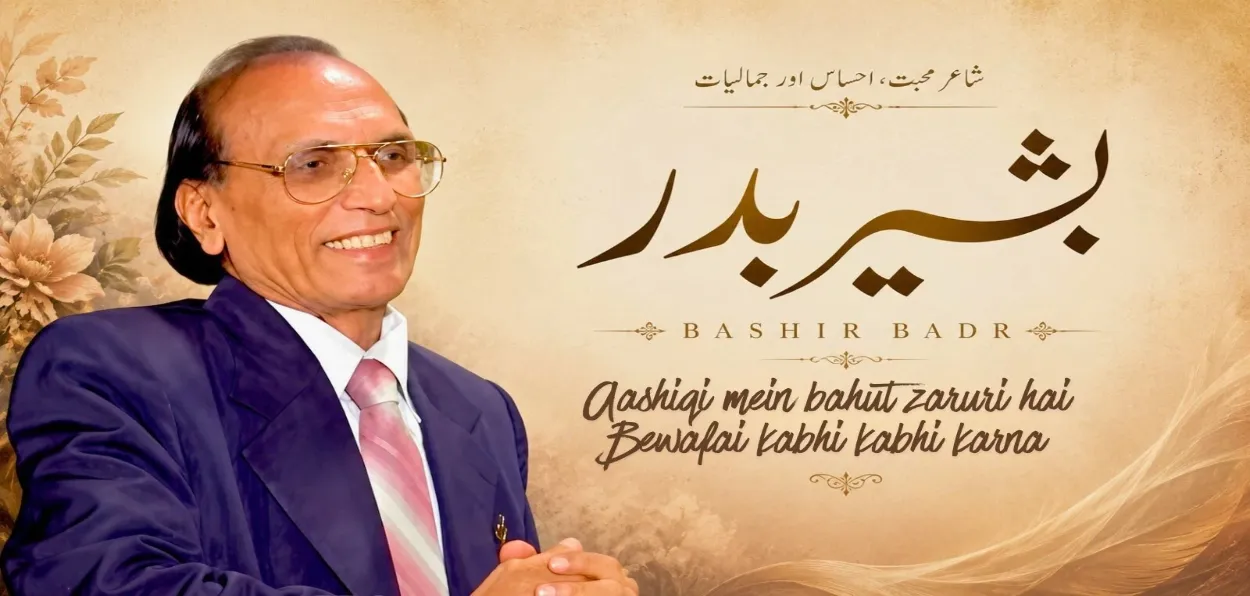
Mir Altaf
When communal violence reduced his home and manuscripts to ashes, Bashir Badr could have become a poet of grievance. Instead, he became a voice of reconciliation, bridged the Hindi-Urdu divide, and showed the way to coexistence for contemporary India.
He spoke of mortality of life and thereby useless emotional bagagges in this couplet: "Ujaale apni yaadon ke hamaare saath rehne do, Na jaane kis gali mein zindagi ki shaam ho jaaye." (Let the light of your memories remain with me; Who knows in which lane the evening of life may descend?)
When Bashir Badr passed away on May 28, India lost one of the great voices of the Urdu ghazal. For more than five decades, Bashir Badr's poetry travelled beyond literary circles and entered the lives of ordinary Indians. His couplets found their way into mushairas, classrooms, newspapers, greeting cards, drawing rooms, television programmes, and, in recent years, social media timelines.
Millions who had never formally studied Urdu could effortlessly quote his verses.
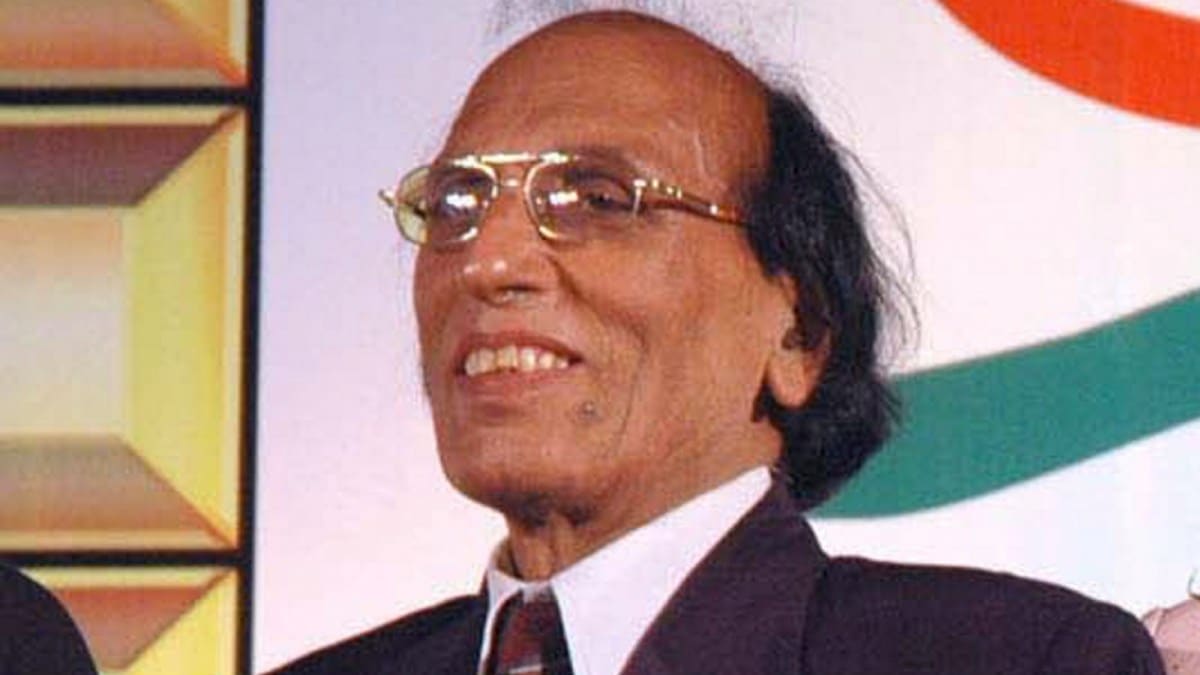 Padam Shri Bashir Badr
However, Bashir Badr's greatest achievement was not literary alone. After experiencing one of the darkest chapters of communal violence in independent India, he chose not bitterness but humanity, not grievance but reconciliation. Through his life and poetry, he demonstrated that cultural confidence, empathy, and coexistence are stronger than resentment and division.
The Urdu ghazal has long been admired for its elegance, sophistication, and layered meanings. Yet, sometimes it created a gap between poetry and ordinary readers. Bashir Badr helped bridge that gap.
He infused the ghazal with conversational ease. His poetry spoke of love, friendship, loneliness, memory, disappointment, hope, and human relationships in language that felt intimate and accessible. His verses could be appreciated by literary scholars and understood by common readers with equal ease. They travelled from mushairas to college campuses, from bookshelves to living rooms, and eventually into the digital age, where countless people continued to quote them without necessarily knowing the intricacies of Urdu literary criticism.
In this sense, Bashir Badr restored poetry to the public sphere and reminded readers that great literature need not be obscure. "Yahan aik bachay ke khoon se jo likha hua hai ussay padho Tera keertan abhi paap hai abhi mera sajda haram hai." (Read what has been written here with the blood of a child; Your devotional singing is a sin for now, and my prayer is forbidden for now.)
His couplets crossed linguistic boundaries with remarkable ease. They were quoted in Hindi literary gatherings, reproduced in mainstream newspapers, shared through greeting cards, and circulated across generations. At a time when language was often used to emphasise difference, Bashir Badr used it to reveal commonality. "Log toot jaate hain ek ghar banaane mein, Tum taras nahin khaate bastiyan jalaane mein." (People spend their lives building a single home, yet you feel no pity in burning down entire settlements.)
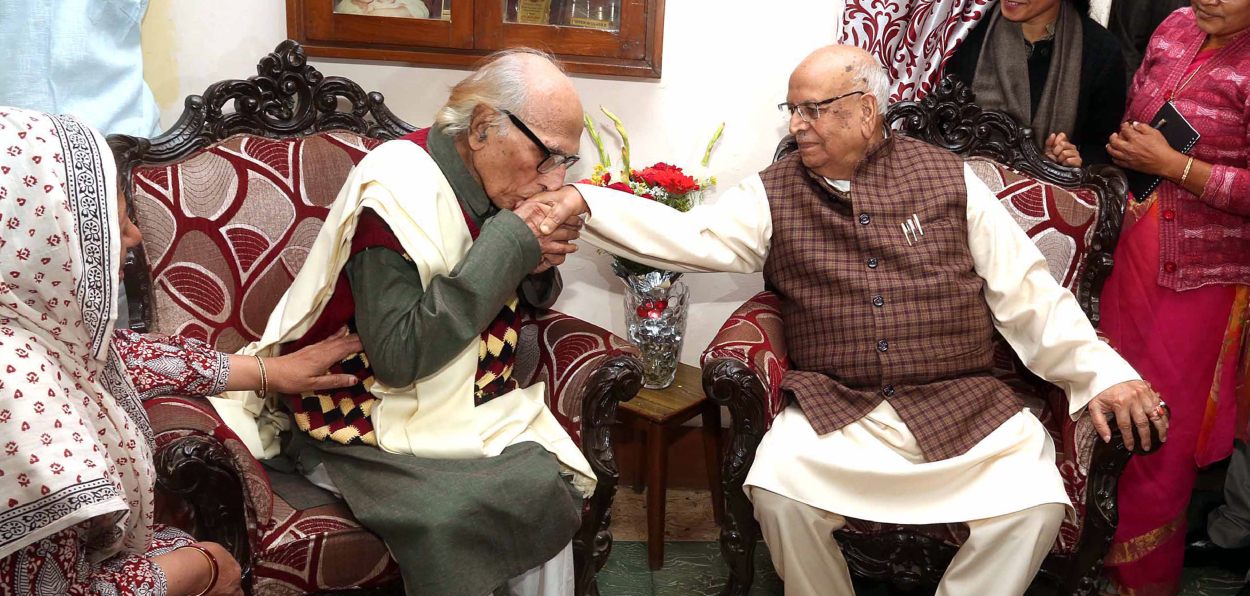 Governor of UP Lalji Tandon conferring Padma Shri award to Bashir Badr at his residence in Lucknow
During the communal violence that engulfed Meerut in 1987, his house was set on fire. Within hours, his home, personal library, and invaluable unpublished manuscripts were reduced to ashes. He left Meerut, carrying wounds that never fully healed. Yet what followed remains one of the most remarkable examples of moral resilience in modern Indian literary history. Bashir Badr refused to let violence define his worldview and reduce human beings to communal identities. He even refused to transform personal pain into collective hatred.
Instead, he transformed suffering into a plea for peace. The enduring power of the above couplet lies in its universality. It does not speak for one community against another. It does not seek to assign blame or perpetuate grievance. It mourns human loss itself. It recognises the dignity of every home and the tragedy inherent in every act of destruction.
"Kuch toh majbooriyan rehi hun gee Yun koi bewafa nahi hota." (There must have been some compulsions or constraints; No one becomes unfaithful just like that.)
Few couplets in modern Urdu poetry capture the philosophy of coexistence as powerfully as these lines. Bashir Badr never allowed poetry to become a prisoner of ideology. He wrote neither as a spokesman for a community nor as a propagandist for a cause. He wrote as an observer of the human condition. Love, separation, friendship, memory, longing, forgiveness, ageing, and hope.
The genius of Bashir Badr lay in his ability to remind people that beneath the layers of identity, politics, and circumstance, human beings remain connected by shared emotions and aspirations. Recognition at the National Level "Who chirag khud nahi jalta jissay haw ana milay Yeh aor baat ki aandhi mai bhi jala hun main." (No lamp can burn without the breath of the wind; Yet I am one who has kept burning through the tempest.)
He was honoured with the Sahitya Akademi Award and the Padma Shri. These awards reflected an appreciation of his role in strengthening India's composite cultural heritage. Bashir Badr also came to embody the broader spirit of cultural dialogue and people-to-people engagement during the outreach efforts of former Prime Minister Atal Bihari Vajpayee for peace in South Asia.
He was someone who believed that dialogue was stronger than hostility and culture more enduring than conflict. The Lesson for Contemporary India "Dushmani jam kar karo lekin yeh gunjaish rahe, Jab kabhi hum dost ho jaayen to sharminda na hon." (Oppose me with all your heart if you must, but do not cross the line from which friendship cannot return.)
Deeply rooted in Urdu culture and Muslim social traditions, Bashir Badr nevertheless spoke to the entire nation. His life embodied a quiet confidence: preserve your identity, but build bridges; remember your pain, but do not become captive to it; strive for excellence, and let your work speak beyond the boundaries of community.
ALSO READ: Nagma Mallick builds India's case before the world through quiet diplomacy
In many ways, Bashir Badr demonstrated that cultural confidence and national belonging are not competing identities; they can strengthen one another. He democratised the Urdu ghazal, but more importantly, he democratized empathy. And in choosing humanity over hatred, Bashir Badr left behind not merely a body of poetry but a moral compass for contemporary India.

_(1)_(1).webp "Jagannath Rath Yatra")








_(1)_(1).webp)
_(1).webp)