




 Rajeev Narayan
There are moments in the life of every rising nation when noise threatens to overwhelm perspective. Markets fall. Currencies weaken. Headlines darken. Commentators predict collapse. Social media amplifies anxiety. Suddenly, a slowdown becomes a crisis, and a correction becomes a catastrophe. In the process, a narrative of decline can take hold, often moving faster than the underlying facts themselves.
India finds itself in one such moment. Over the last few weeks, pessimism has surrounded the economy. The GDP ranking has slipped in dollar terms. Global investors have withdrawn capital from equities. The rupee has touched new lows. Inflation has risen. Stock markets have lost some of their global standing. The conflict in West Asia has pushed energy prices higher, fuelling fears of a prolonged downturn.
Yet, there is another view. Dr Shamika Ravi, Member of the Economic Advisory Council, argues that a story of economic ‘gloom and doom’ is being spread despite India’s enduring strengths. Her assessment reflects a broader question: Are the challenges confronting India signs of structural weakness, or simply the effects of a turbulent global cycle?
The evidence overwhelmingly points to the latter.
Beyond the Headlines
Economic history teaches a simple lesson: Short-term turbulence and long-term trajectories are not the same thing. India’s current challenges are real. Rising oil prices, geopolitical uncertainty, foreign capital outflows and currency pressures have created headwinds. The Reserve Bank of India has revised its growth forecast for FY 2026-27 to 6.6 per cent, while inflation concerns have resurfaced amid volatile energy markets and global instability.
Yet, context matters. Growth of 6.5 per cent may appear modest by India’s recent standards. However, viewed globally, it is exceptional. Most advanced economies would welcome such numbers. Among major emerging markets, India continues to stand apart.
Part of the anxiety stems from India’s descent in global GDP rankings. But rankings can conceal more than they reveal. Nominal GDP tables are denominated in US dollars. When any currency weakens against the dollar, the nation’s ranking moves even if its domestic economy expands. Simply put, exchange-rate changes can alter perceptions without fundamentally altering economic reality.
Despite the massive onslaught of fake news by foreign media, their brown slaves & third rate Indian Finfluencers, the Indian economy numbers are absolutely brilliant in a war situation. Expect even more fake news now!!! pic.twitter.com/hLzMBIjY9W
— Eminent Intellectual (@total_woke_) June 5, 2026
This is also the point made by Vis Raghavan, Executive Vice Chair of Citi and one of the most influential voices on Wall Street. “The fundamentals of India in the long term are phenomenal. Even at 7-per cent growth, India is very, very attractive when looked at from the global lens.” His observation captures what periods of volatility often obscure: India remains a large economy growing faster than most of its peers.
The International Monetary Fund has maintained its assessment of India as the world’s fastest-growing major economy, with growth expected in the mid-6 per cent range. That is no small feat at a time when much of the world is grappling with geopolitical shocks, slowing trade and elevated uncertainty.
The Ranking Trap
Part of the anxiety stems from India’s descent in global GDP rankings. But rankings often conceal more than they reveal. Nominal GDP tables are denominated in US dollars. When a currency weakens against the dollar, rankings can change even as the domestic economy continues to expand. Exchange-rate movements can alter perceptions without fundamentally altering economic reality.
The same logic applies to stock markets. Market cap reflects investor sentiment and liquidity conditions as much as economic strength. During periods of stress, capital often migrates temporarily to perceived safe havens or sectors enjoying cyclical advantages. Today, significant flows are chasing artificial-intelligence opportunities in Taiwan and South Korea. That says as much about prevailing investment fashions as it does about India’s prospects.
Yes, foreign investors have withdrawn sizeable sums from Indian markets. But such flows are among the most cyclical elements of global finance. They arrive quickly and leave quickly. Infrastructure, productive capacity, entrepreneurship and domestic demand are far more enduring.
Structural Strength
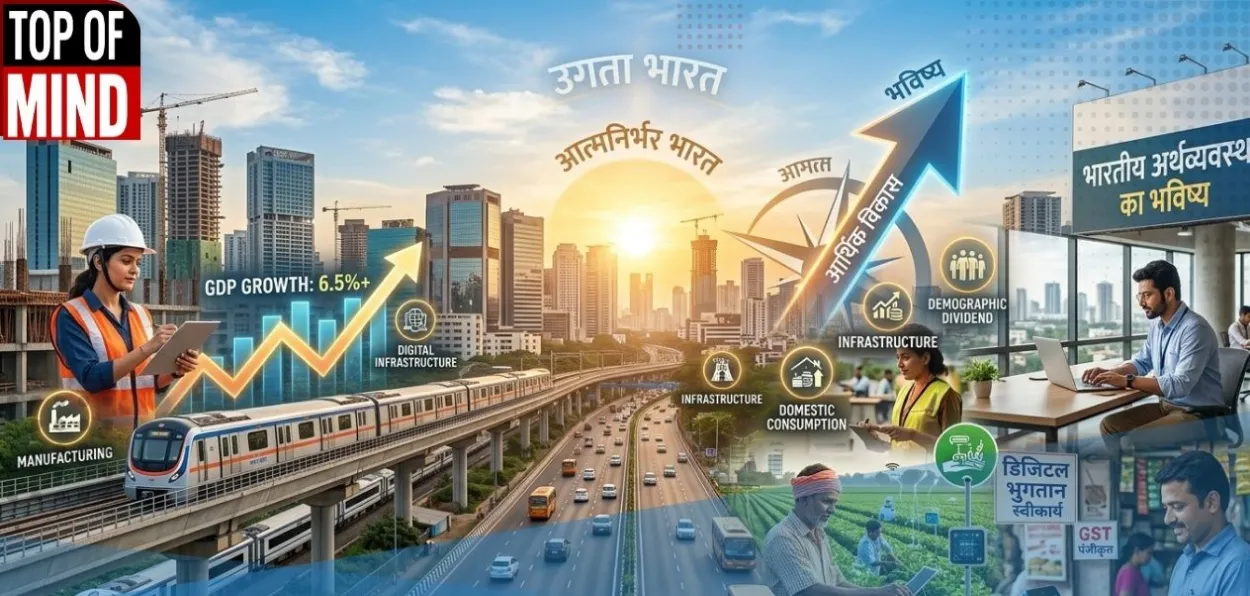
This is where India’s case remains compelling. Its growth is anchored in structural foundations rather than temporary stimuli. Investments in roads, railways, logistics, ports, digital infrastructure and manufacturing have reshaped the economy. Domestic consumption remains among the strongest in the world. Digital payments, GST integration and financial inclusion continue to deepen economic activity. Manufacturing sops are drawing global supply chains, while services exports remain highly competitive.
Consequently, even institutions that have trimmed India’s growth forecasts describe the economy as ‘robust’. The OECD, while acknowledging pressures from energy prices and inflation, still projects India among the world’s fastest-growing major economies. The distinction matters. The debate is not whether India faces challenges. Every major economy does. The question is whether those challenges are cyclical or structural. The evidence strongly favours the former.
As Dr Ravi notes: “These are difficult times, but a story of economic gloom and doom is being spread, which is completely wrong. The truth is that India will get over this turbulence with the kind of resources that it has, and with the kind of international commitments and agreements in place.” Her remarks reveal a critical reality – while external shocks may influence markets and sentiment, India enters this phase with stronger institutions, larger reserves, deeper domestic demand and greater global economic integration than at any point in its modern history.
Policy Signals
Equally telling is the Government’s response. New Delhi has moved to exempt foreign institutional investors from capital gains tax on investments in government securities, a measure aimed at attracting long-term capital and strengthening financial stability. Analysts believe it could improve investor returns, deepen participation in debt markets and support the rupee.
Policymakers are also exploring broader reforms to strengthen resilience. Dr Ravi argues that India should expand gold monetisation beyond traditional gold loans and develop more financial instruments linked to the precious metal, reducing dependence on imports and easing pressure on foreign exchange reserves.
The RBI has also deployed measures to support the currency and maintain order. These are not the actions of a nation in distress; they are the actions of a country managing a difficult external environment while continuing to pursue growth.
Through the Fog
The danger for any nation is not economic weakness but the loss of confidence that can piggyback on temporary setbacks. India’s challenge is not a collapsing economy; it is navigating a turbulent global cycle marked by wars, supply-chain disruptions, energy volatility and shifting capital flows. Such cycles pass. Countries that emerge stronger are those that continue investing, reforming and focusing on long-term competitiveness rather than short-term sentiment.
India’s demographic dividend is intact. Its infrastructure rollout continues. Its entrepreneurial ecosystem is expanding. Its digital infrastructure has become a global benchmark. Its domestic market remains one of the world’s most attractive growth engines.
READ MORE: Aabroo's rise triggered Muslim women's aspiration to join civil services
The coming months will test policymakers, businesses and households alike. Yet, if history is any guide, this period will be remembered not as the beginning of decline, but as a reminder that enduring economic transformations are rarely linear. Today’s headlines may belong to the pessimists. The future, however, may still belong to India.
The writer is a veteran journalist and communications specialist.


_(1)_(1).webp "Jagannath Rath Yatra")










.webp)
_(1).webp)

.webp)
