Amir Suhail Wani
The claim that the Quran obligates Muslims to establish an “Islamic State” has become one of the most contested ideas in modern Islamic discourse. While this notion is often presented as self-evident or divinely mandated, a careful reading of the Qur’an, the Prophetic tradition, and classical as well as modern Islamic scholarship reveals a far more nuanced picture.
The Quran’s primary concern is the moral, spiritual, and ethical transformation of individuals and societies, not the prescription of a fixed political structure. The very idea of an Islamic state, particularly in its modern ideological form, is largely a historical and interpretive development rather than a Quranic command.
The Quran presents itself foremost as a book of guidance (hudā) aimed at shaping human conscience, conduct, and accountability before God. Its recurring themes are belief in God, ethical responsibility, justice, compassion, and social balance. While it does address matters of collective life—such as justice, consultation, charity, contracts, and conflict—it does not outline a detailed political system, constitution, or theory of the state.
Unlike modern political ideologies, the Quran does not define the sovereignty, separation of powers, territorial boundaries, or institutional frameworks of governance. Instead, it repeatedly emphasises moral principles that are meant to inform human action in any social arrangement. The absence of a prescribed state model is not accidental; it reflects the Quran’s universal and trans-historical approach, allowing Muslims to organise their political lives according to context while remaining faithful to ethical values.
One of the most frequently cited Quranic verses in discussions about political authority is “Obey Allah, obey the Messenger, and those in authority among you” (Qur’an 4:59). This verse, however, does not define the nature or structure of political authority, nor does it mandate a religious state. Classical exegetes understood “those in authority” (ulu’l-amr) broadly, encompassing rulers, judges, scholars, or community leaders, depending on context.
Obedience here is conditional, not absolute, as the same verse directs disputes back to God and the Prophet, indicating moral accountability rather than blind political submission. This verse affirms the necessity of order and leadership, not a specific ideological state.
Equally significant is the Quranic principle of freedom of belief. The verse “There is no compulsion in religion” (Qur’an 2:256) establishes a foundational norm: faith cannot be coerced. If belief itself cannot be enforced, then the idea of a state that compels religious observance through law becomes theologically problematic. The Quran repeatedly places belief and disbelief within the realm of personal moral responsibility, with accountability deferred to God in the Hereafter.
Verses such as “Your duty is only to convey the message” (Qur’an 42:48) further clarify that even the Prophet’s role was not to enforce faith but to communicate it. This undermines the argument that a state is divinely mandated to police personal piety.
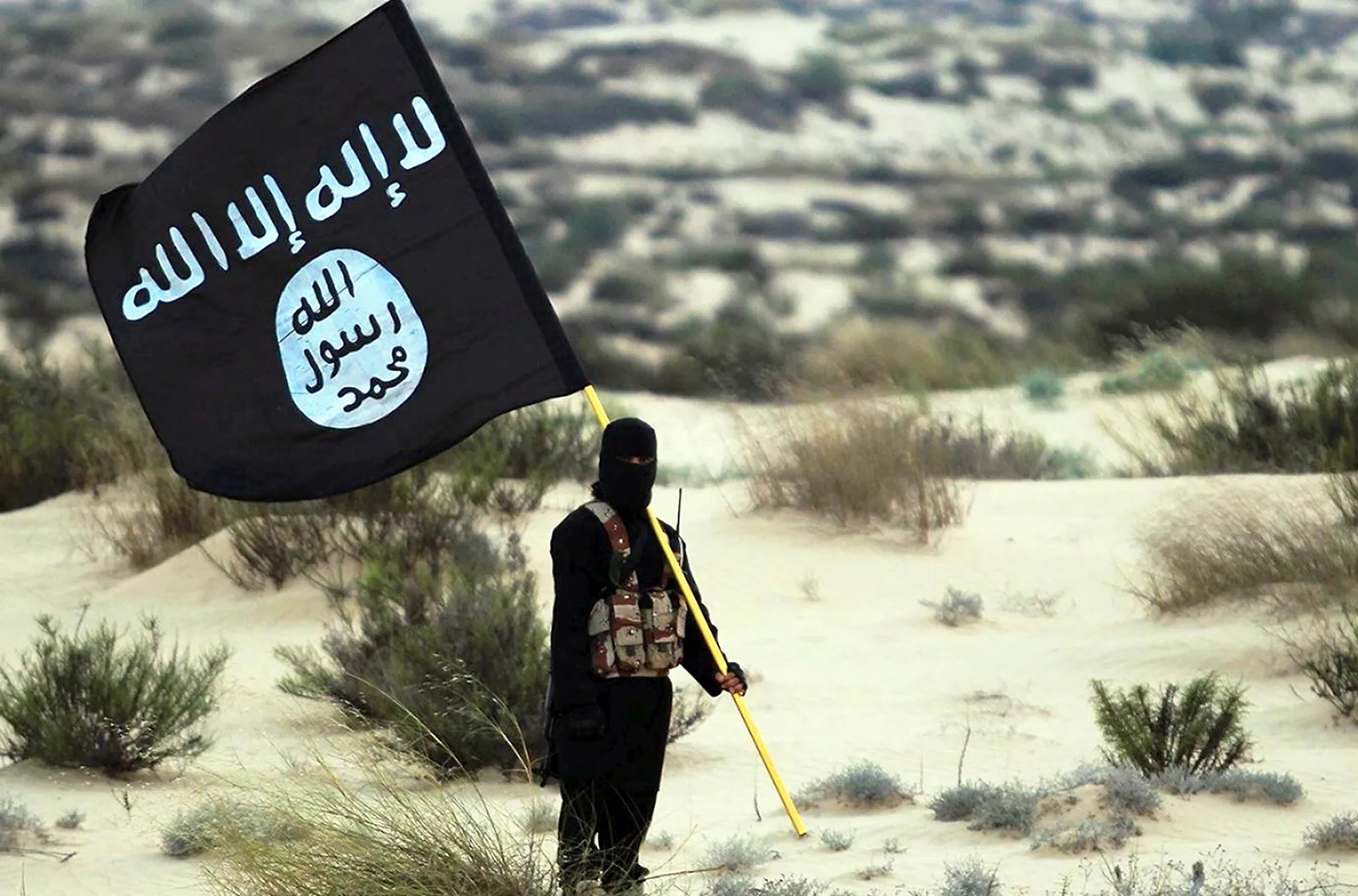
A member of ISIS
The Prophet Muhammad’s own life is often cited as evidence that Islam demands a political state, since he led the community of Medina as both a spiritual and political authority. However, the Prophet’s leadership must be understood in its historical context. Medina was a tribal society in need of arbitration, security, and social regulation. The Prophet’s political role emerged organically from these needs rather than from a prior theological blueprint. The Constitution of Medina, often cited as an early Islamic political document, was a pragmatic agreement among diverse religious and tribal groups, including Jews and pagans, recognising pluralism and shared civic responsibility rather than imposing a theocratic order. It did not declare Medina an “Islamic state” nor enforce religious conformity.
The Hadith literature, while emphasising social harmony, justice, and obedience to authority, does not contain any explicit command instructing Muslims to establish a religious state. Numerous hadith warn against rebellion and chaos, stressing the importance of stability, but they also limit obedience when rulers command injustice or sin.
The focus is on ethics rather than institutions. The Prophet spoke extensively about honesty, mercy, justice, and accountability, but he did not outline a permanent political system for the future. This silence is significant, especially given the importance of governance in human societies.
Classical Islamic scholars, including jurists and theologians, generally treated governance as a practical necessity rather than a theological pillar of faith. While many classical jurists discussed the imamate or caliphate, they did so within the framework of preserving public order, administering justice, and protecting the community.
These discussions were rooted in historical realities rather than explicit Quranic mandates. Importantly, jurists differed widely on qualifications, methods of appointment, and even the necessity of a single ruler for all Muslims, indicating that no consensus existed on a divinely fixed political model. Governance was seen as a means (wasīlah), not an end in itself.
Modern Muslim thinkers such as Javed Ahmad Ghamidi, Fazlur Rahman, Muhammad Arkoun, and Abdullahi an-Na‘im have further emphasised that the Qur’an does not authorise the state to enforce religion. They argue that Sharia, as moral and legal guidance, primarily addresses individual and communal ethics rather than state power.
According to this view, transforming Islam into a State ideology risks reducing a moral faith into a coercive system, undermining the Quranic emphasis on intention (niyyah) and moral choice. These scholars maintain that Muslims are free to live under various political systems, provided justice, human dignity, and religious freedom are upheld.
The modern concept of an “Islamic State” largely emerged in the twentieth century in response to colonialism, Western political dominance, and the collapse of traditional Muslim polities. Islamist movements re-imagined Islam as a comprehensive political ideology, projecting modern notions of sovereignty and law onto religious texts.
While these movements draw inspiration from Islamic history, their political models reflect modern ideological concerns rather than direct Quranic injunctions. As such, they represent one interpretation among many, not a binding religious obligation.
ALSO READ: What do Quran, Hadith, and Caliphs mandate about Illegal religious structures?
In conclusion, the Quran does not demand the establishment of an Islamic state as a religious duty upon Muslims. It calls for justice, ethical governance, consultation, compassion, and moral responsibility—values that can be realised in diverse political contexts. Islam provides principles for righteous living, not a rigid political blueprint. The insistence that Muslims must create a specific type of religious state elevates historical experience and modern ideology to the level of divine command, something that the Qur’an or the Prophetic traditions don't support. The enduring message of the Qur’an is not about power and political form, but about conscience, justice, and accountability before God.



.webp "Representational Image")







.webp "Kassim Ahmad")

_(1).webp)