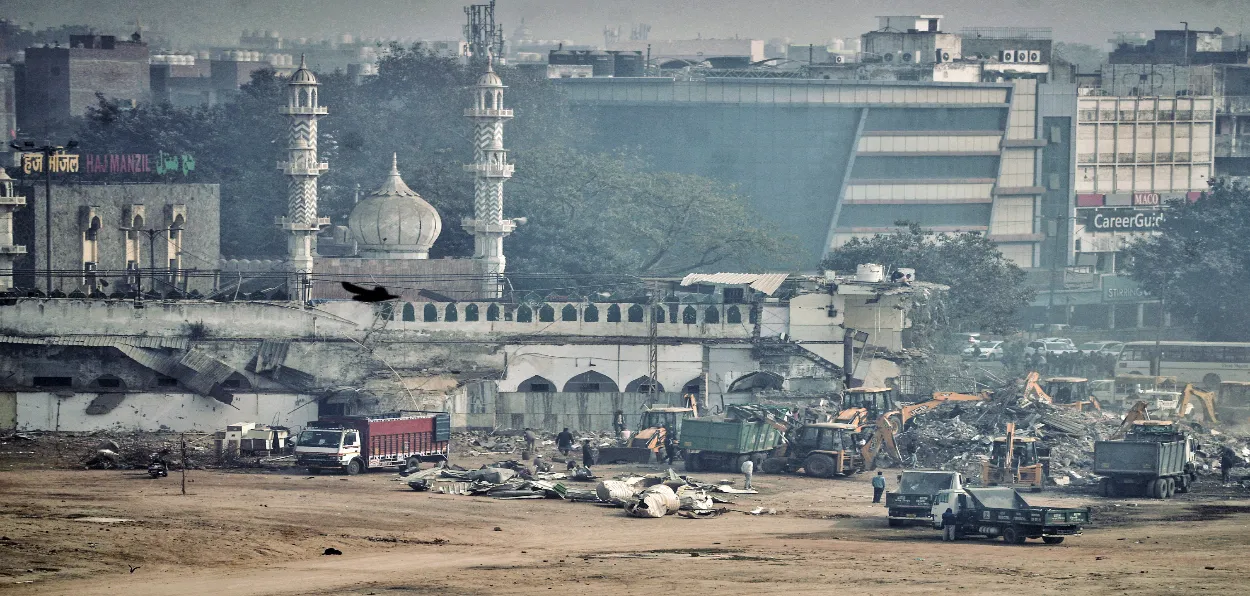
A few days ago, a massive anti-encroachment drive in Delhi sparked a heated debate and controversy. This action in a Muslim-dominated area created tension for some time. Since the administration carried out the operation without taking the people into confidence, a rumour that the mosque was damaged spread and led to stone-pelting. It’s not just right to blame the Police and the law-and-order authorities; Muslims too must introspect on it.
Lack of Dialogue
Often, such incidents betrays a lack of communication between the authorities and the locals. This is why even legal action is perceived as a 'religious target,' triggering rumours. In September 2025, on the occasion of Eid-e-Milad-un-Nabi, a rumour spread like wildfire that the Kanpur Police had torn a banner inscribed with ‘I love Muhammad,’ and consequently, the ‘I love Muhammad’ movement in honour of the Prophet gathered momentum across the country.
The Police were unnecessarily harsh in that case, and as a result, with the normalisation of 'Bulldozer Justice,' the community's trust in the administration wavered even more.
At one time, dialogue initiatives like 'Mohalla Committees' were run in Maharashtra to build trust between the police and the Muslim community. Such efforts are no longer visible in Maharashtra or other parts of the country. This results in a communication gap between the administration and the community.
Although in the Turkman Gate demolition, no mosque was razed, Muslim intellectuals must specifically address a fundamental question that may arise in the future. What exactly is Islam’s stance regarding religious places built on illegal land?
Usurping Others' Property is Anti-Quran
Islam doesn’t support any illegal or unethical act. If a religious site or a mosque is built by usurping land or by encroaching upon public space, it is illegitimate in the eyes of Islam. The very foundation of Islam rests on the value of 'Justice' (Adl). Allah does not accept any prayer or worship performed through 'Zulm' (injustice/oppression).
Clear instructions are given in the Quran regarding this: "And do not consume one another's wealth unjustly (through illegal means)." (Surah Al-Baqarah 2:188). Furthermore, Allah has warned, "Indeed, Allah does not like the wrongdoers (oppressors)." (Surah Aal-e-Imran 3:57). These verses make it clear that if the foundation of a mosque rests on immorality or stolen land, the ethical and spiritual dignity of that structure ceases to exist.
Strict Warning Regarding Encroachment
Prophet Muhammad's stance on property rights was just and strict. In a famous Hadith from Bukhari and Muslim Sharif, the Prophet says: "Whoever usurps even a span of land unjustly, will be sunk the seven earths on the Day of Judgment." (Sahih Bukhari 2452). This is a teaching that forbids violating another's rights under any circumstance.
Another important Hadith states: "Allah is Pure and He accepts only that which is pure." (Sahih Muslim 1015). Many Islamic scholars have said that if the land or money used to build a mosque is 'Haram' (illicit), such worship is not accepted in the court of Allah.
Ideal Justice of Caliphs
During the era of the second Caliph Umar ibn al-Khattab, a part of a mosque that was built on a Jewish man's land without seeking his permission was demolished. The Caliph deemed it more important to deliver justice to a Jewish man than have a mosque.
Another example is from the era of Caliph Umar ibn Abdul Aziz. He ordered the demolition of a portion of the famous Umayyad Mosque in Damascus to return that land to the local Christian community. It was done since the land was taken away forcibly. Both these examples underscore that in Islam, 'Huquq-ul-Ibad' (Human Rights) and justice are considered superior even to religious structures.
Modern Islamic Scholars
Even in modern times, renowned scholars like Dr Muhammad Hamidullah and Yusuf al-Qaradawi have presented the same stance that mosques should only be built on land acquired through legal and ethical means. Construction that hinders public interest or is done illegally goes against 'Maqasid-al-Sharia,' meaning the core objectives of Sharia.
An important verse in the Quran states: "Then is one who laid the foundation of his building on righteousness [with fear] from Allah and [seeking] His approval better or one who laid the foundation of his building on the edge of a bank that is about to collapse, so it collapsed with him into the fire of Hell? And Allah does not guide the wrongdoing people. And that building which they built will constantly remain a cause of doubt in their hearts until their hearts are cut into pieces. And Allah is Knowing and Wise." (Surah At-Taubah 9:109-110).
Need for Introspection
Therefore, the Muslim community needs to adopt the policy of dialogue and follow His commands instead of getting carried away by emotions and engaging in violent protests. Fighting a legal battle with the administration is certainly a democratic right, but the community must also realise that coddling illegal construction as 'religion' is actually going against the principles of one's own religion. Hence, one should avoid the knee-jerk, anti-administration reaction and specifically avoid violent reactions.
ALSO READ: Awaz brings new show on Muslims' relation with faith and world
The community must focus on 'Akhlaq' (character) and ensure none of their actions violate the rights of others. Only by abandoning wrong things and adopting the path of truth, the Constitution, and the law, can we establish our image as a respectable and peace-loving society.
The author is the Editor of Awaz-The Voice, Marathi

.webp "Union Home Minister Amit Shah")

.webp "Ganapati idols being hander over to activists for Kashmir")