Daulat Rahman/Guwahati
Is polygamy prevalent among the Muslim community in Assam only? Or this is propaganda, a reflection of our prejudices?
These questions have become more relevant in view of the Assam Government's recent move to enforce a new legislation banning polygamy, proposing penalties of up to seven years in prison for those who violate the law. The government also announced the creation of a compensation fund for women who may face economic or social hardship as a result of the ban.
However, a study conducted by the Mumbai based International Institute for Population Sciences (IIPS) has found that polygynous marriages are not only prevalent among Muslims, but have also been reported from other communities, including Hindus in Assam. But the practice is on decline, according to a study.
 A Muslim couple praying after their nikah
The IIPS's study, which analysed data from the third (2005-06), fourth (2015-16) and fifth (2019-21) rounds of the National Family Health Survey (NFHS), found that the percentage of polygynous marriages in Assam dropped from 3.3 per cent to 2.4 per cent in 15 years. In NFHS-3, 2.1 per cent Hindus, 6.9 per cent Muslims and 1.3 per cent of other religions reported the practice in Assam, which decreased in the next survey to 1.8 per cent (Hindus), 3.6 per cent (Muslims) and 0.9 per cent (others).
The Biswanath district in central Assam and the Karimganj district in Southern Assam reported the highest prevalence at 4.2 per cent, and they were among the top 40 districts of the country to have the highest percentage of polygynous marriages.
Meghalaya's East Jaintia Hills (where the majority are Christians) topped the list with 20 per cent married women stating that their husbands had other wives besides themselves.
 An Assamese Muslim bride with her family
As per the NFHS-5 data, polygynous marriages among Muslims were highest in Odisha (3.9) and Assam (3.6), according to NFHS-5.
The IIPS's study has found that the practice of polygamy was more common among Buddhists (3.8 per cent) and Muslims (2.6 per cent) as per NFHS-3. In NFHS-5, it was higher among other religions (2.5 per cent), followed by Christians (2.1 per cent) and Muslims (1.9 per cent). Further, polygyny was more prevalent in rural areas than in urban areas, the research brief stated.
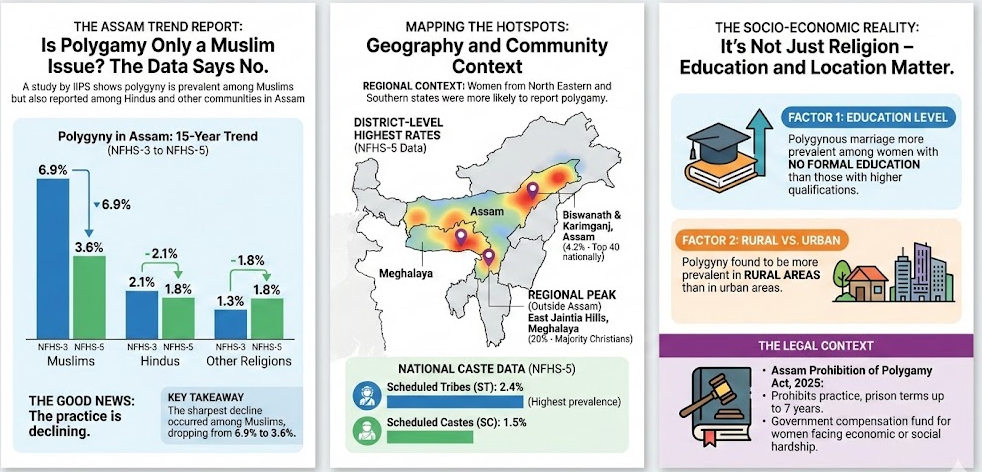
According to the IIPS's study Women from North Eastern states, particularly Meghalaya, and Southern states were more likely to report polygamy. In NFHS-3, altogether 3.3 per cent and 3 per cent of the currently married women in North East and South India, respectively, reported being in polygynous marriages. As per NFHS-5, altogether 2.6 per cent of the women in the North East and 2 per cent in South India reported the same.
The study has further found that polygynous marriage was more prevalent among women who had no formal education than among those who had higher educational qualifications.
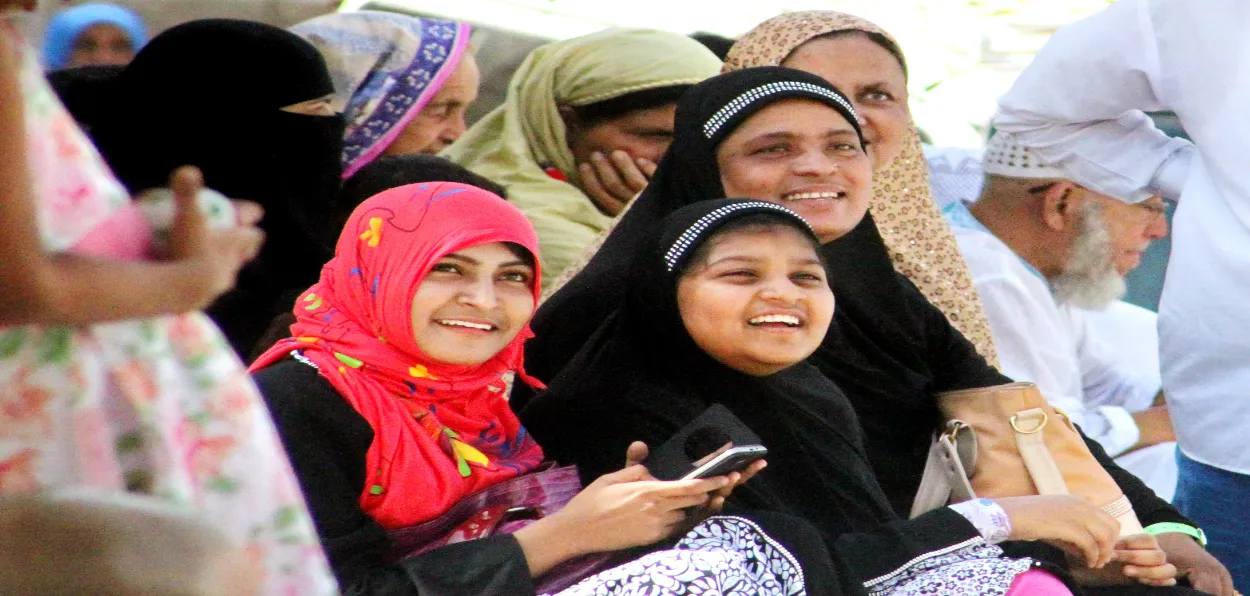 Guests at a Muslim wedding
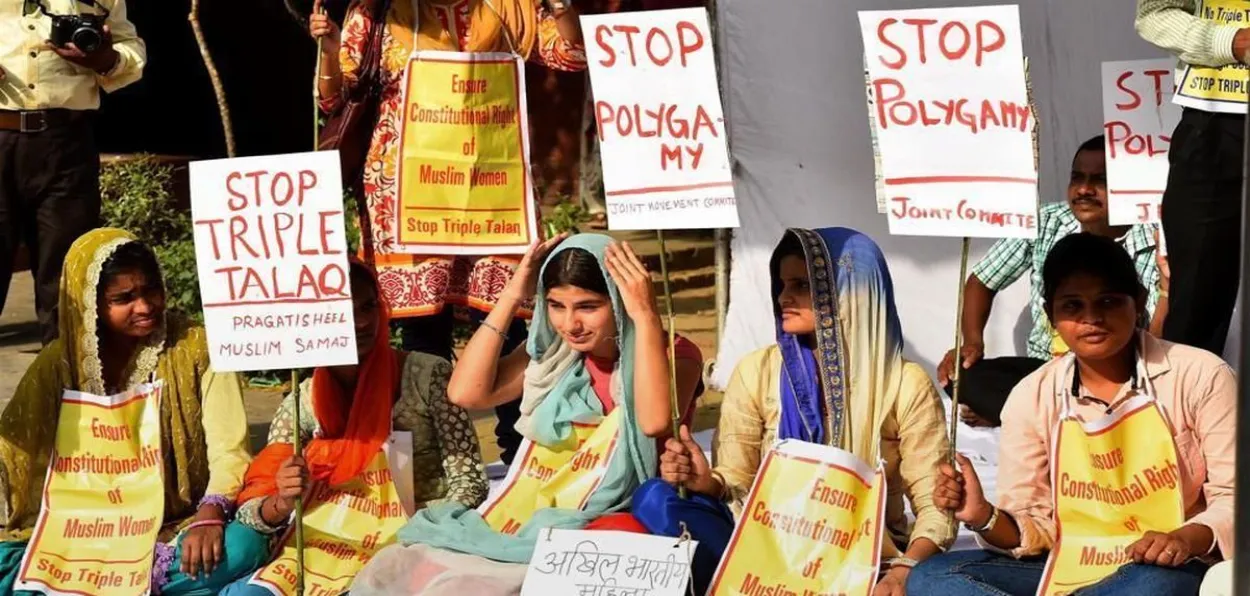
In December last year, the Assam Assembly passed the Assam Prohibition of Polygamy Act, 2025, a legislation intended to prohibit and eliminate practices of polygamy and all forms of polygamous marriage within the State of Assam.
ALSO READ: A boy's journey from Kupwara to India’s top labs as scientist
Sixth Schedule tribal areas have been expressly excluded from its application. While the majority of Muslims in Assam, particularly women, have termed the new law banning polygamy as a progressive one, a section of the community have cautioned that the law should not target the Muslims only.

.webp "Representational Image")