Tarun Nandi, Kolkata
The school itself has become a lesson in environmental education.
From a mini-Sundarbans and rooftop aquaculture to rainwater harvesting and groundwater recharge, students at the school in Hingalganj, North 24 Parganas, learn about nature not merely from textbooks but through hands-on experience.
Behind this transformation is Alokesh Mridha, a teacher who has demonstrated how an ordinary school in a remote and financially challenged area can be turned into a model of practical and environment-centred education.
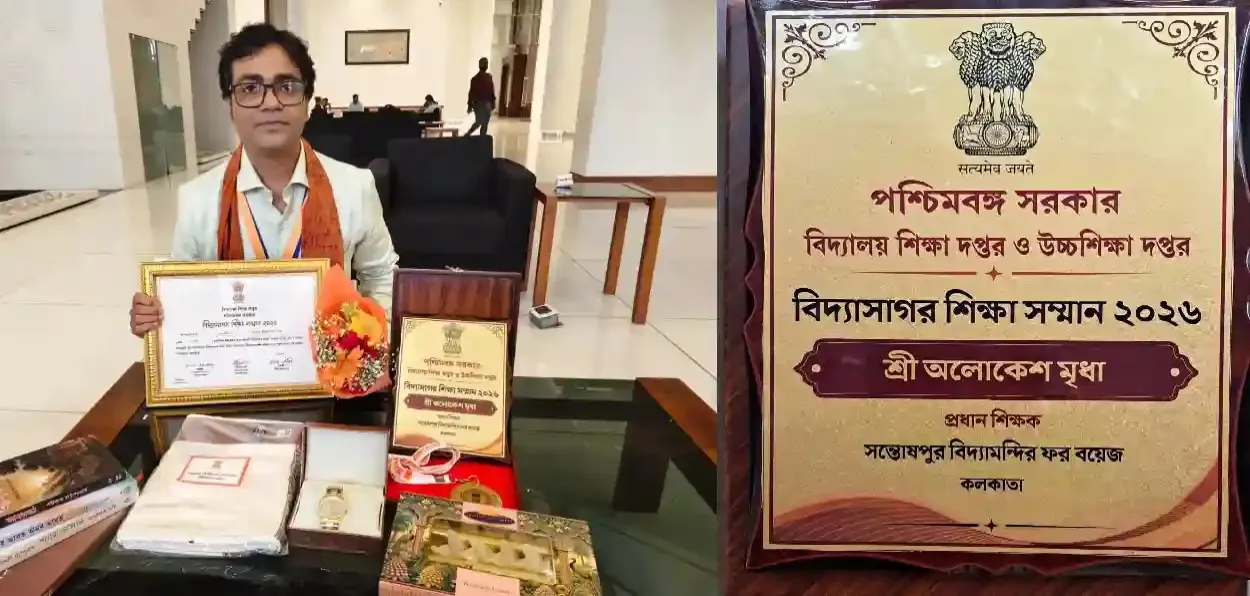
For his outstanding contribution to education, Mridha was honoured with the state government’s prestigious ‘Vidyasagar Education Award 2026’ on Teachers’ Day.
For his students and the local community, however, the award is only a formal recognition of a teacher they have long admired. Mridha is widely respected in the area, and students consider him one of the school’s most beloved teachers.
.jpeg)
Mridha began his teaching career in 2005 as an assistant teacher at Srichanda Mahendranath Memorial Institution. In August 2018, he took charge of the institution as teacher-in-charge. Five years later, he joined Santoshpur Vidyamandir for Boys School as its headmaster.
It was after taking charge as headmaster that he began systematically transforming the school into a centre for experiential learning, with nature and the environment at its core.
The unused space on the school premises was turned into a ‘Mini Sundarbans’, with rows of mangrove trees planted to recreate and preserve the ecosystem characteristic of Hingalganj and the wider Sundarbans region.
For students, the initiative offers an opportunity to observe and understand the mangrove ecosystem at close quarters rather than learning about it only through books.
But the environmental initiatives do not end there. The school’s rooftop has been converted into a site for aquaculture, allowing students to learn about aquatic farming and its practical applications.
A rainwater-harvesting system has also been installed to conserve water, while a groundwater-recharge system has been developed to help replenish underground water resources.
The school has also taken steps to teach students how to preserve seeds of rare plant species. Together, these initiatives have transformed the campus into what can aptly be described as a living laboratory of environmental education.
The impact of the transformation is visible not only in the students’ growing environmental awareness but also in the school’s enrolment.
The number of students, which had remained at around 235 at one point, has risen to 655 in 2026. Alongside environmental awareness, the school has emphasised moral education and co-curricular activities, giving students opportunities to develop and showcase their abilities at national-level platforms.
Mridha’s journey is a reminder that meaningful educational transformation does not always require sophisticated infrastructure or abundant resources. Innovation, commitment and a willingness to take learning beyond the classroom can make an equally significant difference.
Working in a remote part of Hingalganj, Mridha has shown how a conventional school can be transformed into an institution where education is closely connected with nature and everyday life.
ALSO READ: Dr Syed Abdullah and his team save nine newborns from NICU fire
The Vidyasagar Education Award 2026, therefore, is not merely a recognition of an individual teacher. It is also an acknowledgement of a distinctive educational experiment—one in which a school has made the environment itself a classroom.