Ghulam Rasool Dehlvi
Islam does not need to rule the world to be true. It needs to illuminate conscience, cultivate virtue, and accompany human beings in their fragile moral striving. Recovering Islam’s dignity—especially in India—requires abandoning ideological captivity and reclaiming a faith confident enough to live without dominating, and deep enough to belong without excluding.
Prof. Mazhar Asif, Vice Chancellor of Jamia Millia Islamia, expressed these views at a three-day international conference on 'Quran and Science'. He said that the real welfare of mankind lies in understanding the Holy Quran, contemplating it and following its teachings, but unfortunately, that was not happening.
“We read the Quran, but do we really understand it? And even when we understand it, do we truly follow it?” asked the VC. "The Holy Quran, which served as a revolutionary force and built and shaped their moral character and formed a shield against sin, has today become a book to be read only for the benefit of humans".
Seeking to revive the spirit of the Quran as a “living guide” which is not in conflict with modern science and cosmology, Indian and Iranian Islamic scholars at the 3rd International Conference on “Quran and Science” emphasised that the holy book must be read with understanding and applied in daily life, to address moral, social, and intellectual challenges.
The conference saw scholars from India, Iran, Indonesia, and Europe discuss the topic. The conference was organised by the Wilayat Foundation, the Department of Islamic Studies, Jamia Millia Islamia (JMI), and Shahid Beheshti University, Tehran, Iran.
The scholars said that there is no inherent contradiction between the Quran and modern science; rather, both guide humanity toward truth, knowledge, and the understanding of divine laws governing the universe. From the first Quranic revelation, Islam has encouraged reflection, reason, and the pursuit of knowledge as sacred acts and linked scientific inquiry with ethical accountability.
Indian Shia scholar Dr Kalbe Jawad asked why a book revealed over 1,400 years ago continues to be studied today. He argued that several Qur’anic insights align with scientific discoveries that were confirmed centuries later. He asked researchers to study modern science in the light of the Quran.
In his keynote address, Prof. Aslam Parvez, former Vice-Chancellor of Maulana Azad National Urdu University, Hyderabad, said that the Quran repeatedly urges human beings to use their intellect and senses.
Quoting Qur’anic references, he said, “The Qur’an declares that those who do not use their reason are no better than animals.” While the universe functions according to divine laws, humanity must reflect on whether it truly follows those principles in daily life.
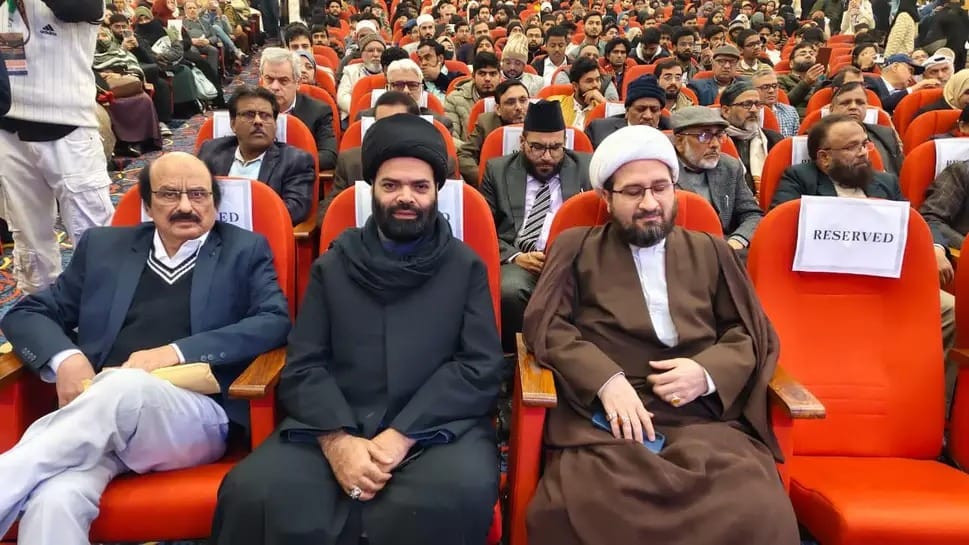
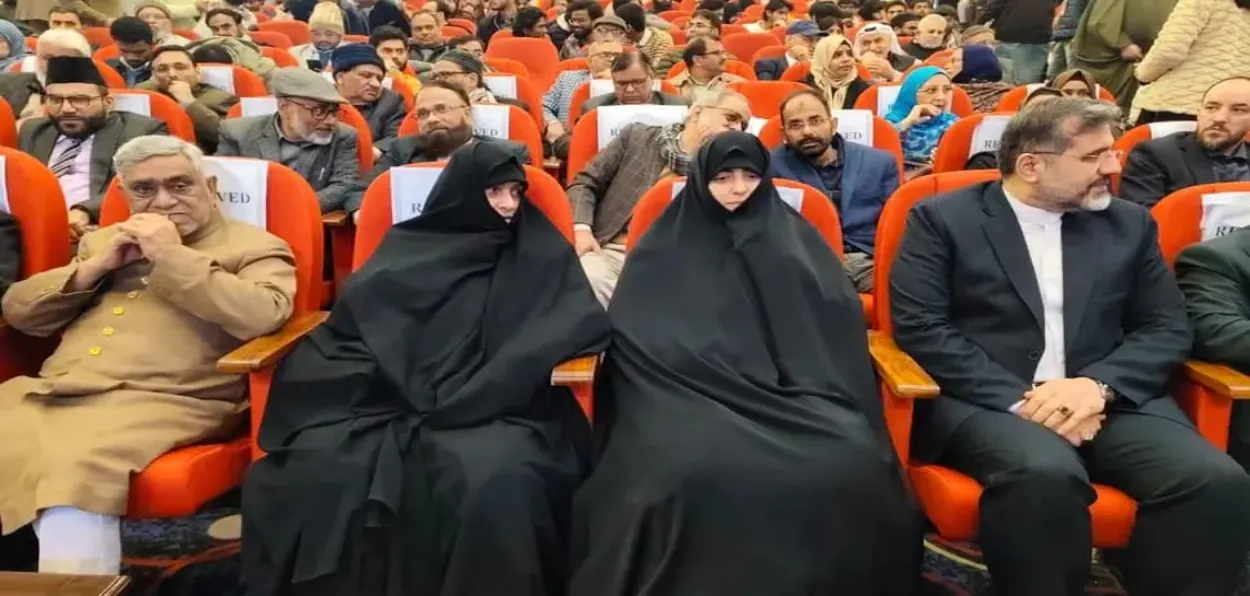
The audience at the Conference
He noted that the Qur’an and Sunnah teach that love is not merely a matter of words or claims but is demonstrated through action. Likewise, the Qur’an lays down the principle that surplus wealth should be spent in the path of goodness for a balanced society.
Chief Guest, Prof. Mahtab Alam Rizvi, Registrar of Jamia Millia Islamia, stated that numerous Quranic verses draw human attention to scientific realities—such as the creation of water, the vastness of the universe, the origin of humankind from clay, the system sustaining the heavens, and the barrier between two seas that prevents their waters from mixing. These signs, he noted, testify to the fact that the Qur’an is not only a book of guidance but also directs humanity toward the scientific principles governing the universe.
Prof. Akhtarul Wasey, a renowned Islamic scholar, stated that the Qur’an has shed light on several aspects of modern science while consistently encouraging humanity to reflect on the creation. “There is no contradiction between the Qur’an and modern science,” he said.
He said that both the Qur’an and science guide humanity toward the same ultimate source of truth—the Oneness of God—where the Qur’an provides principles and science offers the means to understand and interpret them.
Prof. Naser Simforoosh of Shahid Beheshti University of Medical Sciences presented a paper titled “The Two Streams of Knowledge: Revelation (Wahy) and Observation (Ilm) on Life, Suffering, and Mortality.”
He offered a comparative theological and scientific analysis examining both divergent and convergent perspectives of the Qur’an and science on critical ethical and bioethical issues. His paper explored views on illness, the nature and meaning of death, and the moral debate surrounding abortion and fetal termination, aiming to bridge scientific and theological worldviews through Qur’anic principles.
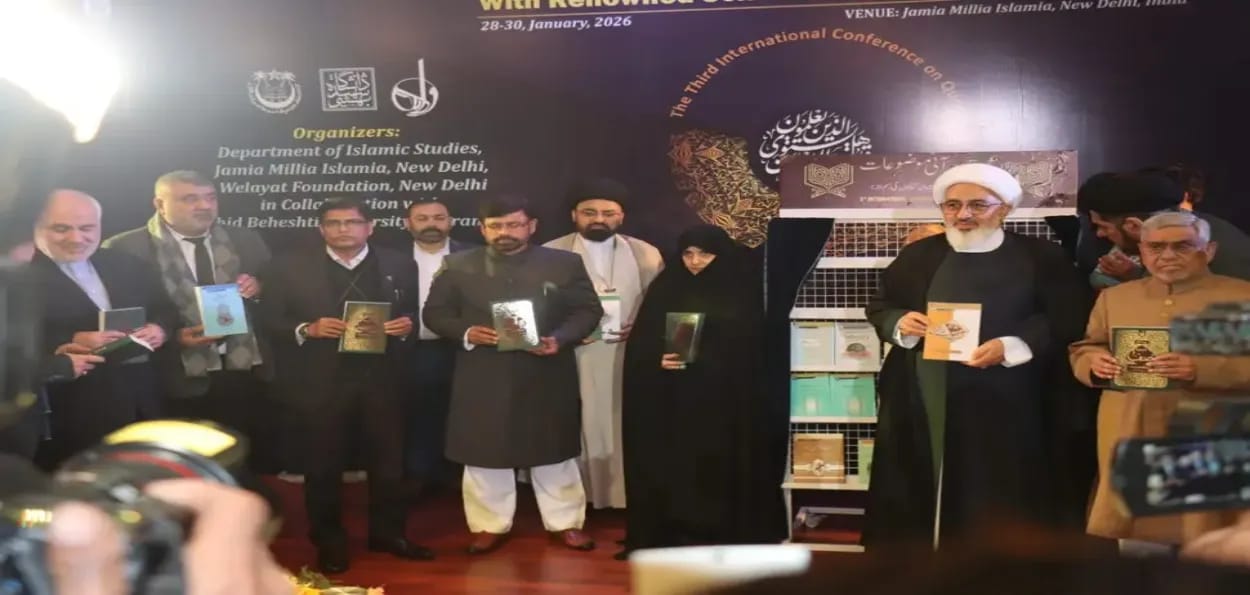
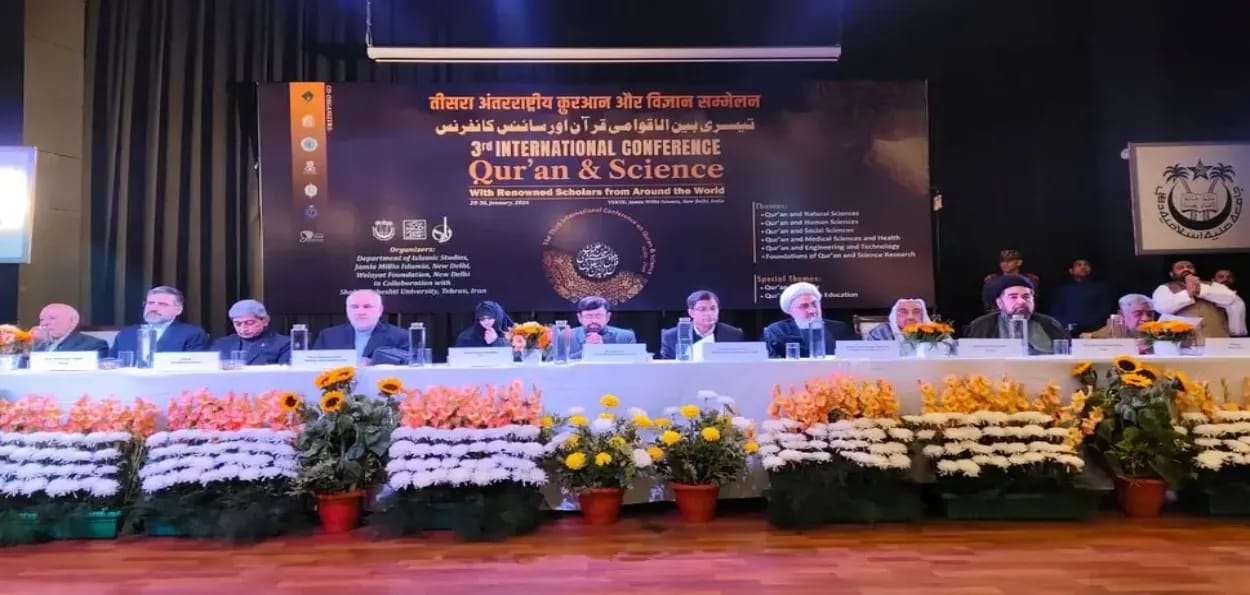
Islamic scholars on the dias
Professor Syed Shahid Ali, former Head of the Department of Islamic Studies, observed that from the earliest periods of Islamic civilisation, the Qur’an has consistently encouraged observation of the universe, reflection, reasoning, and deep contemplation. He noted that the very first revelation instructs humanity to read in the name of its Lord, indicating that the pursuit of knowledge is not merely a worldly necessity but a sacred act and a form of worship.
Speaking as a Guest of Honour, she emphasised the need for youth to strengthen their relationship with the Quran, which alone provides the path to intellectual coherence, peace, security, and success in both worlds.
Her paper Youth and Resolving the Challenges of Realism and Idealism through Educational Reflection in the Life of Prophet Abraham (PBUH) examined the origins and essence of the Abrahamic ideal as the Qur’anic method for understanding and applying Islamic principles across the human sciences.
ALSO READ: A boy's journey from Kupwara to India’s top labs as scientist
Prof. Alamolhoda observed that incidents of Qur’an desecration worldwide reflect ignorance. She also expressed concern over weakening family structures, with young people being raised without parental guidance.
.webp "Union Home Minister Amit Shah")