Eman Sakina
When people hear the word refugee, they often imagine someone escaping war, persecution, or political violence. But there is another growing group of displaced people whose homes are being taken away by something less visible but equally devastating: climate change. Rising seas, prolonged droughts, devastating floods, extreme heat, and disappearing sources of livelihood are forcing families to leave places where their ancestors lived for generations. These people are known as climate refugees.
Friday Musings
For Islam, the question is not simply about migration or climate change. It is also about how we respond when vulnerable people arrive at our door.
The Quran repeatedly reminds human beings that the earth is an ‘amanah’, a trust from Allah. We are not its absolute owners. Allah says: “It is He who has made you successors upon the earth.”— Quran 6:165
Being a successor or caretaker of the earth carries responsibility. When environmental destruction makes people homeless, the consequences are not only ecological. They become questions of justice, compassion, and human dignity.
The Quran strongly condemns corruption and destruction on earth: “And do not cause corruption upon the earth after its reformation.” — Quran 7:56
Climate change has many causes and cannot be reduced to the actions of one individual or community. Yet the Islamic principle is clear: human beings must avoid causing harm and must protect what has been entrusted to them.
But what happens when someone has already lost their home?
Islam has a long tradition of welcoming those who are forced to leave their homes. The story of the Prophet Muhammad's migration to Madinah itself carries a powerful lesson. The people of Makkah who migrated were called ‘the Muhajirun’, while the people of Madinah who welcomed and supported them were called the Ansar. The Quran praises the Ansar for their generosity: “They give preference to others over themselves, even though they are in privation.”— Quran 59:9
This verse describes an extraordinary attitude toward displaced people. The Ansar did not see the newcomers simply as outsiders competing for food, houses, jobs, or resources. They saw them as human beings in need.
That lesson has meaning today.
Faizal Khan, known as Khan Sir, popular educationist who launched a major relief campaign in Bihar after floods speaking about his experience on Facebook:
खान सर खुद बाढ़ पीड़ितों तक पहुँचकर राशन और राहत सामग्री बाँट रहे हैं❤️🥹#KhanSir #KhanSirPatna #KhanGlobalStudies #KGS #Bihar pic.twitter.com/UW0z0Bi7lY
— Ritik Raj (@kinghritikraj) September 17, 2026
A family displaced by flooding does not stop being someone's mother, father, child, or grandparent simply because they have crossed a border. A farmer who loses his land to drought does not lose his dignity. A child forced to leave home because rising waters have destroyed the family house remains a child deserving safety, education, food, and affection.
The Quran commands believers to stand for justice: “Indeed, Allah commands justice and good conduct.” — Quran 16:90
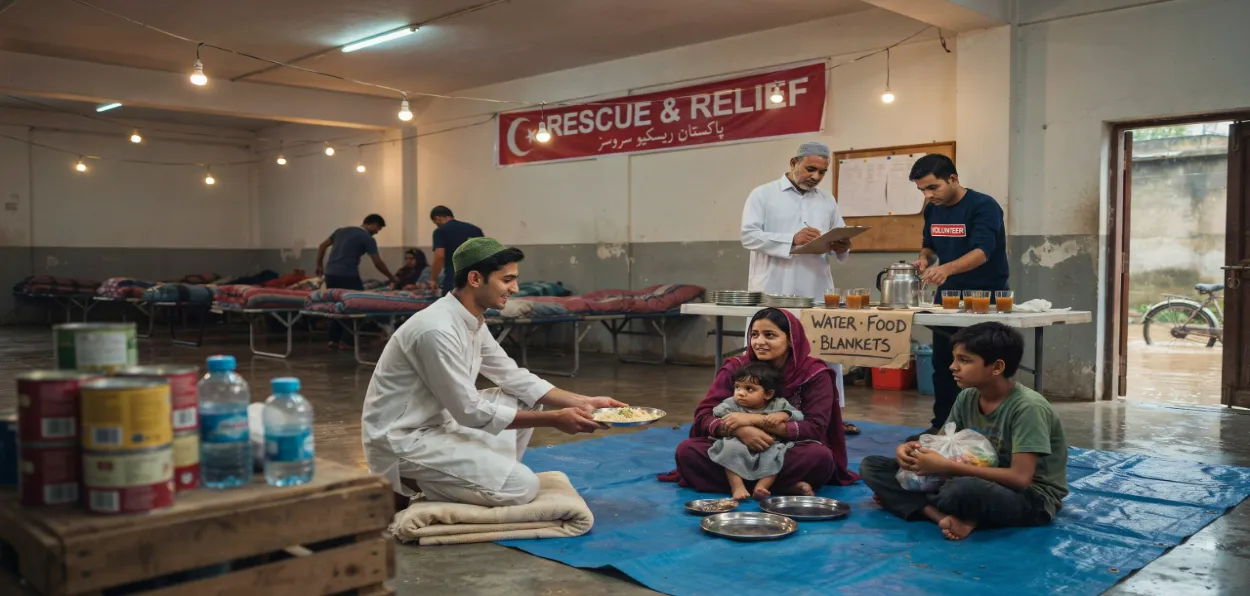
Hosting displaced people does not necessarily mean that every individual must personally provide a home to a refugee family. Governments, communities, charities, mosques, and international organisations all have different responsibilities. But ordinary Muslims can still contribute: donating food and clothing, supporting emergency shelters, helping children continue their education, offering employment opportunities, raising awareness, or simply refusing to treat displaced people with suspicion and contempt.
Hospitality in Islam is not merely about offering guests a meal. It is about recognising their humanity.
The challenge of climate displacement also reminds us that compassion must be combined with prevention. We cannot keep destroying forests, wasting water, polluting rivers, and consuming resources irresponsibly while expecting vulnerable communities to bear the consequences. Caring for refugees and caring for the planet are connected responsibilities.
Perhaps the most important lesson is that a person's worth is not determined by the place written on their passport. Before they are migrants, refugees, villagers, farmers, or foreigners, they are human beings created by Allah.
The Quran says: “And We have certainly honoured the children of Adam.” — Quran 17:70
That honour belongs to humanity as a whole.
Climate refugees therefore challenge us to look beyond geography and ask a deeper question: What kind of people do we become when someone else's home disappears?
ALSO READ: How Mudasir Dar’s brought peace to hotbed of militancy in Kashmir
Islam calls us toward mercy, justice, responsibility, and hospitality. If climate displacement becomes one of the defining humanitarian challenges of our time, these principles can guide Muslims not only in helping those who have been displaced, but also in becoming better caretakers of the earth that we all share.








.webp)