Aasha Khosa
In the early nineties, Kashmiri Hindus did leave their homes and hearths while fleeing militancy and violence in their land. And it’s also true that the gunmen who killed some of them and others in Kashmir were Muslims. However, beyond this generalisation of a tumultuous situation, the reality is more nuanced; it is not always a black and white situation; there are shades of grey.
Unforgettable experiences
This is the story of my Mama, my mother’s youngest of four siblings, who lived in a central Kashmir village close to the shrine of Charar-e-Sharif in Budgam district. He lived with his mother, wife and three children – two daughters and a son – in the family's ancestral house. For some reason, he did not study beyond school.
He owned a paddy field, an orchard, a vegetable garden, small rice and oil mills, and lived a contented life in the village. A small canal meandered in front of his house. Sitting in the French window of the second floor of his house, we could see Mama close the mills located right across the canal and walk home for lunch and a siesta at noon.
When turmoil hit Kashmir and the Hindus left en masse in January-February 1990, Mama refused to follow the trend. Everyone in our extended family was worried about him. However, he did not budge.
“We all villagers – Hindus and Muslims – have taken a pledge to remain united and support each other. I can’t break the promise and there is no reason for me to do so,” he would tell his sisters and elder brother, who nudged him from Jammu, where most of the Kashmiris had shifted, on the telephone.
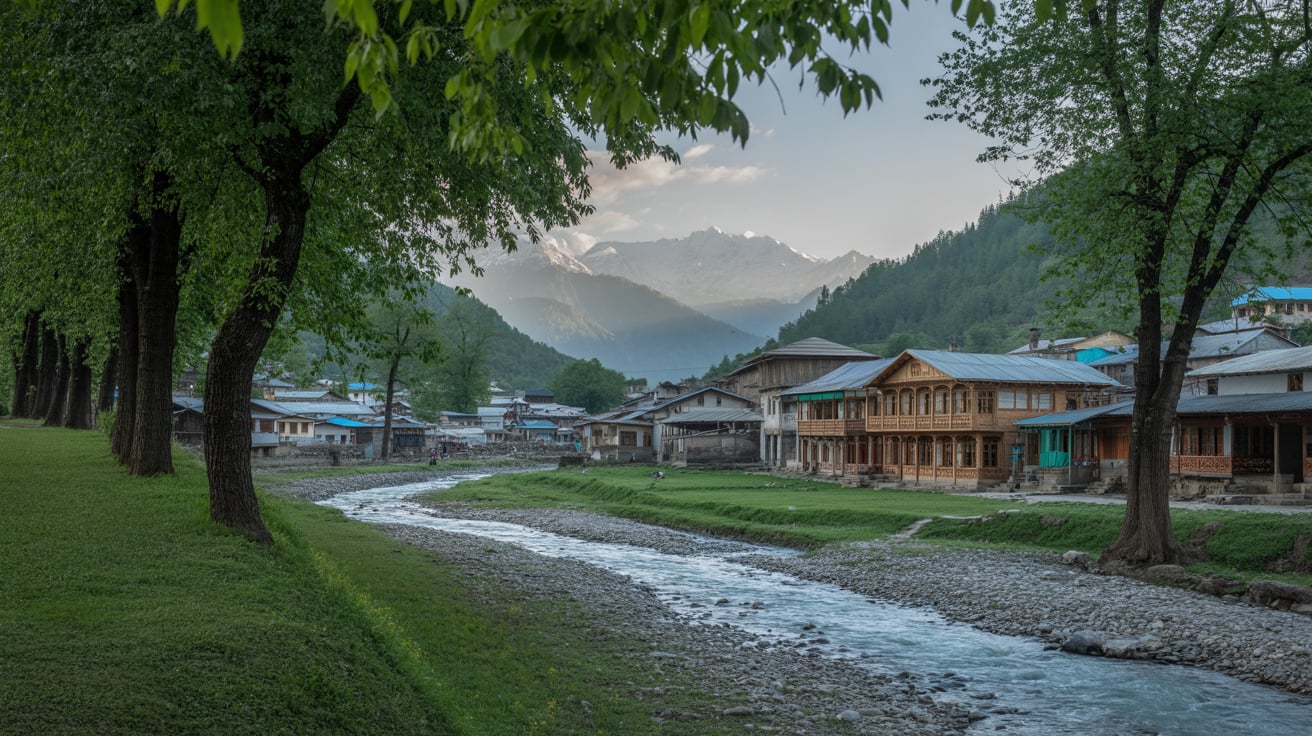 A serene village of Kashmir (AI-generated)
It would be an understatement to say that the situation in Kashmir was tense. Never before had Kashmir seen such large-scale violence, targeted killings and social turmoil. However, the people living in that particular village had consciously decided to go against the current.
Later, as a journalist, I realised that people like my uncle, who were not educated enough to deal with challenges outside their turf, hesitated to leave.
One summer afternoon, my uncle was closing his mill for lunch break when a stranger approached him. “Can you guide me to Bablooji’s house?” he enquired. Bablooji was an engineer posted in Pulwama, South Kashmir. His old mother lived alone in the house, which was located on the backside of ours.
Like other non-Muslims, Bablooji (nickname) too lived and worked in a secure zone, as per the official policy. Occasionally, he visited home to meet his mother.
My Uncle directed him to Bablooji’s house.
He had closed two gates of his mills and was crossing the small bridge over the canal to his home when he heard the gunshots.
The birds perched on walnut and poplar trees flew in fright. The wailing of a woman peirced the serenity of the village. Soon, villagers were rushing towards Babloo’s house.
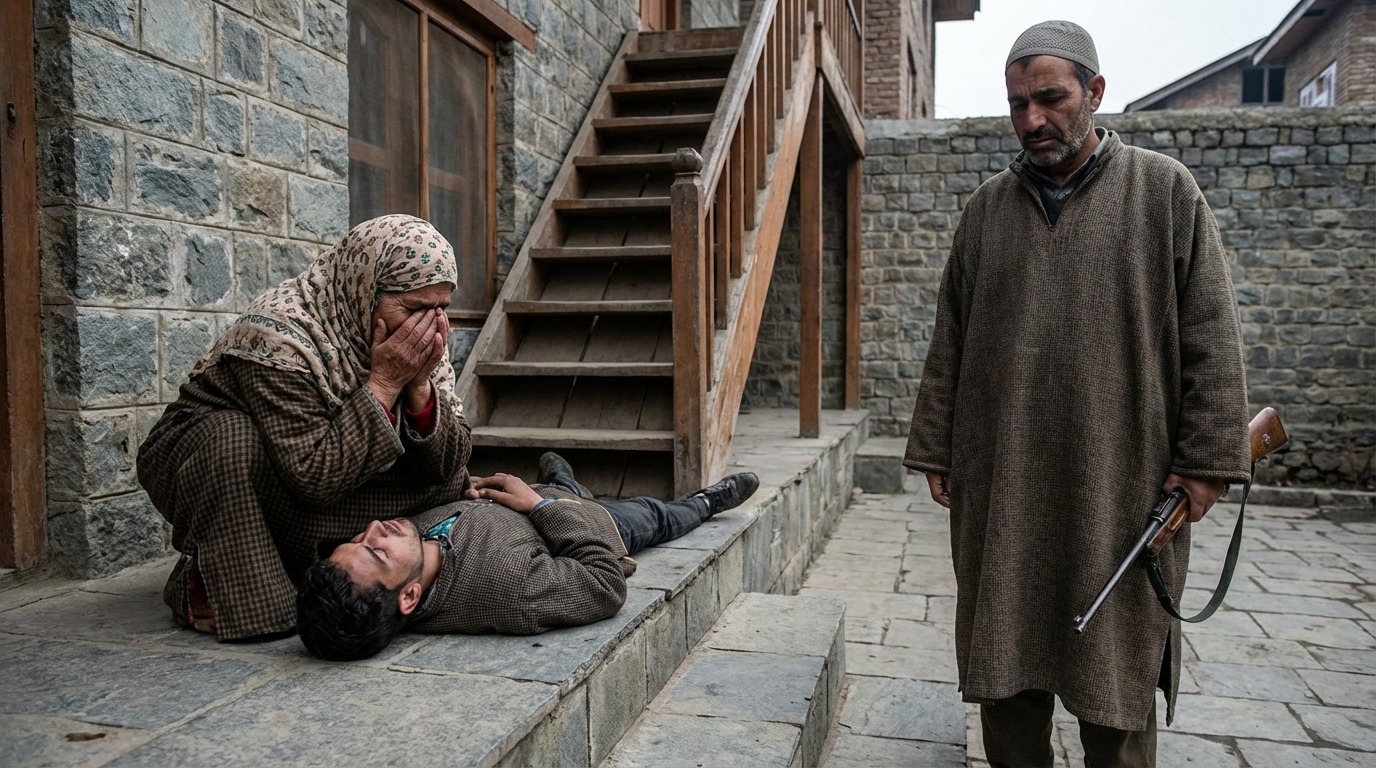 AI-generated image
My Mama froze and was later carried home in a semi-conscious condition.
Bablooji had barely entered his house when there was a knock at the wooden main door of the house. His mother opened it. “Is Bablooji inside? I have to meet him,” the stranger, who had met my Mama a few minutes ago, said.
Bablooji came down from the first floor; the stranger shot him with a pistol. Bablooji was killed in front of his mother.
The killing shattered the villagers’ belief that unity can protect them. They realised that pistols and guns in the hands of strangers could kill anyone at will in the new Kashmir.
Mama felt guilty of sending the killer to Balooji. The broad daylight killing had shocked everyone. With heavy hearts, the Muslims asked Hindus to move out, for they could no longer protect them, as it happened in Bablooji’s case.
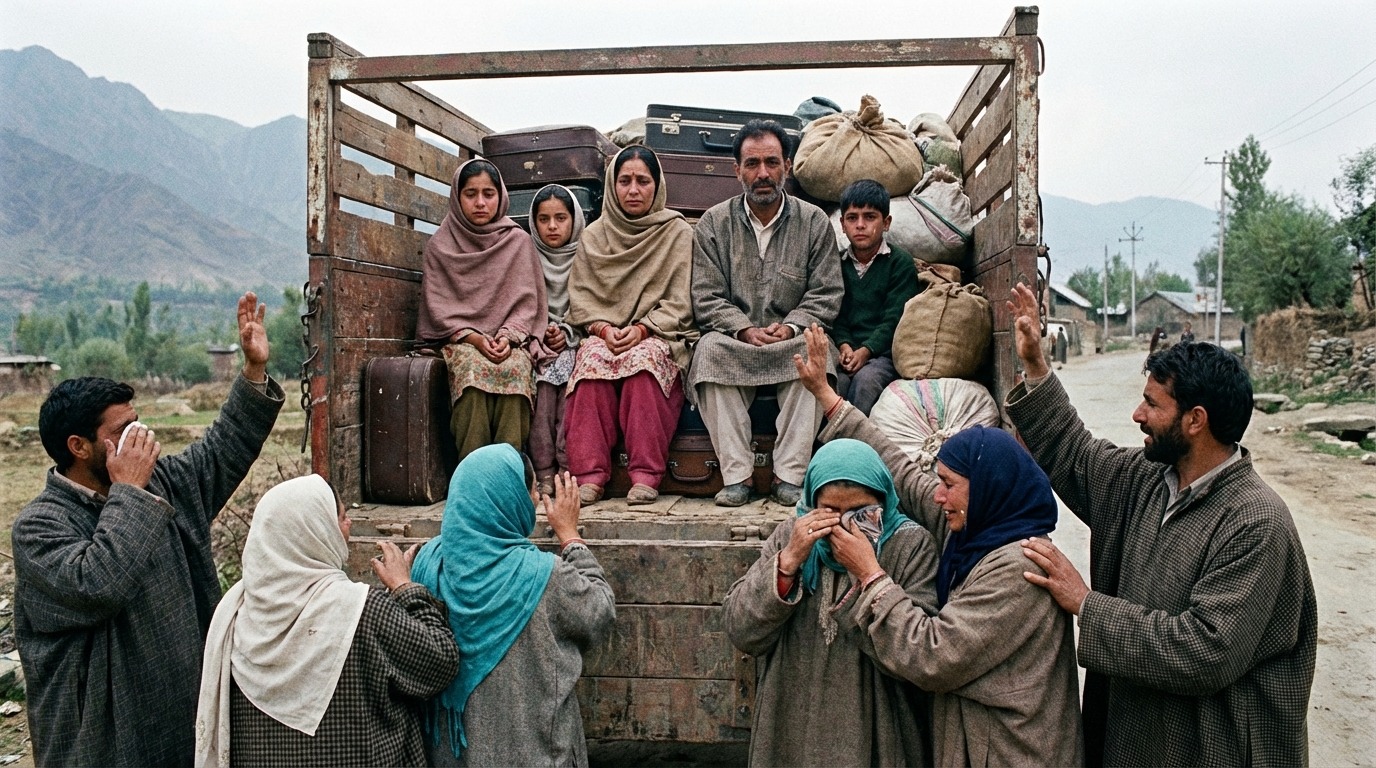 Muslims bidding a tearful farewell to their Hindu neighbours (AI-generated image)
Hindus packed their valuables. In the evening, the villagers arranged a few trucks for their Hindu neighbours to leave for Jammu, 300 km away. In the evening, the villagers bid them a tearful farewell and sought a promise that they would return as soon as the situation improved.
The next day, the truck arrived in Jammu, where it was very hot. Initially. the family had no idea where to go. My uncle sought to pay the driver for ferrying him and his family to Jammu.
What happened next was a surprise for Mama. The driver was in tears as he refused to accept the money.
The middle-aged driver instead thrust a few currency notes into my uncle’s palm and closed his fist. He held it firmly and said, “I can not accept money from you. I have not helped you; I have uprooted you from your home and dropped you on the roadside to nowhere.”
ALSO READ: 2 Muslims discover essence of India through their temple visits
Both hugged each other and wept their hearts out.
Readers are welcome to share their experiences of communal harmony or interreligious friendship on [email protected] for publication - Editor













.webp)