Kabul (Afghanistan)
An earthquake of magnitude 3.8 struck Afghanistan on Tuesday, a statement by the National Center for Seismology (NCS) said.
The earthquake occurred at a depth of 70km.
In a post on X, the NCS said, "EQ of M: 3.8, On: 09/12/2025 14:36:02 IST, Lat: 35.87 N, Long: 69.41 E, Depth: 70 Km, Location: Afghanistan."
EQ of M: 3.8, On: 09/12/2025 14:36:02 IST, Lat: 35.87 N, Long: 69.41 E, Depth: 70 Km, Location: Afghanistan.
— National Center for Seismology (@NCS_Earthquake) December 9, 2025
For more information Download the BhooKamp App https://t.co/5gCOtjdtw0 @DrJitendraSingh @OfficeOfDrJS @Ravi_MoES @Dr_Mishra1966 @ndmaindia pic.twitter.com/iz6T6sy5rp
Earlier in the day, another earthquake of magnitude 4.5 occurred at a shallow depth of 10km, making it susceptible to aftershocks.
In a post on X, the NCS said, "EQ of M: 4.5, On: 09/12/2025 13:17:35 IST, Lat: 34.53 N, Long: 70.54 E, Depth: 10 Km, Location: Afghanistan."
EQ of M: 4.5, On: 09/12/2025 13:17:35 IST, Lat: 34.53 N, Long: 70.54 E, Depth: 10 Km, Location: Afghanistan.
— National Center for Seismology (@NCS_Earthquake) December 9, 2025
For more information Download the BhooKamp App https://t.co/5gCOtjdtw0 @DrJitendraSingh @OfficeOfDrJS @Ravi_MoES @Dr_Mishra1966 @ndmaindia pic.twitter.com/SVE5LP0OY0
Shallow earthquakes are generally more dangerous than deep earthquakes. This is because the seismic waves from shallow earthquakes have a shorter distance to travel to the surface, resulting in stronger ground shaking and potentially more damage to structures and greater casualties.
Afghanistan has a history of powerful earthquakes, and the Hindu Kush Mountain range is a geologically active area where quakes occur every year, according to the Red Cross.
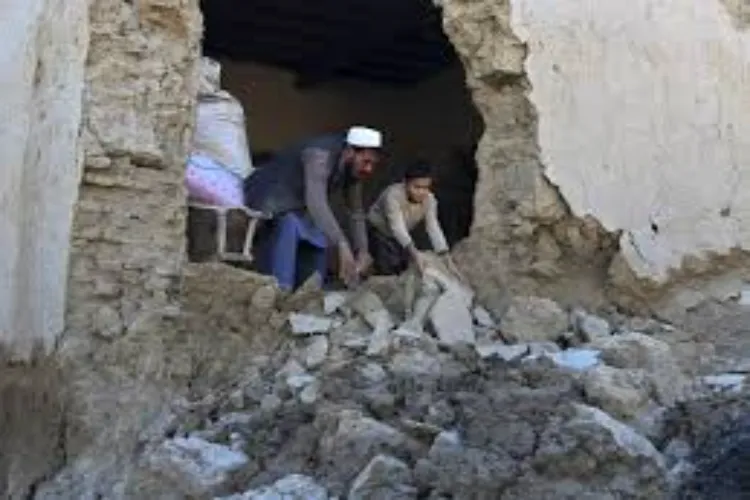
On November 4, a powerful earthquake rattled northern Afghanistan, killing at least 27 people and injuring 956 more, according to Sharafat Zaman Amar. The tremor also damaged one of the country's most beautiful mosques, CNN reported.
Families were jolted awake in the early hours of Monday when the 6.3-magnitude quake struck near Mazar-i-Sharif, one of the most populated cities in the north of the country, at a shallow depth of 28 kilometres (17.4 miles), the United States Geological Survey said, as per CNN.
Afghanistan sits on numerous fault lines between the Indian and the Eurasian tectonic plates, with a fault line also running directly through Herat. Its location on several active fault lines along the collision zone between the Indian and Eurasian tectonic plates makes it a seismically active region. These plates meet and collide, causing frequent seismic activity.
ALSO READ: Haji Ibrahim Khan: The Water Warrior of the Aravalli
As per the United Nations Office for the Coordination of Humanitarian Affairs (UNOCHA), Afghanistan remains highly vulnerable to natural disasters, including seasonal flooding, landslides and earthquakes.
These frequent earthquakes in Afghanistan cause damage to vulnerable communities, which are already grappling with decades of conflict and underdevelopment and have left them with little resilience to cope with multiple simultaneous shocks, UNOCHA noted.











.webp "US President Donald Trump")





.webp)