




Ashhar Alam | New Delhi
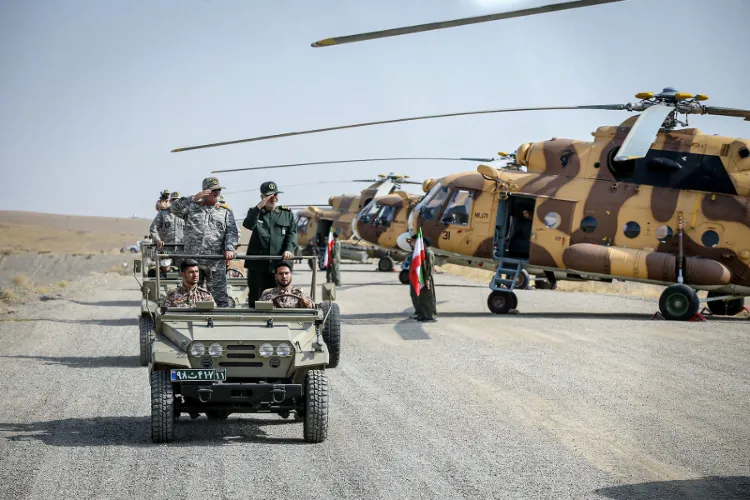
The European Union has taken a decisive step against Iran by agreeing to designate the Islamic Revolutionary Guard Corps (IRGC) as a terrorist organisation, marking a significant shift in Europe’s approach toward Tehran’s leadership. The move places the powerful military force in the same category as groups such as the Islamic State and al Qaeda, according to a report by The Times of Israel.
Reacting to the decision, EU foreign policy chief Kaja Kallas said repression by the Iranian regime could not be ignored. “Any regime that kills thousands of its own people is working toward its own demise,” she wrote on X, underscoring Europe’s growing frustration with Tehran’s actions.
Repression cannot go unanswered.
— Kaja Kallas (@kajakallas) January 29, 2026
EU Foreign Ministers just took the decisive step of designating Iran’s Revolutionary Guard as a terrorist organisation.
Any regime that kills thousands of its own people is working toward its own demise.
The designation has been welcomed by Israel, which described it as a landmark moment after years of diplomatic advocacy. Israeli Foreign Minister Gideon Sa’ar called the decision “historic,” while an Israeli official said it would significantly ease the prosecution of IRGC members across Europe by lowering the legal threshold to prove affiliation rather than direct involvement in specific terror plots.
Momentum for the EU’s decision gathered pace following a brutal crackdown on nationwide anti-regime protests earlier this month, which reportedly left thousands dead. Dutch Foreign Minister David van Weel said the bloc needed to send a clear signal that the violence used against protesters was unacceptable. France and Italy, previously hesitant over concerns that such a move could derail dialogue with Iran or endanger European citizens, backed the designation this week.
I welcome the decision of the EU Foreign Ministers to designate Iran’s Revolutionary Guards as a terrorist organization.
— Gideon Sa'ar | גדעון סער (@gidonsaar) January 29, 2026
This is an important and historic decision.
For years, and with even greater intensity in recent weeks, Israel has worked to achieve this outcome.
The number…
Established after Iran’s 1979 Islamic Revolution, the IRGC has evolved into one of the country’s most influential institutions, with deep reach into the economy, armed forces, and oversight of ballistic missile and nuclear programmes. While some EU member states had long pushed for the terrorist label, others had urged caution, fearing diplomatic fallout.
From Israel’s perspective, the new status carries tangible legal and operational consequences. An Israeli official said the designation would strengthen cooperation among European law-enforcement agencies through Europol, make asset freezes easier, and deter criminal networks from assisting the IRGC. “Once they realise European authorities are closely watching, they will think twice,” the official said.
Behind the scenes, Germany played a key role in rallying support within the bloc, persuading countries including France, Italy, Spain and Portugal to back the move. Diplomatic outreach focused on a range of concerns, from terror-related activities in Europe to Iran’s arms transfers, proxy operations and human rights record.
Iran, however, respon
Several countries are presently attempting to avert the eruption of all-out war in our region. None of them are European.
— Seyed Abbas Araghchi (@araghchi) January 29, 2026
Europe is instead busy fanning the flames. After pursuing 'snapback' at the behest of the U.S., it is now making another major strategic mistake by…
ded angrily. Foreign Minister Abbas Araghchi condemned the decision as a “major strategic mistake,” warning it would only inflame tensions in an already volatile region. In a post on X, he accused Europe of “fanning the flames” at a time when some countries were trying to prevent a wider conflict, and linked the move to pressure from the United States over Iran’s nuclear programme.
Despite the tougher stance, EU leaders stressed that channels of communication with Tehran would remain open. Kallas said Europe still expects dialogue to continue, while Italy’s Foreign Minister Antonio Tajani noted that engagement with Iran would not cease because of the decision.
ALSO READ: I received my wages for hard work of decades: Ghafruddin on Padma Shri
Alongside the IRGC designation, the EU announced fresh sanctions on 15 individuals and six entities over serious human rights abuses, including senior officials and IRGC commanders. Additional measures target organisations linked to censorship, online disinformation, and Iran’s drone and missile programmes, with tighter restrictions on exports of components used in unmanned aerial vehicles and missiles.
The move, while largely symbolic, signals a sharper European posture toward Iran at a time of rising internal unrest and growing international pressure on Tehran.
_(1)_(1).webp "Jagannath Rath Yatra")






.webp)
_(1).webp)
.webp)
