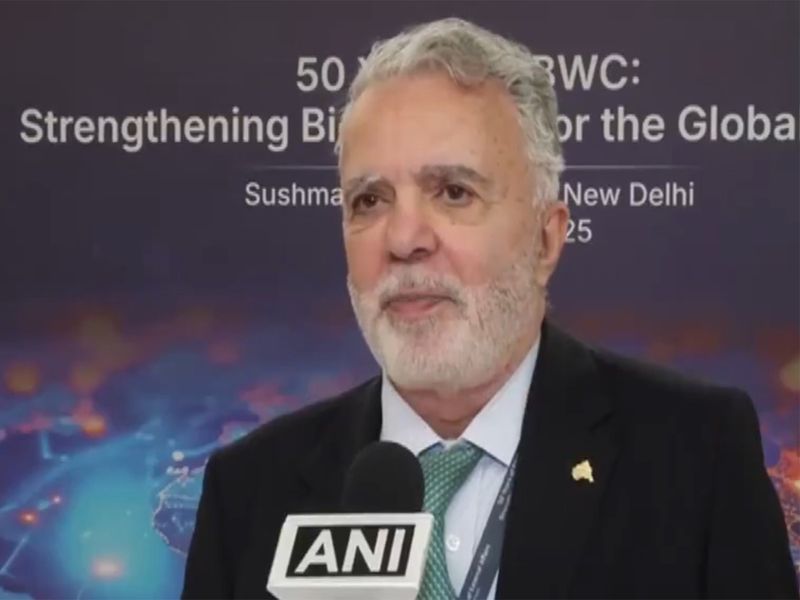
Frederico Meyer, the Permanent Representative of Brazil to the Conference on Disarmament
New Delhi
Frederico Meyer, Permanent Representative of Brazil to the Conference on Disarmament and Chair, Working Group on the Strengthening of the Biological Weapons Convention (BWC), said that the "biggest gap" in the current global biological weapons governance framework is the "international situation."
Expressing his concern over the lack of a governance framework for biological weapons, he said, "Science evolves at the speed of light, while diplomats move very slowly."
"The biggest gap (in the current global biological weapons governance framework) is the international situation. On the floor of the room where we discuss, there are strong national positions, which are very much involved with the polarisation in foreign policy at the moment," Frederico Meyer told ANI.
However, Meyer also remained optimistic that the convention is still very young and as the world and the international scene evolve, efforts to close the gap will be made.
"The convention is a young girl. It's only 50 years old. So, of course, the world has been in permanent evolution. That's why we have this working group, to strengthen the convention. As the world and the international scene evolve, we have working groups that want to address and close those gaps," he said.
The international conference on '50 Years of BWC: Strengthening Biosecurity for the Global South', is being organised by the Ministry of External Affairs on December 1-2 in New Delhi to commemorate the 50th anniversary of the entry into force of the Biological Weapons Convention (BWC)
External Affairs Minister Dr S Jaishankar addressed scientific experts, policy makers and diplomats from over 80 countries and representatives from international and regional organisations, as well as Indian academia and industry during the inaugural session on Monday.
EAM reaffirmed India's commitment to the full and effective implementation of the Biological Weapons Convention and India's well-established non-proliferation record. He urged the participants to reflect on the new challenges posed by the rapid developments in science and technology in the context of the BWC.
He highlighted India's proposal for a National Implementation Framework that covers identification of high-risk agents, oversight of dual-use research, domestic reporting, incident management and continuous training, according to a release from MEA.
He noted that India's annual Disarmament and International Security Affairs Fellowship and Capacity Building Programme under ITEC on UNSC Resolution 1540 and Strategic Trade Controls further demonstrates its contribution to the global non-proliferation architecture.
During the Conference opening, EAM also visited an exposition showcasing India's strengths in bio-surveillance, biotechnology, diagnostics, therapeutics and digital technology for disease surveillance and related fields.
The exposition showcases the success stories of products and solutions developed by Government Departments/organisations, including DRDE, CSIR, the Ministry of Health and Family Welfare, the Department of Biotechnology-BIRAC, ICMR, and the Department of Animal Husbandry, and their private industry partners. The ICMR BSL-3 Lab and the DAHD Mobile Veterinary Unit are part of the exposition that represents India's innovation in public health preparedness.














_(1).webp)