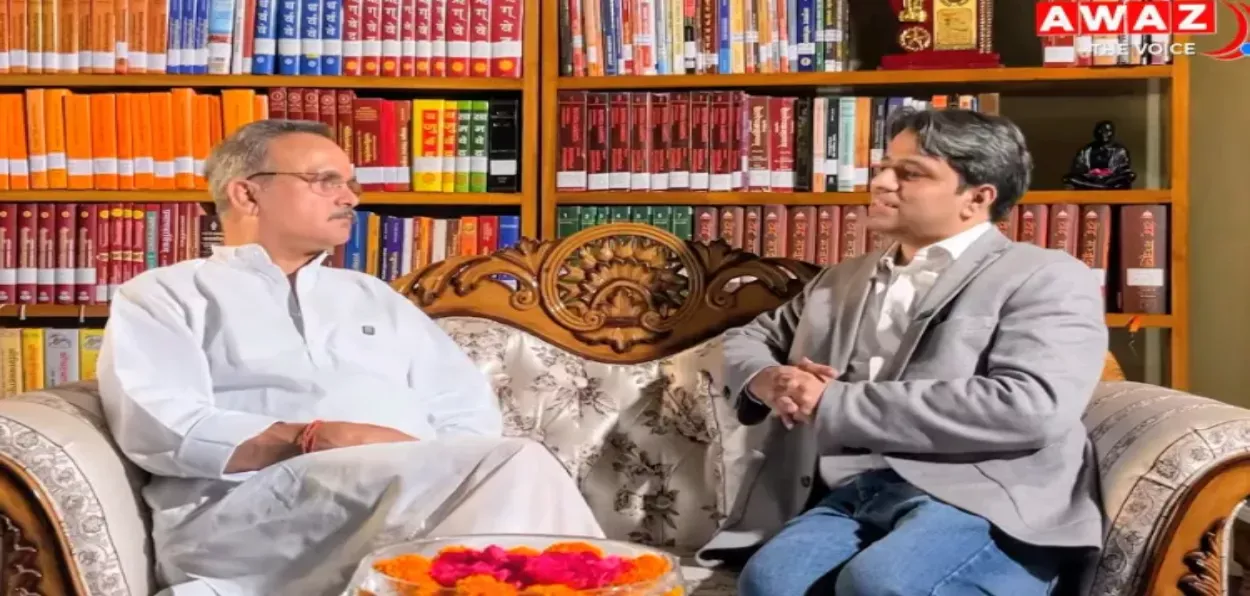
.webp "Dr Atanu Nath, Assistant Professor at Tihu College in Nalbari, Assam")
Satananda Bhattacharya/Hailakandi (Assam)
Dr Atanu Nath of Assam’s Nalbari district has been awarded the 2026 Breakthrough Prize in Fundamental Physics, also known as the “Oscars of Science.” He received this prestigious award as part of an international collaboration of 376 scientists, including 11 Indians, recognised for their work on the Muon g−2 experiments conducted at CERN, Geneva, Brookhaven National Laboratory, and Fermilab.
This makes Nath, who works as an Assistant Professor at Tihu College in Nalibari district, the first and only scientist from North East India to receive the Breakthrough Award in Basic Physics.
The long-running precision experiments in which he and other awardees are involved are recognised as major milestones in modern physics.
The Breakthrough Prize in Fundamental Physics is a prestigious $3 million award funded by Silicon Valley entrepreneurs like Yuri Milner and Mark Zuckerberg. It honours major, transformative advances in physics, with a focus on recent discoveries, including specialised awards for career researchers.
Dr Atan Nath is a resident of Lalabazar in Hailakandi district of South Assam and is currently working as an Assistant Professor of Physics at Tihu College in Nalbari district.
 Dr Atanu Nath with students
Dr Nath is the second son of retired assistant teacher Birendra Kumar Nath and retired assistant teacher Binta Rani Nath of Lalbazar.
Dr. Nath completed his undergraduate studies at Gurucharan College (now University) in Shillong. He later obtained his Master's Degree from S N Bose National Centre for Basic Sciences, Kolkata and pursued advanced studies at Tata Institute of Fundamental Research (TIFR), Mumbai.
In 2013, he joined the University of Naples Federico II in Italy for doctoral research under Professor Giancarlo D'Ambrosio of the Instituto Nazionale di Fisica Nuclear (INFN), working in Quantum Chromodynamics (QCD). In 2016, he received his PhD.
He then joined Professor Michael Lekovaci’s Muon G-2 laboratory, first as a visiting researcher and later in 2017 as a postdoctoral fellow.
He became part of Fermilab’s international collaboration and remained involved in the trial until 2020.
Within the project, he worked on the laser calibration system, which is a critical component for ensuring detector precision. The Naples group was specifically responsible for the source monitoring system, and Dr Nath Miun Campus was closely involved in this effort. He later served as the run coordinator during Run-3.
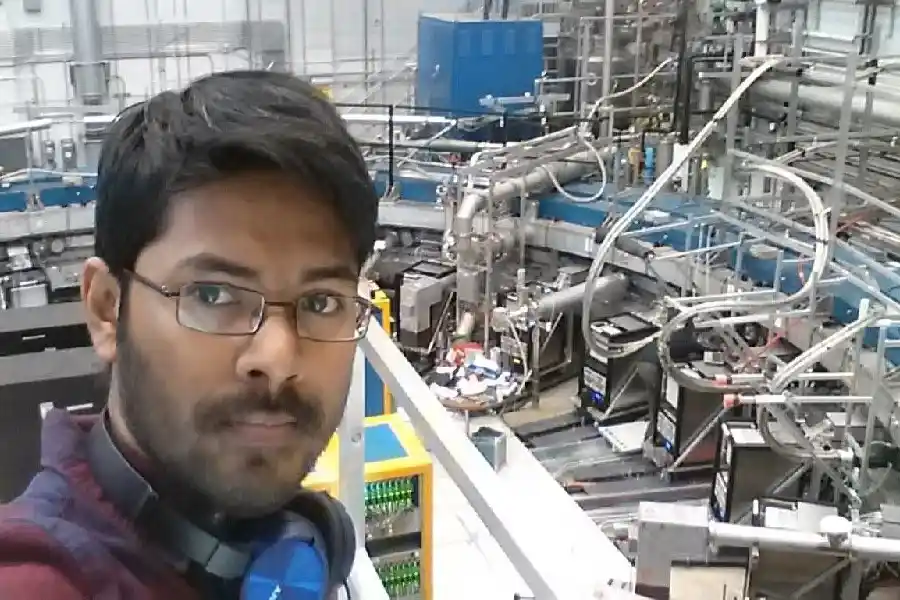 Dr Atanu Nath in the laboratory
After returning from the United States in 2020, he joined IIT Guwahati as a postdoctoral researcher. He worked in the High Energy Physics Laboratory and contributed to Fermilab's DUNE and NOvA neutrino experiments. He also became a founding member of the Centre of Advanced Studies and Innovation Lab (CASILab), a Shillong-based research initiative.
In 2022, Dr Nath joined Tihu College as an Assistant Professor.
Brookhaven National Laboratory interim director John Hill, Fermilab physicist Chris Polley, Boston University physicist Lee Roberts, Fermilab director emeritus Young-Ki Kim, and CERN director general Mark at the awards ceremony Saturday at the Barker Hangar in Santa Monica, Calif Thomson, University of Washington physicist David Hertzog and Brookhaven Laboratory physicist William Morse accepted the award on behalf of all scientists in the three experiments.
The award was launched in 2012 by the Breakthrough Award Foundation. Its founders include Sergei Brin, Priscilla Chanand, Mark Zuckerberg, Yuri and Julia Milner, and Annie Wojcicki to honour transformative discoveries and fundamental research.
According to experts, the one-year prize centres on decades of research into the magnetic properties of muons, the elementary particle described as a serious cousin of electrons.
ALSO READ: Assam-born Fazlur Rahman finds cancer's link with environment
The muon behaves like a tiny magnet, and its subtle motion in a magnetic field is measured with extraordinary accuracy. Any discrepancy between theory and experiment could indicate unknown particles, new energy, or limitations in existing theory. For this reason, the Muon G-2 program is considered the most important reliability test in particle physics.










.webp "Hafiz Ahmed's photograph of Bagurumba dance")