.webp "Zeenat Kaife, First Muslim journalist of Rajasthan")
Neelam Gupta
"My entire family had gone to attend a wedding. While we were there, my grandmother got me engaged. I was in Class III at St. Joseph's School in Jaipur." Senior journalist and Urdu writer Zeenat Kaife begins the story of her life that she shaped by courage, defiance, heartbreak, and determination.
"My father was a college lecturer. Neither he nor my mother approved of the engagement, but they remained silent before my grandmother. That silence pushed my life onto a difficult path."
The boy she was to marry was the son of her father's friend and lived in the same neighbourhood.
"My future in-laws declared that I would no longer wear skirts. My school was changed. Though I continued to be in an English-medium school, the school uniform was a salwar-kameez. Soon, I was asked to wear a burqa while going to school. I was too young to understand its significance. I only knew that I felt suffocated. Sometimes I even stumbled and fell while walking."
After finishing school, Zeenat enrolled at Maharani College, Jaipur, where she completed her Master's degree in Urdu. She later earned an M.Phil. and a PhD, writing her doctoral thesis on "A Critical Analysis of Urdu Novels on the Culture of India."
"My father often told me when I was young, 'Love your language, otherwise it dies.' Those words stayed with me forever."
With her academic qualifications, she could easily have become a lecturer. "But I never wanted that. It felt too routine for me. I wanted to step outside the home and work in a profession full of excitement and challenges."
That desire led her to Delhi, where she completed a one-year diploma in journalism from a private institute.
Even before completing the course, she had begun writing for leading Hindi magazines such as Grihshobha, Sarita, Mukta, and Manohar Kahaniyan. Her poems and short stories were already appearing regularly in literary publications.
"My first short story was published when I was in Class X." Although she loved poetry, her father did not allow her to recite at public mushairas.
"He believed that female poets were often not treated with respect."
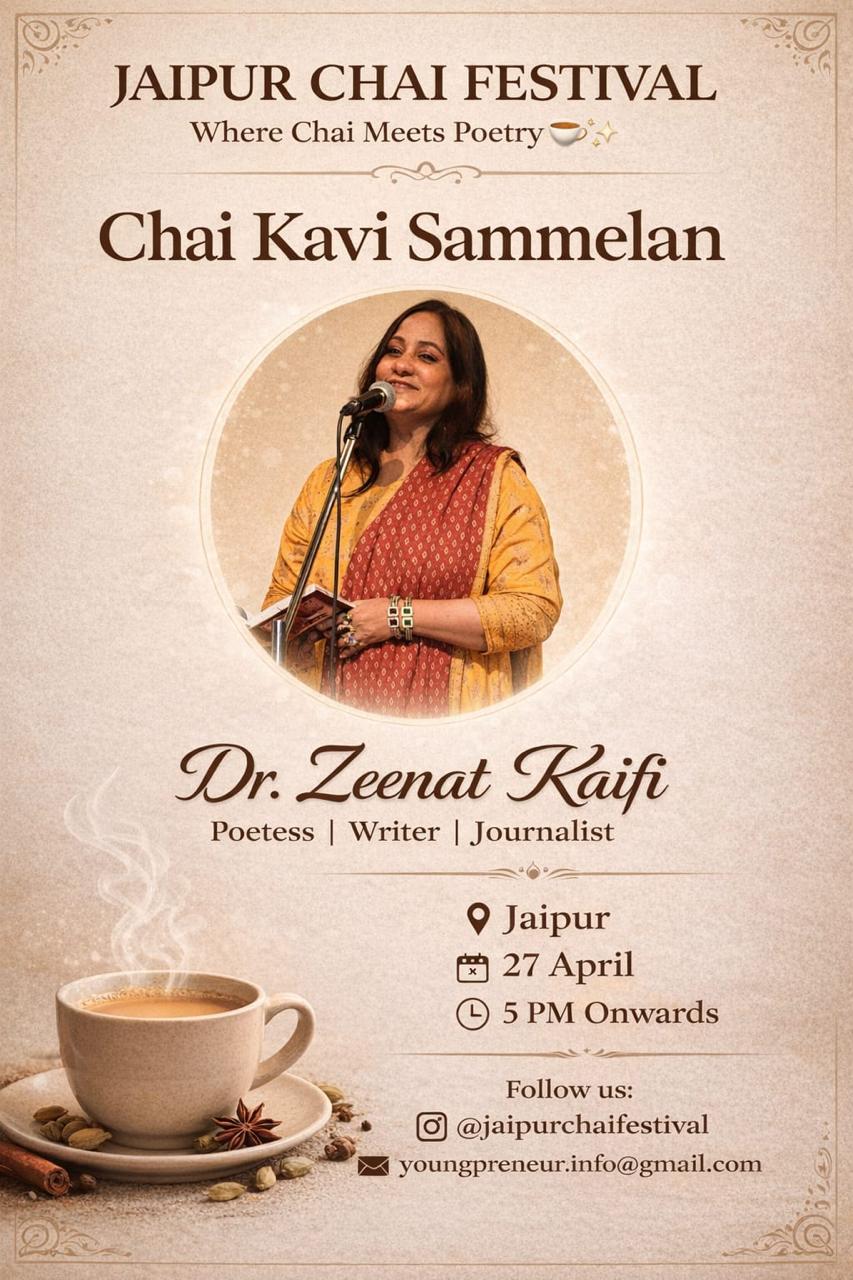
She could, however, recite at school and college functions. Later, she began participating in programmes on All India Radio and was invited to television mushairas.
"My father himself was a poet and often attended mushairas. If we were both invited, I would accompany him. Later, when he moved to Singapore for business, I started attending them alone."
While studying journalism, Zeenat frequently visited the office of Navbharat Times.
"I would sit there for two or three hours every day and do whatever work I was assigned."
Her family was not enthusiastic about her joining journalism. "But once I had made up my mind, nobody tried to stop me."
One day, the newspaper assigned her an interview with legendary actor Dilip Kumar, who was visiting Jaipur.
"They knew I had already interviewed Shah Rukh Khan and Salman Khan as a freelancer for magazines."
She secured an appointment and confidently went to meet him.
"The moment I sat down, he said, 'Young lady, I am not going to tell you anything about this film. If you want to discuss something else, go ahead.'"
She froze. "He looked at me and smiled, 'You haven't done your homework, have you? Go back, prepare properly, and come after three days.'" That moment became the greatest lesson of her journalistic career.
"I learnt that no matter where you go, always do your homework." For three days she immersed herself in everything she could find about Dilip Kumar—in libraries, newspaper archives, and old records.
"When I returned, our conversation began at eleven in the morning and continued until evening."
The interview was splashed on one page and appeared under her byline in Navbharat Times. It earned her recognition among journalists and readers alike.
.jpeg)
"I thought this would finally get me a permanent job there." It did not. Instead, the film reporter at the newspaper became jealous of the attention she received. "The hostility reached a point where I felt it was better to leave."
Around the same time, while recording a programme at All India Radio, a producer from its Urdu service informed her that Rashtriya Sahara was launching an Urdu newspaper from Delhi.
"I applied to become their Jaipur correspondent and was selected."
For the first time, she had a proper newsroom, an official designation, and complete professional responsibility. "It gave me tremendous confidence."
Since the publication was a weekly newspaper, she had sufficient time to pursue investigative and offbeat stories. "I always tried to find stories that others ignored." Her work soon attracted the attention not only of readers but also of politicians and bureaucrats.
"I exposed several scams. My report on child labour led to official action." Eventually, she says, she no longer had to search for stories. "The stories began finding me."
Covering the All India Muslim Personal Law Board conference presented another challenge. "I had to wear a burqa because the chairman would not speak to me otherwise."
On several occasions, she used the burqa simply as a practical tool to gain access to places where women journalists were otherwise not permitted. "I was the first Muslim woman journalist in Rajasthan. I worked fearlessly, boldly, and with complete dedication."
But professional success did not protect her from workplace discrimination. "The editor, who was based in Noida, would often rewrite my best stories and publish them under his own name." Whenever she protested, he would dismiss her.
"He would say, 'You don't write well enough. That's why I rewrite them.'"
When he visited Jaipur, she was expected to spend the entire day accompanying him, regardless of whether there was any work. "If we visited government offices, I would simply be made to wait outside."
She recalls one particularly humiliating expectation. "In the beginning, he even wanted me to open his car door whenever he arrived." She refused.
"As I kept rejecting such demands, he stopped publishing my stories altogether." Her colleagues in the Hindi edition of Sahara encouraged her not to give up. "They told me to write for them instead."
Many of her reports appeared in the Hindi edition. "There were moments when I wanted to resign. I wasn't receiving promotions, and new obstacles kept being created for me. But jobs are not easy to find, especially in a profession you love. So I stayed."
Only after that editor left did her situation improve. "The new editor promoted me." However, in 2018, when the Sahara Group entered a financial crisis and salaries stopped coming for six months, she finally resigned.
Over the years, Zeenat received numerous honours for both journalism and literature. In 2002, the Pinkcity Press Club, Jaipur, honoured her with a Lifetime Achievement Award. She was also recognised by the Rajasthan Urdu Academy and received several awards for her Urdu poetry and short stories.
She participated in mushairas across India and abroad. "When the Urdu Academy in the United States read my poems published in magazines, they invited me to America. It was a fully sponsored tour, and we travelled to ten different cities."
Despite her successful career, Zeenat's personal life was far from straightforward. Her childhood engagement remained intact until she entered college. "I invited the boy to meet me at a restaurant in Jaipur."
The meeting ended dramatically. "He handed me a lighter, put a cigarette in his mouth, and ordered me to light it." She refused twice. "When he insisted again, I threw a glass of water on his face and walked out."
Soon afterwards, police reportedly raided the restaurant and detained several couples, including him. The boy's family complained to her parents.
"I told my parents that if I had informed them before meeting him, I would never have discovered what I now knew." She bluntly declared that she would never marry someone who was, in her words, "not only physically incompatible but also intellectually empty."
"When my mother told me the other side had called off the engagement, I said, 'Distribute sweets!'"
Two more engagements followed, and both collapsed because prospective families insisted she stop attending mushairas and begin wearing the burqa permanently.
"By then, I had already become the person I wanted to be. I couldn't accept those conditions."
Later, while covering the Ajmer Urs for Sahara TV, she met another journalist from Noida. "We spent nearly ten days together and felt we could build a life together."
They became engaged. But fate intervened again.
"When I visited the Noida office for an official meeting, I discovered he was deeply involved in a relationship with one of his colleagues." That engagement ended as well.
The proposal that eventually changed her life came from an unexpected person—a childhood friend from St. Joseph's School. They had studied together before she changed schools after her engagement.
By then, he had already been married and had four children. "I initially refused." They continued to meet as friends.
Later, while Zeenat was performing the Hajj pilgrimage with her parents, an unusual incident happened. "In Madinah, someone came to me carrying a bouquet. Inside it was a letter." The letter was from her childhood friend.
It read: "I will keep you happy. I will never impose restrictions on you. You are free to live exactly the way you wish."
Her parents read the letter too. "After a great deal of thought, the entire family agreed."
They married. "Today we have a son, and my husband has beautifully brought both families together."
Life seemed complete until tragedy struck in 2022.
One of her three sisters passed away unexpectedly. "I couldn't bear the loss. I slipped into depression."It took nearly a year to recover.
"My son stood by me throughout that difficult period and gradually brought me back to life."
READ MORE: Shabana Dagar safeguards 500-year musical legacy
Today, Zeenat Kaife is once again ready to face the challenges of journalism with the same courage that has defined every twist and turn of her remarkable journey—a journey marked by resilience, independence, and an unwavering refusal to surrender her identity.

.webp "Representational Image")