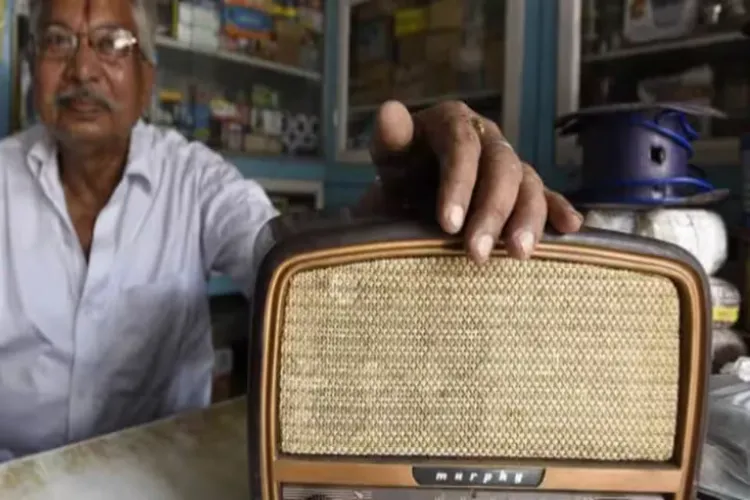
Jhumri Telaiya
“Agli farmaish hai Jhumri Telaiya se” — a phrase that once sent a thrill through radio listeners across India — still echoes fondly in this quiet lakeside town nestled amid Jharkhand’s hills.
For decades, Jhumri Telaiya, part of a rich mica belt discovered by the British in 1890, enjoyed a unique cultural fame. In the early 1950s, the town unexpectedly emerged as India’s most prolific sender of song requests to Radio Ceylon and later All India Radio’s Vividh Bharati, turning it into a household name far beyond Jharkhand.
As Radio Ceylon — the Sri Lankan broadcaster that popularised the iconic Hindi film song countdown Binaca Geetmala — completes 100 years this week, memories have resurfaced in Jhumri Telaiya, where many still refer to it simply as “Radio Ceylon”.
Residents recall gathering around radio sets, thumping tables in excitement whenever announcers like Ameen Sayani announced that the next request came from their town.
According to Rajiv Ranjan, a 1991-batch Indian Revenue Service officer, Jhumri Telaiya’s radio obsession was closely linked to its economic prosperity during the mica boom.
“The mica barons of Jhumri Telaiya — particularly Chattu Ram Bhadani and Horil Ram Bhadani — controlled nearly 1,000 mines. Their wealth transformed the town from a sleepy village into a thriving hub with a deep love for music,” said Ranjan, whose family lived in the town for nearly five decades.
He recalled that the Bhadani family even invited Bollywood playback singer Suraiya to perform in Jhumri Telaiya, while his own family helped bring shehnai maestro Ustad Bismillah Khan for a concert in 1971.
“We still remember ‘Dil Ka Khilauna Haay Toot Gaya’ performed by Ustad Bismillah Khan,” he said.
The radio craze gathered momentum when mica trader Rameshwar Prasad Barnwal began sending postcards with song requests to Radio Ceylon almost daily for Binaca Geetmala.
“Because Barnwal was such a regular, his name kept being announced on air. That inspired many others to start sending requests,” Ranjan said.
Soon, sending farmaishein became a town-wide obsession. Informal listeners’ clubs sprang up, with residents competing to see who could send the most requests in a day or month.
When All India Radio launched Vividh Bharati in 1957 and resumed Hindi film music, Jhumri Telaiya flooded the station with requests. To manage the volume, AIR eventually printed standardised request formats on postcards.
“At one point, most requests for film songs received by radio stations came from Jhumri Telaiya,” says local history accounts.
Leading industrialist Rahul Modi, whose grandfather was also a mica trader, earlier told PTI that friendly wagers were common. “People used to bet on whose name would be announced during the programme.”
The radio culture also shaped student life at Sainik School Tilaiya. Dr Deepak Kumar, associated with a UN body, recalled that radios were officially banned in hostels.
“Still, we found ways. Songs from Binaca Geetmala would drift in from staff quarters,” he said.
Retired Merchant Navy officer Capt Arun Kumar Singh, who studied there in the 1970s, remembers sprinting to the mess just before the programme began.
“There was a radio there. We’d run from class to catch the countdown. That joy is etched in my memory,” he said.
Binaca Geetmala aired on Radio Ceylon from 1952 to 1988 before shifting to Vividh Bharati, where it continued till 1994.
READ MORE: Nirmal, my Abba's most trusted son
For nearly four decades, millions tuned in across India — and more often than not, the next song request came from Jhumri Telaiya, a small town that once ruled the nation’s airwaves.

.webp "S. Irfan Habib with Saquib Salim in Deen Aur Duniya")










.webp)

.webp)