Washington
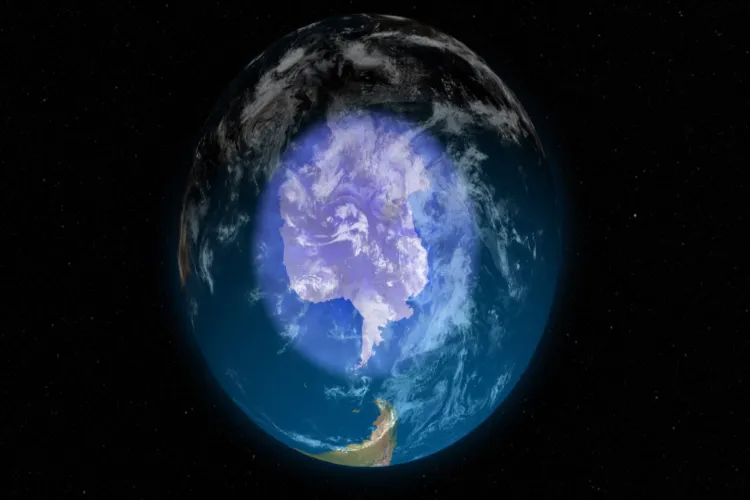
The ozone hole over Antarctica this year has ranked among the smallest observed since the early 1990s, signalling steady progress from decades of global action under the Montreal Protocol, according to scientists from NASA and the US National Oceanic and Atmospheric Administration (NOAA).
Researchers said declining levels of ozone-depleting chlorine compounds and warmer stratospheric temperatures helped limit ozone loss during the 2025 season. The ozone hole was the fifth smallest recorded since 1992, when the Montreal Protocol began taking effect.
At its peak between September 7 and October 13, the ozone hole averaged 7.23 million square miles (18.71 million sq km) and began breaking up nearly three weeks earlier than the average timing of the past decade. Its largest single-day extent was recorded on September 9, when it reached 8.83 million square miles, about 30 per cent smaller than the record high observed in 2006.
Using satellite data dating back to 1979, scientists ranked the 2025 ozone hole as the 14th smallest on record.
Experts said the findings reinforce evidence that international restrictions on chlorofluorocarbons (CFCs) and other harmful chemicals are enabling gradual recovery of the ozone layer. Ozone-depleting substances in the Antarctic stratosphere have declined by about one-third since peaking around 2000, scientists noted.
READ MORE: Rajesh Khan Machchari's dedication has changed conditions for his backward community
While banned chemicals still linger in older materials and landfills, researchers expect the Antarctic ozone hole to recover to pre-depletion levels by the late 2060s, provided current global controls remain in place.
















.webp)

.webp)