




Vidushi Gaur/New Delhi
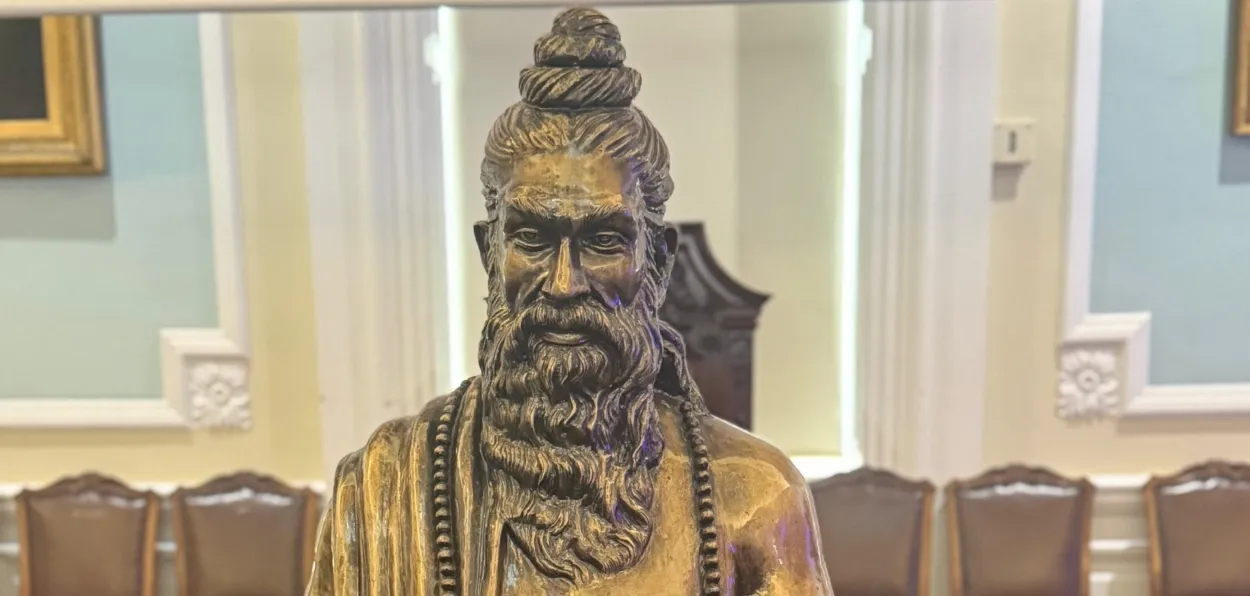
In the quiet halls of the Royal College of Surgeons in Edinburgh, the oldest Surgical College in the world, a small but powerful presence draws the attention of visitors who understand the language of medicine and history. It is the bust of Maharishi who considered tha father of modern surgery,
It was about 2600 years ago that the Kashi-based Sushruta performed the first surgery and wrote Sushruta Samhita, a foundational text of Ayurveda that documents over 300 surgical procedures, 120 surgical instruments, and pioneering reconstructive techniques.
Edinburgh, a city known for its deep medical heritage, has long celebrated pioneers of surgery. Within this landscape of scientific remembrance, Sushruta’s presence feels both natural and extraordinary. Natural, because his contributions belong to the foundation of surgical science itself; extraordinary, because he lived more than two thousand years ago in a world without modern instruments, yet described procedures that resemble the principles of modern reconstructive surgery.
Sushruta’s text, the Sushruta Samhita, documented surgeries for cataracts, fractures, plastic reconstruction of the nose, and even principles of dissection and surgical training. In an era when many civilisations still treated illness through ritual alone, he insisted on observation, experimentation, and hands-on practice.
His surgical students were trained not just in theory but in precise technique using natural substitutes before ever touching a patient. In many ways, he was not only a surgeon but also a teacher who understood that medicine is as much discipline as it is science.
Sushruta statute unveiled in Royal Surgeon Society Edinburgh
— Muji Singh Rangi (@mujifren) June 22, 2026
Liver Doc might get a stroke seeing this pic.twitter.com/nEZIyGMngB
The presence of his statue in Edinburgh therefore carries symbolic weight. It quietly acknowledges that the history of modern surgery is not a single European story, but a shared human journey. Yet, for many visitors, there is a moment of surprise, why is an ancient Indian surgeon honoured so visibly in a Western institution, while in India itself, his presence is often absent from the most visible spaces of modern healthcare?
In Australia as well, Sushruta’s legacy finds recognition not through grand national monuments but through quieter spaces of academic remembrance. Within some surgical training environments and medical schools, particularly in anatomy departments and history-of-medicine collections, the teachings of Sushruta are acknowledged as part of the foundational story of global surgery.
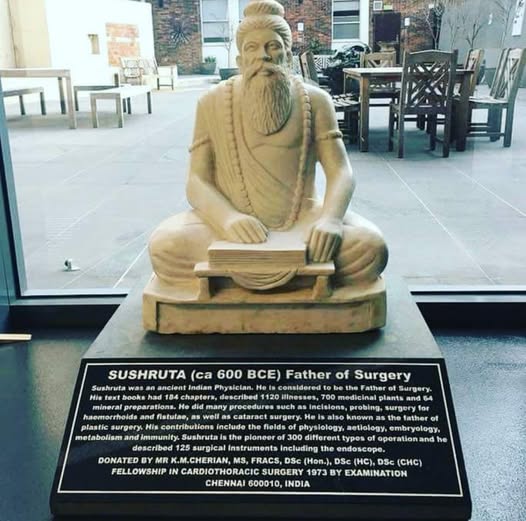 Statue of Sushruta in Royal Australian College, Melbourne, Australia
Walk through many large hospitals in India today, and you will find portraits of modern medical leaders, political figures, and sometimes generic symbols of healthcare. But statues or memorials of Sushruta are rare, almost invisible in the physical architecture of medical institutions. This absence is not a reflection of his importance, but rather of how history has been curated, remembered, and sometimes overlooked in the very place where it was born.
The contrast becomes sharper when one thinks of Edinburgh’s decision to preserve and honour him. It is not merely an act of admiration for a distant figure; it is an acknowledgement of intellectual inheritance. The city has chosen to say that medical science did not begin in one geography, but evolved through multiple civilisations. In doing so, it has embedded Sushruta into a global narrative of surgery.
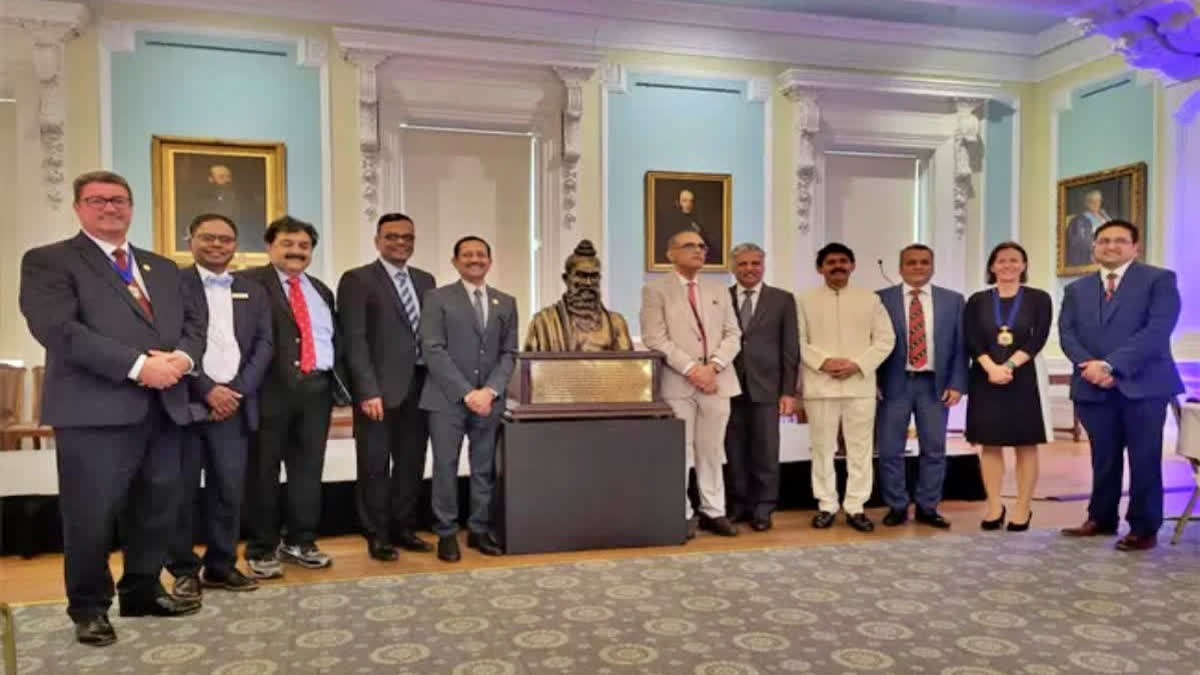 The Bust of Sushruta in Royal College of Surgeons in Edinburgh
It is not that India lacks pride in its ancient medical heritage. Ayurveda is widely acknowledged, and Sushruta is celebrated in academic discourse. Yet symbolic representation matters. A statue in a hospital is not just stone or bronze; it is a daily reminder to doctors, nurses, and patients that they are part of a long continuum of healing knowledge. It turns history into presence.
In Edinburgh, the statue quietly fulfils this role. It stands not as decoration but as dialogue between past and present, East and West, tradition and modernity. A young medical student passing by might pause, read the name, and discover that surgical precision was being taught in ancient India when much of the world had not yet documented such practices. That single moment of awareness becomes a bridge across centuries.
READ MORE: How Amal Ayub's Bridalbug.Co is redefining luxury weddings
Interestingly, while writing when I asked my peers what did they know about Sushruta, I drew blank stares.
A statue in a hospital courtyard, a dedicated surgical wing, or even a teaching centre named after him would not merely honour the past, it would anchor it in the present. The story of Sushruta’s statue in Edinburgh is therefore not just about recognition abroad. It is about reflection at home.





_(1).jpg)
_(4).webp)