New Delhi
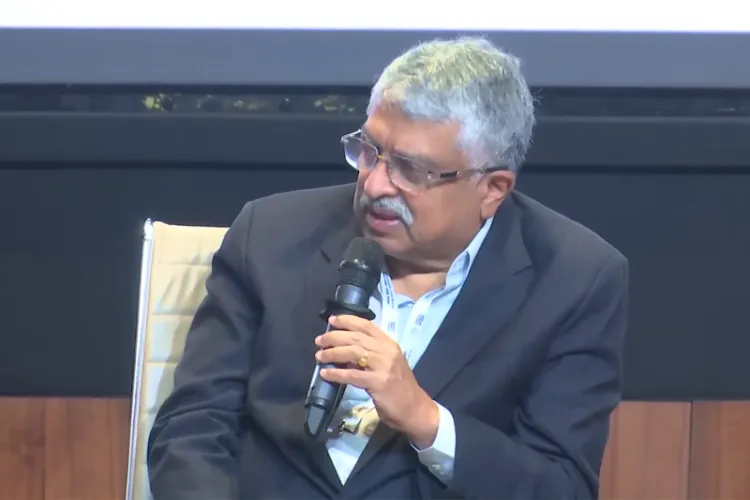
Artificial Intelligence can become a powerful driver of large-scale societal transformation when combined with open networks and decentralised ecosystems, Nandan Nilekani, co-founder of Infosys, said on Friday.
Speaking at a panel discussion during the India AI Summit 2026 in New Delhi, Nilekani emphasised that the convergence of AI agents with open digital architectures is the fastest and most effective way to diffuse technology productively and improve lives at scale.
“If a user—be it a farmer or someone producing a small amount of electricity—can easily transact with someone else through an AI agent in their own language, that is inclusion at a massive scale. I really see AI agents on open networks as the fundamental construct for massive diffusion of technology,” he said.
Nilekani pointed to India’s success with open digital infrastructure, particularly the Unified Payments Interface (UPI), as a proven blueprint for scalable growth. He noted that the same principles are now being embedded in newer open systems such as Beckn, which enable multiple innovators to build applications at the edge.
“Open networks allow many actors and innovators to build applications using AI. The real power of AI agents lies in their ability to remove complexity for the end user,” Nilekani said, adding that this is particularly transformative for sectors such as agriculture and energy.
A critical enabler of this diffusion, he said, is the removal of language barriers. Nilekani highlighted several Indian initiatives aimed at making technology accessible in local languages and dialects, including Bhashini and AI for Bharat.
“Language as a barrier will go away. If a person can talk to an agent in their own language, and the agent executes transactions while hiding all the underlying complexity, that’s the holy grail,” he said.
On the economics of AI adoption, Nilekani stressed the importance of drastically reducing the cost of AI inference, especially for the Global South. He warned that high per-query costs would prevent AI from serving mass populations.
“If serving one customer costs hundreds of rupees per query, it’s not going to work. The cost of inference has to drop dramatically,” he said, adding that while the industry is currently focused on training larger models, the long-term shift must be towards affordable inference.
“Low-cost inference combined with agents that hide complexity is the key to massive diffusion,” he said.
To illustrate this, Nilekani cited the example of AgriConnect, an open network for farmers. By integrating advanced weather models into such a platform, millions of farmers can instantly access granular, predictive information.
READ MORE: Uttarakhand: Rohit Prakash pleads for Muslim keeping shops open till late
This plug-and-play nature of open networks, he said, allows rapid integration of new AI capabilities, enabling scalable solutions to some of the most pressing societal challenges.










.webp "Union Home Minister Amit Shah")