Dakshin Dinajpur
As dusk settles over a small clearing ringed by bamboo in West Bengal’s Dakshin Dinajpur district, 57-year-old Madhab Sarkar tightens the cords of a crimson costume on his son’s shoulders. The outfit, adorned with shimmering hand embroidery, contrasts sharply against the black spandex clinging to the young performer’s torso — the first step before he transforms into a deity for the night.
Nearby, a crumbling village shrine — known locally as a than — stands in quiet witness, its shape barely discernible in the darkness. A bonfire crackles at the centre of the clearing, fed by damp wood, while a few flaming torches cast flickering shadows around the perimeter. Villagers gather in anticipation, their silhouettes dancing in the firelight, waiting for the gods to descend — not from the heavens, but through masks and movement.
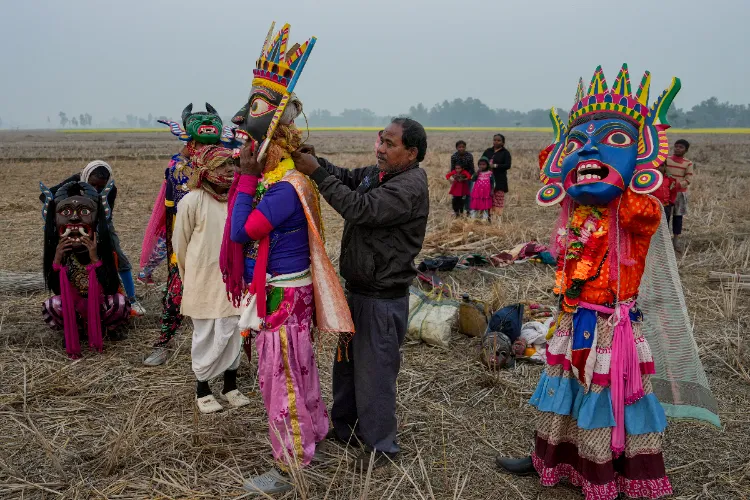
Sarkar leads a troupe of over 20 Gomira performers, custodians of a centuries-old masked dance tradition steeped in ritual, myth and agrarian belief. The dancers don heavy wooden masks, meticulously carved to represent figures such as Bura-Buri (symbolising Lord Shiva and Goddess Parvati), Goddess Kali, Narasingha — Vishnu’s fierce avatar — along with demons and animals. Once masked, performers are believed to enter a trance-like state, embodying the divine beings they portray.
As drummers strike the dhol and metallic clangs of the kashi — a brass plate played rhythmically with a wooden stick — pierce the air, the tempo intensifies. The beats grow faster, more insistent, driving the dancers into vigorous movements across the open clearing that serves as their stage.
Rooted deeply in Puranic symbolism, each sequence of Gomira is meant to drive away malevolent forces and invoke divine blessings for prosperity, particularly at the onset of a new agricultural cycle.
From the edge of the firelit circle, Sarkar murmurs instructions to performers waiting for their cue. He moves swiftly between the dancers, helping some change costumes in an improvised greenroom hidden by darkness among the trees. The performance builds toward a frenetic climax, and beads of sweat form on Sarkar’s brow despite the winter chill of Pous in the Bengali calendar.
Yet even as the energy peaks, a familiar worry lingers. Sarkar knows that once the current set of village programmes ends, opportunities will thin out. Fresh bookings are unlikely until Chaitra — the final month of the Bengali year — when the Gajan or Charak festival brings a surge in demand, often for all-night performances. After that, the cycle pauses again until Durga Puja months later.
“I learnt every step, every mudra, from my father — who learnt it from his own father,” Sarkar said. “This tradition runs in our blood. I’m preparing my son to carry it forward.”
But not all families feel the same pull.
“Many fellow artists tell me their children don’t want to continue,” he added. “They don’t see a future in it.”
Believed to be more than 150 years old, Gomira today faces dwindling interest and erratic income. Younger performers are often unwilling to commit to year-round training for a dance that is physically demanding and offers work only in brief seasonal bursts.
“We farm during the rest of the year, but our practice never stops,” Sarkar said. “Still, I don’t know how long this can continue. Even in villages, audiences are losing interest.”
There is a quiet irony in watching Sarkar’s troupe walk back after an overnight performance — masks and costumes still on — through mustard fields glowing yellow under the morning sun, heading toward their home village of Khagail. The land looks fertile, abundant, yet the art born from it struggles to survive.
“In the off-season, we depend on government events and political campaigns,” Sarkar said. “But people’s attention spans are shorter now. Long performances are cut down to 15 or 20 minutes.”
Once widespread across Dinajpur and neighbouring districts of north Bengal, Gomira has largely retreated to the Kushmandi block. Barely a hundred dancers remain, spread across a handful of troupes.
In Khagail, 29-year-old mask-maker Loknath Sarkar carefully applies natural vegetable dyes to freshly carved faces. His hands move with precision as he works on wood sourced from mango, neem or kadam trees.
“We don’t dilute our craft,” he said. “Some use cork instead of wood to cut costs, but that’s a shortcut. We have to protect the authenticity.”
The Geographical Indication (GI) tag awarded to Gomira masks in 2018 has offered some recognition and protection, Loknath acknowledged, though it has not translated into sustained livelihoods.
Madhab Sarkar said his troupe has performed in cities like Delhi, Goa and Kolkata, showcasing Bengal’s folk heritage beyond the state. Such invitations, however, remain rare.
With state elections approaching, Sarkar hopes political programmes will once again bring temporary relief during the otherwise dry months.
“We perform before speeches begin,” he said with a faint smile. “We finish fast, clear the stage — but at least the payments help keep the art alive.”
ALSO READ: India’s-EU landmark FTA to spur growth, jobs, increase New Delhi's relevance
For Gomira’s remaining practitioners, survival now depends not just on devotion and discipline, but on whether changing audiences can still find meaning in ancient rhythms masked by time.












_(2).webp)