

Ehsan Fazili/ Srinagar
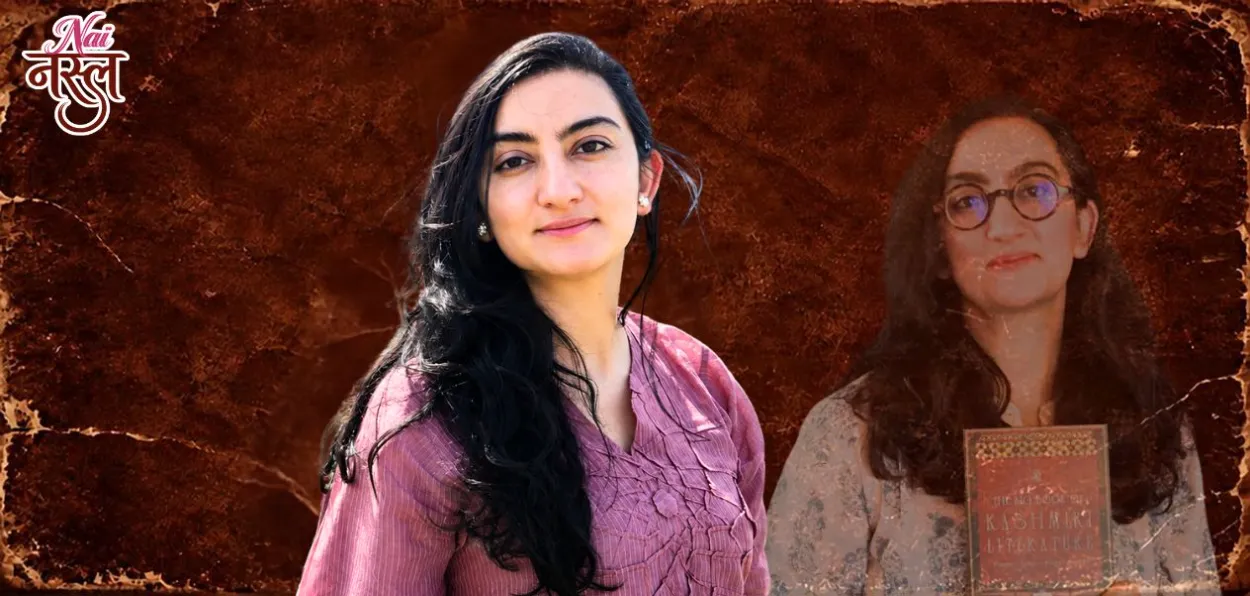
An anthropologist, writer and translator, Onaiza Drabu’s latest book, The Big Book of Kashmiri Literature, a collection of 30 Kashmiri literary works over the past seven centuries, was launched in Srinagar late last month on September 24.
The anthology of literary works in the Kashmiri language has gained accolades for the young writer and author, who has to her credit many written works, books and articles over the last two decades. These literary works in Kashmiri written over the centuries comprise poems, songs, plays and stories.
Through her works, Onaiza Drabu “tries to make sense of the world around” her through language and literature. Her first book, a retelling of Kashmiri folklore, The Legend of Himal Nagrai, was published in 2019 by Speaking Tiger, a book that reflects on Kashmiri culture and that fascinates her the most. Himal and Nagrai is a classic Kashmiri folktale about an immortal serpent prince and a human princess.
 Author Onaiza Drabu
When asked about the idea that led to writing The Big Book of Kashmiri Literature, Onaiza Drabu told Awaz-The Voice that having been “keen to spend time reading Kashmiri literature”, it was a lucky chance.
Her editor, Moutushi Mukherjee, came up with the idea, on a recommendation from writer Basharat Peer to compile it, she added. “For Kashmiri, I decided the structure based on my knowledge and approach. I first drew up the table of contents of what would be the book based on what I as a reader would enjoy, but also as an editor I had a few aims with this”, she said.
Onaiza added that she wanted to keep poetry and rhyme inherent in the language at the centre of it. “I wanted all genres represented. I wanted a range of writers represented - those who publish within the traditional publishing ecosystem and outside of it. I also wanted a range of translators and translation styles. So, it is an assemblage of translators, genres”, she said.
 Onaiza Drabu at a book release function
On the challenges faced in the process of working on this collection, Onaiza said that “collecting the works was the easier part, but the labour involved in anthologising these last few years was wider. Especially with the range of writers and translators involved in the book - across geographies, time zones and time periods”, she said.
The beginning, she said, was made by reading literary histories in Kashmiri, in English, in Urdu. Then there was the involvement of translators, and she had the privilege of having guides like Prof Neerja Mattoo, to whom she could turn.
“Because I had been reading for many years, I had collected books I could start with. I also accessed libraries at the Cultural Academy, University of Kashmir, public libraries in Srinagar, Sahitya Akademi and other personal collections. I had a lot of conversations with people who would lead me to places”, she said.
Onaiza Drabu said that “more difficult than finding the works was finding copyright holders and tracing them and having conversations. A process full of adventures and stories of its own, I have built some beautiful friendships over the years with families of writers, introducing in some cases, the grandchildren of writers who are now reading their grandparents’ works in English for the first time”.
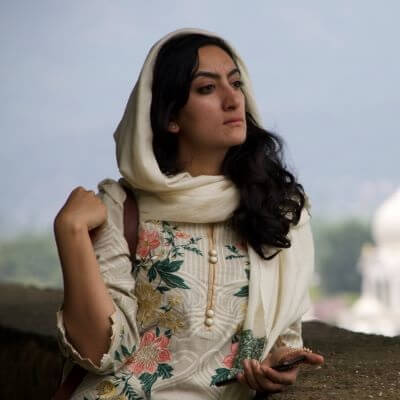 Onaiza Drabu
Onaiza’s written works include an essay in the Violent Phenomena: 21 Essays on Translation published by Tilted Axis Press, and her work has appeared in Asymptote Journal, Guernica, Inverse Journal, amongst others. She co-curates a newsletter called ‘Daak’, on South Asian literature and art. She runs a Consultancy that uses anthropology for business and works remotely, living between Srinagar and Lucknow.
“I have always been a keen reader and grew up reading a lot, so I had always wanted to write”, she told Awaz-The Voice.
Recalling her school days, Onaiza said: “I published my first article when I was only 16 in the Greater Kashmir”.
This, according to her, was the beginning that was followed by writing “for other publications on and off alongside work”,
“It is only much later in my late 20s that an opportunity came my way to retell Kashmiri folklore. And that is how it came about - one thing led to another”, Onaiza commented.
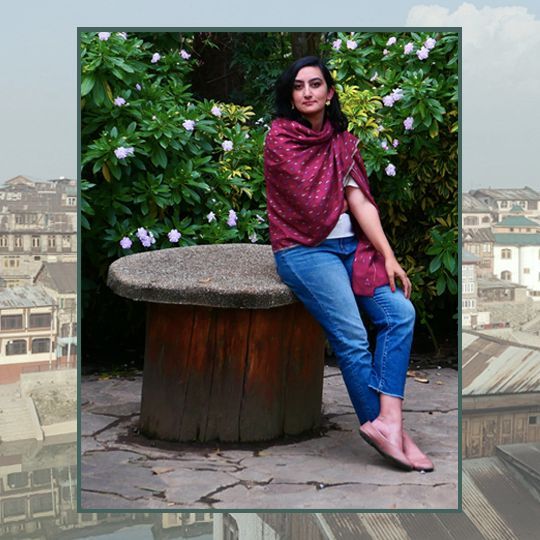 Onaiza Drabu
The young writer, born and brought up in the family of professionals, doctors, engineer in Srinagar, had her schooling at the Presentation Convent, where she passed the class 10th examination. After Matriculation, she moved to Delhi, where she completed her graduation in business. Interested in writing, she completed her post-graduation in Anthropology from the UK.
She studied Anthropology for her post-graduation.
When asked about the need to hone the art of writing among Kashmir youth, Onaiza Drabu said: “I think not just Kashmiri youth but youth globally need to work doubly hard to find their voice in the age of AI! It is tempting to resort to tools like ChatGPT to polish our writing, but the need is not to do to hone it the hard way”. In her message to the youth in Kashmir, she said: “I don’t know if I’m qualified to give them a message! But from what I see on social media and in interactions with them, I think we are in safe hands!”
READ MORE:Azhar Iqubal left IIT to launch Inshorts and make news a 60 word affair
On her parents’ role in giving a direction to her cravings, Onaiza said that “they have never understood what I do but have been supportive nonetheless. I come from a family of professionals, and for them my unconventional career choices have always been hard to explain to others. Yet I credit them for it as they enabled and created the atmosphere for these choices, particularly my grandmother”.