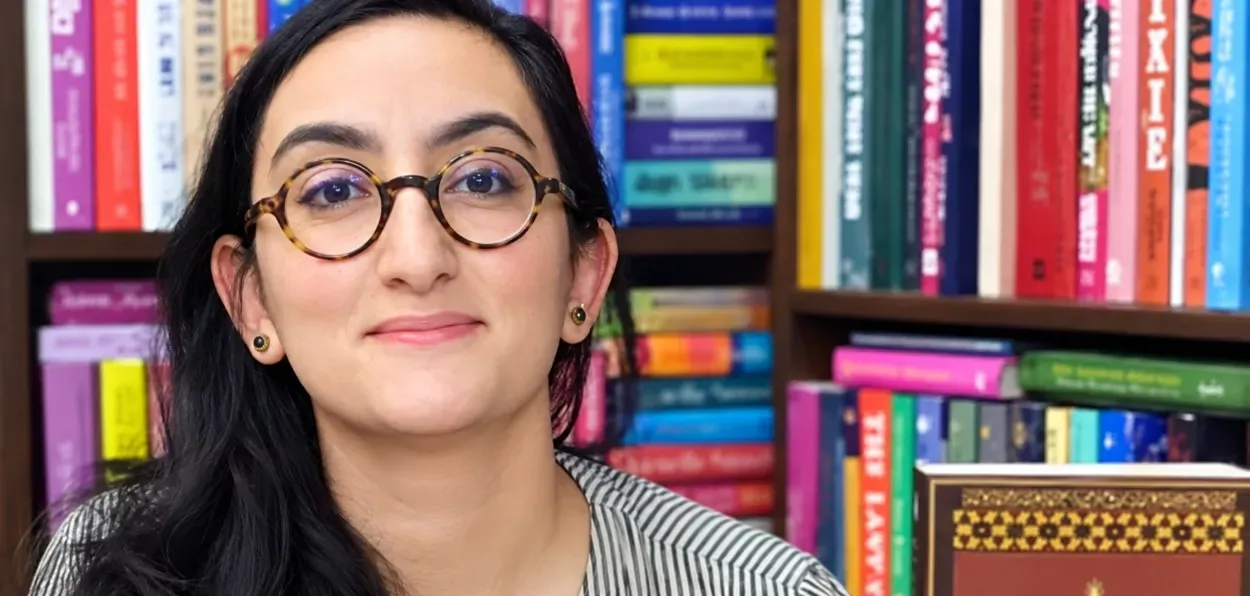
.webp "Sarah Mehmood, writer")
Saniya Anjum/Bengaluru
Sometimes, a story begins long before the writer realises they have one to tell.
For Bengaluru-based Sarah Mehmood, it began with reading. On an online platform where young writers worldwide published their novels chapter by chapter, she found herself drawn into their stories. But she also noticed what was missing: Muslim fiction rooted in the Indian context, particularly stories that reflected the lives and aspirations of young Muslim women.
“I stumbled upon writing by chance,” Sarah recalls.
What began as a reader's curiosity soon became a desire to create the stories she couldn't find. Her aim was not simply to increase Muslim representation, but to make it feel authentic.
“I wanted to contribute to Muslim representation in a way that felt authentic and positive,” she says, “while giving young women of our times relatable characters they could look up to and draw inspiration from.”
 Sarah Mehmood ast her graduation ceremony
That meant moving beyond familiar stereotypes. Sarah imagined women who could be modest in their dressing, devoted to their Creator and still ambitious about their futures. Women who could follow their faith unapologetically without being defined by it alone.
Her fiction explores young adult relationships and love from an Islamic perspective. Still, its characters are also navigating something more universal: the tension between who society expects them to be and who they want to become.
That tension comes sharply into focus in Bowled Over by the Broken.
The book grew from Sarah's desire to bring fiction closer to reality. She had encountered readers dismissing situations in books with the familiar observation: “But all of this just happens in stories.”
She wanted to prove otherwise.
“If readers are going to spend their time reading, I wanted the experience to be meaningful and worthwhile,” she explains.
So she drew from experiences that many young South Asian women may recognise, from being taunted for a brown complexion to the pressure to consider marriage soon after completing one's education, and the assumption that compatibility can somehow be manufactured after marriage.
These aren't extraordinary events. That's precisely what makes them powerful. They are the everyday comments, expectations and family conversations that can quietly shape how young women see themselves and their futures.
Sarah doesn't simply place these realities in a romantic plot. She uses them to question the assumptions surrounding relationships and marriage.
Most notably, she refuses to treat the wedding as the finish line.
“Most stories end at the wedding,” she says. “In this book, the most eventful part begins after it.”
It is a small shift in storytelling, but a significant one. The celebrations may end at the wedding, but real life, compatibility, expectations, compromises and the work of building a relationship begin there.
Running through Sarah's three self-published books, however, is a deeper thread: faith as something lived rather than compartmentalised.

“The crux of all my books is that you do not have to abandon your religion while seeking to accomplish your dreams,” she says.
For Sarah, that principle extends beyond fiction. She hopes her readers will think about how faith informs their routine decisions.
“When readers put the book down, I want them to reflect on how they can embody their faith in their everyday lives and decisions.”
That perspective is shaped not only by her personal beliefs, but also by her academic life.
Sarah is an Assistant Professor with a background in Food Science and Nutrition. Her academic training has influenced the way she observes situations, encouraging her to question, analyse and look beyond the obvious.
“My education as a whole has shaped the perspective I project through my writing,” she says. “It allows me to view situations critically and with an understanding that perhaps I wouldn’t have had otherwise.”
For someone balancing teaching, research and writing, there is little room for an empty calendar. Yet Sarah doesn't necessarily see her creative work as another demand competing for her time. Quite often, it is what helps her deal with everything else.
“On days when I think I’m too busy for anything apart from work,” she says, “those happen to be the same days when I find myself scrambling to pen down my thoughts as a means of destressing.”
That admission is honest. Writing isn't always something she schedules neatly around her professional life. Sometimes, it simply insists on being there.

And perhaps that's because, for Sarah, writing is less about adding another achievement to the list and more about having an outlet, a space to process thoughts, explore ideas and create something that might resonate with someone else.
She puts it more simply: “Painters paint, bakers bake, and writers write.”
It is a fitting description of a creative instinct that doesn't disappear simply because life gets busy.
Sarah's journey from an online reader to a self-published author and academic didn't follow a conventional route. There was no grand plan to combine fiction, research, and academia. It began with noticing a gap and wondering what might happen if she tried to fill it herself.
Today, her work occupies that space between the personal and the universal: faith and ambition, fiction and reality, tradition and individuality.
Perhaps that is what makes her stories worth paying attention to.
They don't ask young Muslim women to choose one identity over another. Instead, they make room for complexity, for dreams alongside devotion, ambition alongside values, and love alongside the realities that come after the happily ever after.
ALSO READ: JCO Salman Khan's Asiad rowing medal ignites his Olympic dream
Sarah started writing because she couldn't find enough stories that felt like hers.
Now, she is writing stories in which others might finally recognise themselves.







_(1)_(1).webp "Naib Subedar Salman Khan")
_(1).webp "Biki Hussain, a young entrepreneur from Bihdia village, Kamrup, Assam")
_(1).webp "Abdulqadir Indorewala. Para Swimmer")