

Saniya Anjum/Bengaluru
When Awais Ahmed talks about sending satellites into space, his story is not just about rockets, technology, and scientific ambition; it is about a curious boy from Aldur, Karnataka, a young entrepreneur navigating uncertainty, and an unexpected investment deal that gave one of his satellites a deeply personal name: Shakuntala.
Ahmed, the co-founder and CEO of Pixxel, grew up fascinated by the universe. His father brought home encyclopedias that introduced him to worlds far beyond his village. Ahmed recalled, “I was always fascinated with space.” At a time when internet access was limited, books became his window to possibilities he could only imagine.
His journey eventually took him to BITS Pilani, where he studied mathematics and became involved in student-led space technology projects. He also served as engineering lead for Hyperloop India, a student team that developed a transport pod for SpaceX’s Hyperloop competition. The experience taught him what it meant to attempt something without a ready-made blueprint. As he recalled, “You can’t Google how to build a Hyperloop pod."
 Awais Ahmed with his parents
That observation captures a lesson for young people growing up in an age of instant answers. Information is easier to access than ever, but meaningful innovation still requires experimentation, teamwork, and the courage to solve problems.
In 2019, Ahmed and his co-founder, Kshitij Khandelwal, established Pixxel with an ambitious vision: to build satellites equipped with hyperspectral imaging technology. Unlike conventional satellite imagery, hyperspectral imaging captures information across numerous wavelengths of light, helping reveal details about crops, vegetation, and environmental changes that might otherwise go unnoticed.
The ambition was enormous, but the practical challenges were equally significant. The young company needed investment, reliable launch opportunities, and the ability to navigate an emerging private space industry. Ahmed’s account of those early years reveals that "building a space technology company involves much more than scientific brilliance."
 Awais Ahmed in the laboratory
“We are always on the lookout for launch opportunities that work for our timeline and work for our cost,” he explained. His words offer a grounded perspective on entrepreneurship: big dreams must eventually meet budgets, deadlines, and difficult decisions.
Pixxel initially booked a launch through Russia’s Soyuz program in 2019. Later, following India’s 2020 announcement opening the space sector further to private participation, the company was approached about launching through ISRO. Ahmed recalled being delighted by the opportunity: “And we were more than happy to do that. Always was the intention.”
But plans did not unfold neatly. Delays affected the company’s launch schedule, and the team had to prepare for the possibility that its first demonstration mission might not succeed. Ahmed explained the logic behind arranging a backup, acknowledging the risks of spaceflight: “because that’s a non-zero probability in space.”
 Awais Ahmed
For young people who feel discouraged when plans go wrong, this detail matters. Preparing for setbacks is not the opposite of ambition. It is part of taking an ambition seriously.
Then comes the story of Shakuntala, perhaps the most unexpectedly personal chapter of Pixxel’s early journey. While trying to raise investment, Ahmed approached a potential investor after months of discussions. He wanted to turn the conversation into a decision.
He offered two promises in exchange for an investment. If he met Elon Musk again, the investor could come along to say hello. And the investor could choose the name of Pixxel’s next satellite.
The deal was agreed, and two brothers who invested in the company chose to name the satellite after their mother. Ahmed explained the reason simply: “Shakuntala is their mother’s name. So it was a gift for their mother.”
There is something remarkable about that detail. A satellite designed to travel into orbit carried a name chosen not by an engineer or a committee, but by two sons who wanted to honour their mother. Behind the complex machinery and technical calculations was a personal gesture, made possible by a conversation and a willingness to take a chance on a young company.
Ahmed also explained how that investment commitment helped make it easier to bring together a larger funding round. It is a reminder that entrepreneurship depends not only on ideas but also on relationships, credibility, and the ability to persuade others to believe in a future that has not yet materialised.
The practical side of space technology remained just as important. Discussing launch costs, Ahmed estimated that SpaceX’s rideshare program charged around $6,000 per kilogram at the time of the interview, with ISRO also offering relatively competitive prices. He explained that Pixxel selected launch opportunities according to cost, timing and the availability of rockets capable of reaching the required orbit. The company could not afford to leave completed satellites waiting indefinitely for a suitable launch.
Shakuntala eventually completed its mission and returned to Earth’s atmosphere in 2024. Its time in orbit was finite, but it formed part of Pixxel’s early development as the company continued building its satellite capabilities. The mission represents a broader truth about scientific progress: every experiment, whether successful or imperfect, can contribute to what comes next.
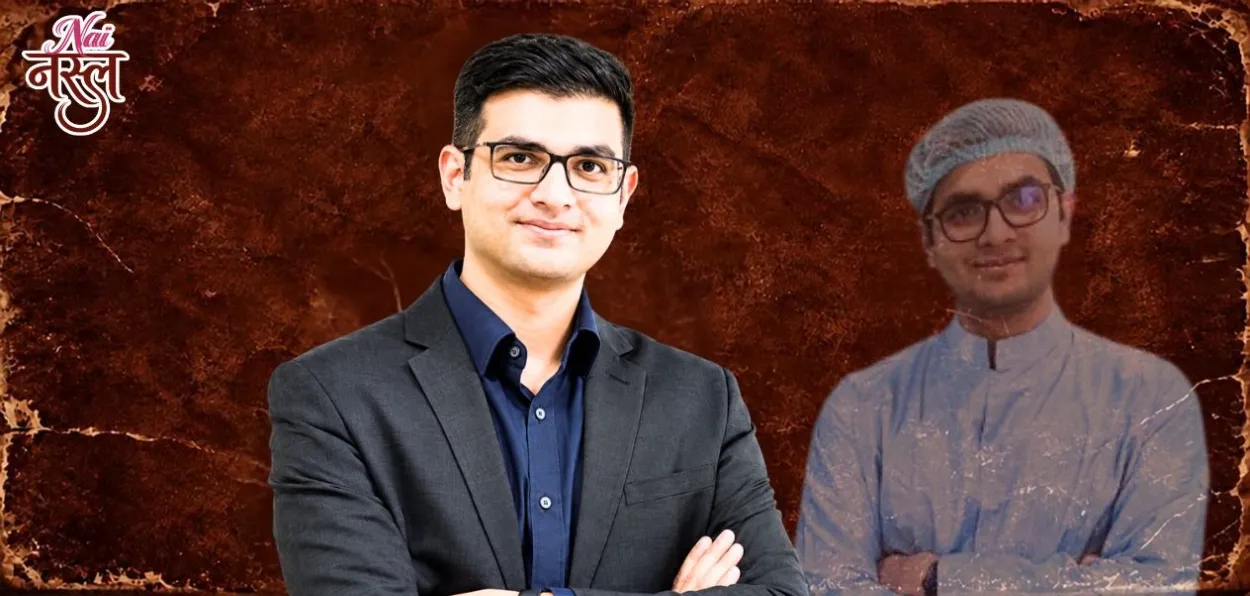
 Pixxel cofounders Awais Ahmed and Kshitij Khandelwal
For today’s youth, Ahmed’s journey offers a message that extends far beyond space. "You do not need to have every answer before beginning. You need the willingness to learn, the discipline to work through problems, and the confidence to ask others to support an idea. Not every young person will build satellites, but every young person can apply curiosity and determination to a problem worth solving."
From reading encyclopaedias in Aldur to leading a company that observes Earth from space, Ahmed’s journey shows how an interest can evolve into something far greater when it is pursued with purpose. His story is not about a straight road to success. It is about opportunities recognised, setbacks confronted, and decisions made before the outcome was certain.
And perhaps that is what makes Shakuntala’s story so memorable. It reminds us that even the most ambitious journeys are built on human connections. A childhood dream, a founder’s determination, two brothers’ faith in an idea, and a mother’s name all became part of the same story.
ALSO READ: Zahid Manzoor turns his disability into a voice against drugs
The stars may seem impossibly distant when we first look up at them. But every extraordinary journey begins somewhere ordinary, with a question, a little curiosity, and the courage to take the first step.