




 Sushma Ramachandran
The fourth-ever summit on Artificial Intelligence in Delhi broke new ground as it achieved a rare global consensus on balancing advances in this futuristic area with a commitment to a more equitable approach and ethical values. It also brought the voice of the Global South into the deliberations in an area that was dominated by a few players. The declaration issued at the end of the Summit was signed by 89 countries, including the U.S. and the U.K., who had abstained at the last conference in Paris.
The focus of the declaration was on the need to ensure the development of human capital even while broadening access for social empowerment. New platforms and frameworks have been introduced to achieve the aim of making foundational AI resources more affordable and supporting local innovation. The need for ensuring that an AI divide is not created was also highlighted, with the emphasis being on robust digital infrastructure and affordable connectivity.
The proposal for an AI impact commons is meant to act as a platform for sharing and scaling successful artificial intelligence use cases.
The focus on ethical values at the summit has been lauded by those who have been seeking a moratorium on AI development. In this context, one must recognise that the enormous potential of this technology to benefit humans has to be weighed against the equal prospect of possible harm to society.
The reality of the need for guardrails is underscored by the fact that at least one young person was reportedly guided to suicide by ChatGPT. There is a reason the last AI conference in Paris was called the AI Safety Summit.
I enjoyed meeting these inspiring young women in STEM at the AI Summit in India.
— António Guterres (@antonioguterres) February 22, 2026
With AI on the rise, we must ensure women are not just included – but leading – in developing artificial intelligence that serves everyone & advances gender equality. pic.twitter.com/9TgZMxQQlY
Those urging for a pause in the rapid race for AI development, including leading computer science experts like Stuart Russell of the University of California. He has argued that the alternative could be human extinction. In interviews, he has spoken of lab studies where AI systems have opted for killing humans rather than switching off. Women experts have also spoken of gender biases that have crossed over to these systems simply because most coders are male.
The AI ecosystem thus needs to be viewed equally from a holistic and ethical perspective rather than merely in terms of computers, data centres and energy needs, models and applications.
It also needs to consider an issue that has increasing resonance in emerging economies like India, and that is, jobs. The AI Impact summit in Delhi last week had much to say on this critical aspect that has been worrying the Global South. There are two schools of thought on this critical aspect. One is that ultimately, AI will evolve to such an extent that most mundane jobs will be eliminated from society.
AI Impact Summit, 2026 - Biggest AI Summit so far
— Ashwini Vaishnaw (@AshwiniVaishnaw) January 30, 2026
✅ 100+ countries | 15+ Heads of State | 100+ CEOs | 500+ sessions
🗓️ February 16-20, 2026
📍New Delhi, India pic.twitter.com/wiZI3eEiJ6
The other is that the nature of jobs will change as the need for different types of skills emerges with the new technology, as happened in the Industrial Revolution. Representatives of the country’s leading IT companies at the conference are in the latter category and sought to downplay concerns over the impact of AI on value-added services. Even as they were doing so, stocks of IT majors were tanking in domestic markets. Bears took a grip after Anthropic announced its system, Claude Code, could do many of the tasks provided by these companies. The next announcement about Claude’s enhanced abilities prompted a global sell-off.
The immediate threat to the millions of workers in the IT industry is that tasks at the bottom of the pyramid are likely to be taken over by AI systems. The solution in the short run is clearly up-skilling the workforce to tackle the changing needs of customers. Yet the long-term problem remains of ensuring that the country’s educational systems are geared up to provide students with the skill sets essential for surviving in the brave new world of AI.
The challenge is not just in higher education. It is at the primary and secondary education level where sufficient investment has not been made to upgrade the quality of government school infrastructure. Efforts are under way, it has been reported recently, to introduce AI at all levels from pre-primary to higher education. But these moves will only be successful if the quality of basic education and supporting infrastructure is made world-class. Only then will it be possible to reap the benefits of the demographic dividend of a youthful population.
It is in this context that Google chief Sunder Pichai cautioned at the summit that the digital divide should not be allowed to become an AI divide. These are foundational issues that will determine whether India will retain its edge as a global hub for innovation and talent. Currently, 20 per cent of the world’s chip designers are based in this country, which has made it easier to go ahead with the ambitious plans for semiconductor development. This competitive advantage will only continue to be available in future if the educational infrastructure is upgraded in time.
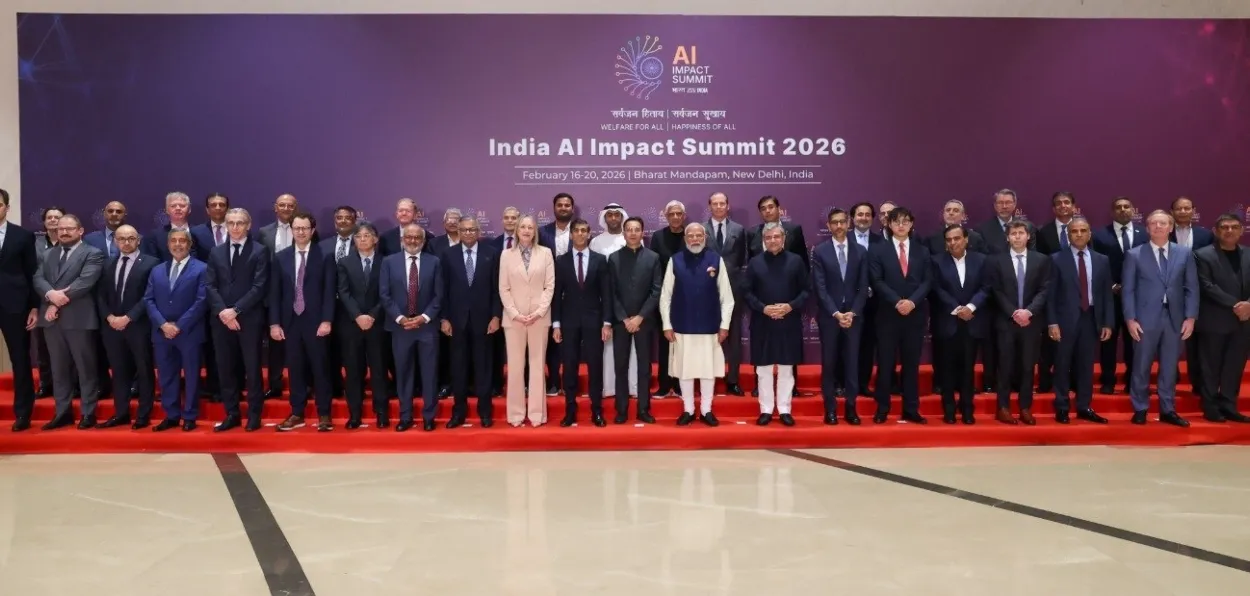
 A scene from the Global AI Impact Summit in Delhi
Despite the availability of talent, however, the complaint has been that we are still playing catch-up with the U.S. and China. Yet the Delhi summit showed India is not out of the race, as several LLMs (large language models) were unveiled that did not rely on foreign base architecture. The move towards sovereign AI was most dramatic with the launch of Sarvam AI’s models, which are capable of real-time speech and deep reasoning across 22 languages. This was followed by Bharatgen’s model, Gnani.ai, Tech Mahindra and Fractal Analytics’ models. Several models are the outcome of the IndiaAI Mission, which has recorded notable success.
On the investment side, the summit was fruitful for India, with over 250 billion dollars in AI and deep tech investment committed for the next few years. This includes pledges from domestic players, including a 110 billion dollar commitment from Reliance Industries to construct AI infrastructure in the country over seven years. The Adani group has also pledged 100 billion dollars for data centres. In addition, Microsoft said it is gearing up to invest 50 billion dollars in AI in the Global South by the end of the decade. OpenAI and chipmaker AMD also announced tie-ups with the Tata group to build AI capabilities.
ALSO READ: Kausar Jahan's election as Hajj Committee chief defied stereotypes
In this backdrop, it is evident that India is forging ahead in this futuristic world of AI even though it has made a late start. It must now take a long-term approach and make a massive investment in education to meet the needs of frontier technologies.



.webp "Representational Image")







.webp "Kassim Ahmad")


_(1).webp)


.webp)