Mrudgandha Dixit
Typically, if you go to any residential society in Pune during the evening, you will see the cars with residents returning from the office rushing in, senior citizens engrossed in conversations on the benches, and children playing and shouting in the open areas.
Lately, even the number of these playing children has dwindled because most young ones are opting to sit at home with their eyes glued to mobile or TV screens.
However, in some places, something extraordinary happens during the evenings; the children are seen holding plastic bottles, threads, balloons, and sometimes pieces of magnets in their hands. The different plot is unfolding there as the children are engrossed in the world of science.
The person behind this innovative project is Prof. Mujtaba Lokhandwala. Going beyond the rote learning happening all around, Lokhandwala Sir is doing the crucial work of awakening the natural curiosity in children's minds right in the courtyards of their societies.
In today's education system, even a fascinating subject like science is often learned just for securing marks and by rote. Children who can parrot "What is Newton's law?" often fumble when asked to explain how that law works.
Identifying exactly this flaw, Lokhandwala Sir started 'Activity-Based Learning' for kids in residential societies. He also serves as an official trainer for 'Activity-Based Learning' for the Department of Science and Technology, Government of India.
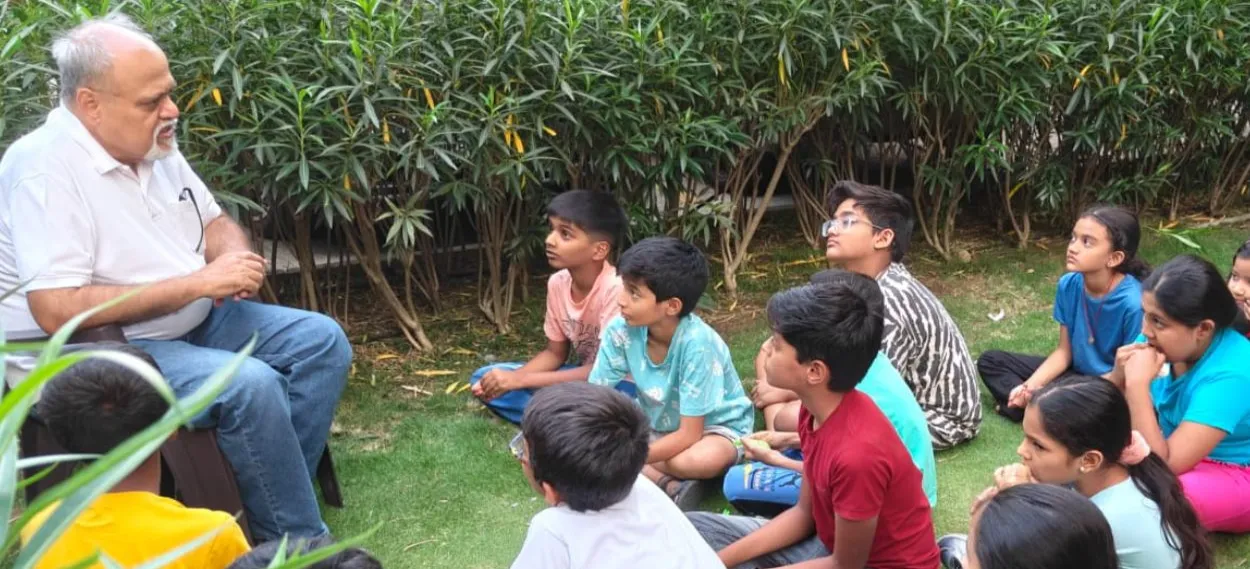
 Prof. Mujtaba Lokhandwala with young children in Pune Housing Society
Speaking on the importance of these practical experiments, Sir says, "The primary purpose of science is not to score marks in exams, but to look at the things happening around us with curiosity and a logical perspective. Rather than handing expensive gadgets to children, when a scientific rule is proven using simple household waste, it stays in their memory forever. A laboratory shouldn't be inside a closed room; it should be in the courtyards of societies and in the hands of the children."
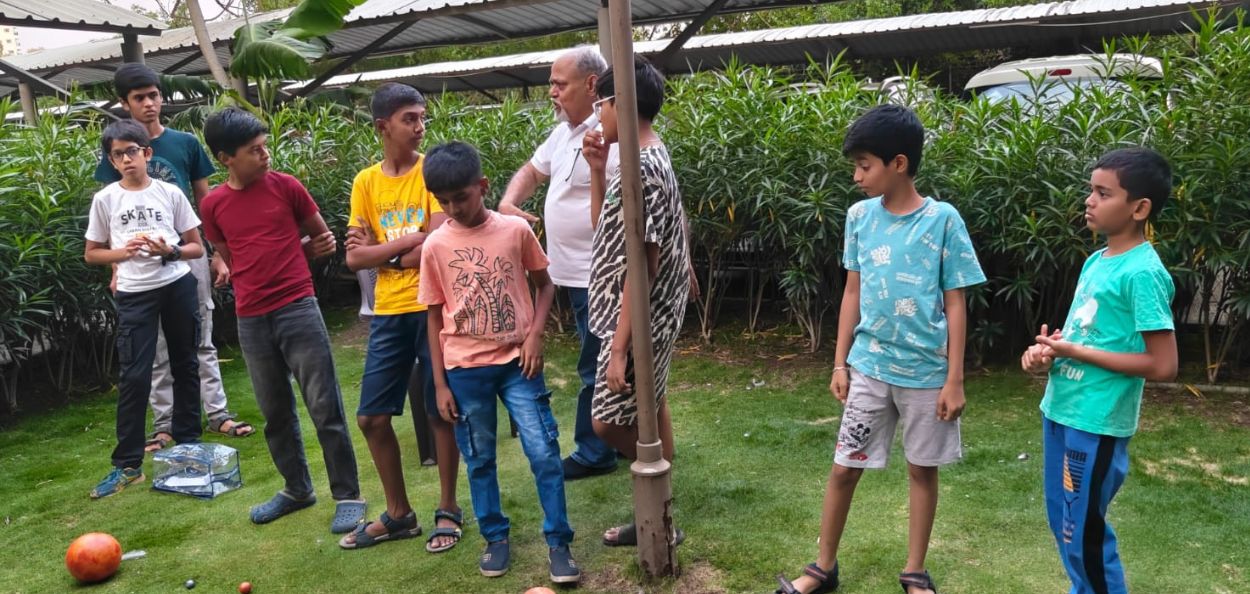
People from housing societies contact Sir to schedule his workshops. The children gather around him. Sir doesn't carry any thick, heavy books. He has simple, everyday items. With the help of a small straw and an empty bottle, he teaches the children how air pressure works.
Games revolving around how light reflects are played using two simple mirrors. While playing, children start learning the laws of gravity, motion, and energy. Here, no one has the fear of being 'right or wrong'. Children have absolute freedom to ask questions.
"It is only when a child asks 'Why is it like this?' that the scientific process truly begins," Sir says.
Once this workshop is conducted, a 'Science Club' is formed in that society. To keep it running, Lokhandwala Sir trains interested adults from among them. It is expected that the club takes the initiative to conduct at least one science activity with the children every month.
This initiative doesn't just stay grounded in earthly science; it reaches straight up to the sky. Astronomy is a subject very close to Lokhandwala Sir's heart. He has been the former President of India's oldest and most renowned astronomical institution, the 'Jyotirvidya Parisanstha'. These young kids reap the greatest benefits from his vast experience.
As darkness envelops the skies, the second phase of this initiative begins. Often, an astronomy class convenes on the society's terrace. When these children look through a telescope for the first time and see the craters on the Moon or the moons of Jupiter, the gleam of wonder and curiosity in their eyes is far greater than any bookish knowledge.
Where the Big Dipper (Saptarshi) is, how to identify the North Star (Dhruvatara), what the Pleiades (Krittika) constellation looks like—Sir narrates the stories behind these so fascinatingly that children, who otherwise wouldn't even tilt their heads up to look at the night sky, are now accurately identifying the positions of stars.
Speaking about this connection forged with the sky, Sir says, "Looking at the sky doesn't just mean memorising the names of constellations. It means understanding what our place is in this vast, endless universe. When a child looks at the miracles of the sky through a telescope, the joy on their face and the realisation they experience is immense."
Lokhandwala Sir has a degree in Mechanical engineering. He has taught engineering students for 18 years. Currently, he works as a 'mentor' to the CEOs of several large companies. Yet, despite all this, he answers an innocent question asked by a fifth-grade kid in society with the same seriousness and warmth.
Commenting on today's changing lifestyle, he says, "We say that today's generation is getting lost in screens, but have we given them an equally engaging and participatory alternative? These games of science do the job of taking children away from mobiles and connecting them directly with nature and science."
This initiative not only has a positive impact on the children but also begins to show a positive effect on the entire atmosphere of the society. Parents, who initially came just to see what their kids were up to, have now started taking an interest in these experiments themselves.
ALSO READ: Prof Nilofer Khan, first woman Vice Chancellor of the Kashmir University
Just as other cultural programs in society draw crowds, this 'Science Katta' (Science Corner) has started attracting them too. During holidays, instead of discussing which mall to visit, kids are now seen discussing which new experiment to conduct with Sir.
_(1).jpg "Visitors gather at the Santosh Mitra Square Durga Puja pandal, themed on the 150th anniversary of Vande Mataram and its historic role in India's freedom movement, ahead of the festival, in Kolkata")
.jpg "Gujarat’s women entrepreneurs bring their craftsmanship to life during Navratri")






.webp)