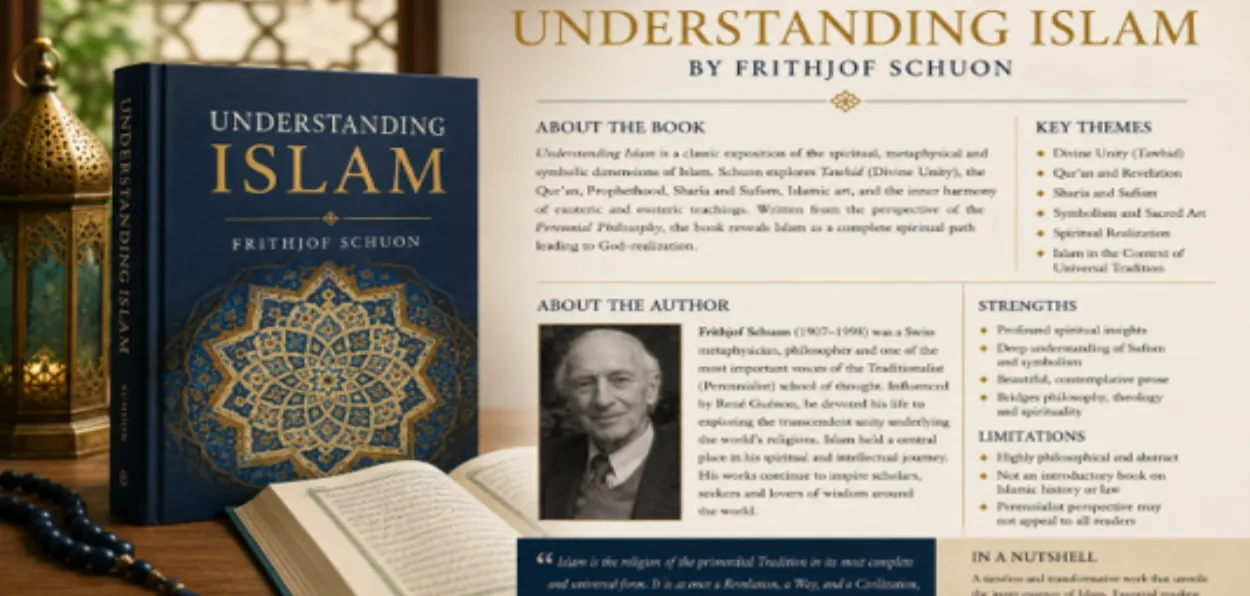
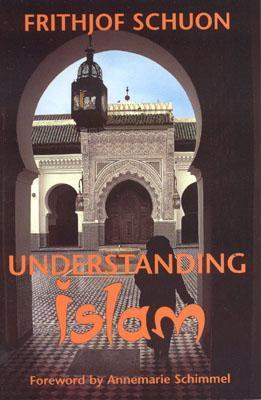
Understanding Islam by Frithjof Schuon is a deeply contemplative exploration of Islam’s inner meaning, spiritual symbolism, metaphysical foundations, and universal significance. Through elegant philosophical prose and penetrating spiritual insight, Schuon seeks to unveil what he regarded as the essential and timeless reality underlying Islamic revelation. The result is a work that continues to influence scholars, spiritual seekers, and students of comparative religion worldwide.
Born in 1907, Schuon was a Swiss philosopher, metaphysician, and one of the leading representatives of the Traditionalist or Perennialist School of thought. Deeply influenced by thinkers such as René Guénon, he devoted his intellectual life to exploring the transcendent unity underlying the world’s major religions. His writings combined metaphysics, spirituality, sacred art, symbolism, and comparative religion, while consistently emphasising the distinction between outward religious forms and inward spiritual essence.
Although Schuon wrote extensively on Christianity, Hinduism, Buddhism, and Native American spirituality, Islam occupied a central place in his intellectual and spiritual life. Closely associated with Sufism, he regarded Islamic spirituality as one of the clearest and most complete expressions of metaphysical truth. His major works, including The Transcendent Unity of Religions, Stations of Wisdom, and Understanding Islam, remain foundational texts within perennial philosophy.
One of the most remarkable features of Understanding Islam is its insistence that Islam must be understood not merely in sociological or historical terms, but spiritually and metaphysically. Schuon argues that modern discussions of religion often remain trapped in externalities — politics, legalism, or historical controversy — while neglecting the transcendent truths that give religion its sacred character.
He therefore approaches Islam from within its spiritual core, seeking to uncover the principles that animate its doctrines, rituals, and symbols.
For Schuon, Islam is fundamentally rooted in the doctrine of Divine Unity, or Tawhid, which forms both the essence of Islamic theology and the foundation of Islamic spirituality. His treatment of Tawhid is among the strongest aspects of the book. He explains that the Islamic testimony of faith — “There is no god but God” — is not merely a theological declaration but a metaphysical affirmation about reality itself. According to Schuon, the statement negates all forms of illusion, fragmentation, and false absolutisation while affirming the sole reality of the Divine.
Every aspect of Islamic life, from prayer and fasting to art and ethics, flows from this central recognition of unity. The strength of Schuon’s interpretation lies in his ability to connect theological doctrine with spiritual experience. He presents Islam not simply as a system of beliefs, but as a path toward realising the unity and transcendence of God in every dimension of existence.
Another major contribution of the book is its nuanced discussion of the relationship between exotericism and esotericism. Schuon distinguishes between the outward dimension of religion — represented by law, ritual, and communal structure — and the inward dimension, represented by spiritual realisation and mystical knowledge. He argues that Islam contains both dimensions in harmonious balance. The Sharia provides the external framework necessary for religious discipline and social order, while Sufism represents the inward path toward direct knowledge of the Divine.
In Schuon’s view, one of the great tragedies of modernity is the reduction of religion either to empty formalism or to vague sentimental spirituality. Islam, he contends, traditionally preserved a profound equilibrium between outer practice and inner realisation.
His discussion of Sufism is especially compelling. Schuon presents Sufism not as a marginal or optional aspect of Islam, but as its spiritual heart. He highlights practices such as remembrance (dhikr), contemplation, invocation, and spiritual discipline as means of transcending the ego and attaining closeness to God. Unlike many Orientalist writers who exoticised Sufism or detached it from Islamic orthodoxy, Schuon insists upon its organic relationship with Qur’anic revelation and Prophetic tradition. For him, Sufism is the inward flowering of truths already present within Islam itself.
The book also contains illuminating reflections on Islamic art and symbolism. Schuon argues that sacred art is not merely decorative; it is a visible expression of spiritual truth. Islamic architecture, calligraphy, geometry, and ornamentation reflect metaphysical principles of order, harmony, infinity, and unity. He interprets the abstraction characteristic of Islamic art as an effort to transcend materialism and direct consciousness toward the Divine.
These passages are among the most aesthetically rich sections of the work and demonstrate Schuon’s deep sensitivity to the spiritual dimensions of beauty. His treatment of sacred art anticipates later works by Seyyed Hossein Nasr, who similarly emphasised the sacred function of Islamic aesthetics.
One of Schuon’s greatest strengths as a writer is his ability to synthesise philosophy, spirituality, symbolism, and theology into a coherent whole. The prose of Understanding Islam is often poetic and meditative, yet intellectually rigorous. Rather than presenting Islam as an object of detached academic study, Schuon writes with reverence and existential engagement. As a result, readers encounter not merely information about Islam, but an invitation to contemplate its spiritual meaning.
At the same time, the book demands intellectual patience. Schuon’s style is highly metaphysical and frequently abstract, making the text challenging for readers unfamiliar with perennial philosophy or mystical theology. He often employs symbolic language and philosophical terminology that may appear dense to beginners. Unlike introductory works that explain Islamic history, jurisprudence, or doctrine in straightforward terms, Understanding Islam presupposes a reader willing to engage deeply with metaphysical ideas.
 A Kashmiri Muslim woman showing her ink mark after voting in Assembly elections
Consequently, the book is perhaps best suited to advanced readers, students of philosophy, and seekers interested in spirituality, rather than those looking for a simple overview of Islam.
Another important aspect of the book is its comparative religious perspective. Schuon consistently situates Islam within the broader framework of universal spirituality. He argues that all authentic religions originate in divine revelation and embody transcendent truth, though expressed through distinct forms and symbols. This perennialist perspective allows him to draw parallels between Islamic spirituality and mystical dimensions within Christianity, Hinduism, and other traditions. For Schuon, religious diversity reflects different modes of access to the same ultimate reality.
This universalist approach has been both admired and criticised. Admirers appreciate Schuon’s ability to foster interreligious understanding and highlight shared spiritual insights across traditions. His work has been especially influential among scholars of comparative religion and interfaith dialogue. Critics, however, argue that perennialism can blur important theological distinctions and underestimate the uniqueness of particular religious revelations.
Some Muslim scholars question whether Schuon’s emphasis on universal metaphysics sufficiently respects the doctrinal specificity of Islam. Others contend that his interpretation sometimes privileges mystical abstraction over the historical and legal realities central to Islamic civilisation.
Nevertheless, even many critics acknowledge the extraordinary intellectual depth of the work. Schuon writes with evident reverence for Islamic spirituality and with profound familiarity with Qur’anic symbolism, Sufi teachings, and classical metaphysics. His defence of sacred tradition against modern secular reductionism resonates strongly in an age marked by spiritual fragmentation and materialism. He challenges modern readers to reconsider religion not merely as a cultural identity or ethical system, but as a means of transcending the ego and attaining knowledge of ultimate reality.
 Indian Muslims
The enduring significance of Understanding Islam lies partly in its response to modern misunderstandings of Islam. In contemporary discourse, Islam is often reduced either to political conflict or legal rigidity. Schuon offers an alternative vision — one centred on contemplation, beauty, metaphysical depth, and spiritual universality. He presents Islam as a civilisation rooted in the remembrance of God and oriented toward inner transformation.
This perspective remains deeply valuable in a world where superficial representations of religion frequently dominate public discussion.
Moreover, the book possesses literary and spiritual qualities that distinguish it from ordinary theological writing. Schuon’s language often carries a contemplative rhythm that mirrors the themes he explores. His reflections on prayer, sacred beauty, and divine unity are written not merely to inform, but also to awaken spiritual intuition. Many readers describe the experience of reading Schuon as intellectually demanding yet spiritually elevating.
Understanding Islam remains a profound and enduring contribution to Islamic thought, comparative religion, and spiritual philosophy. Through this work, Frithjof Schuon sought to reveal the metaphysical essence and spiritual beauty of Islam beyond superficial interpretations and modern prejudices. Its exploration of divine unity, Sufism, sacred symbolism, and perennial wisdom offers readers a vision of Islam as a deeply contemplative and universal path rooted in transcendence.
ALSO READ: Naima Khatoon, AMU's first woman VC is injecting dynamism in varsity's culture
Although its abstract style may challenge some readers and its perennialist framework remains debated, the intellectual richness and spiritual insight of the work are undeniable. More than half a century after its publication, Understanding Islam continues to inspire scholars, seekers, and readers interested in the inner dimensions of religion and the timeless human quest for divine truth.


_(1)_(1).webp "Khanqah Emadia Qalandaria, Patna, Bihar")





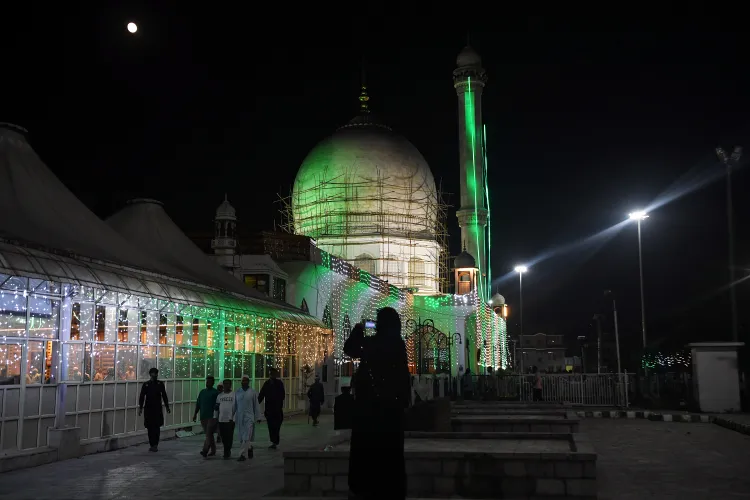
.webp "People offering Eid prayers at the Hazratbal shrine, Srinagar")

.webp "Representational image (File)")