Amir Suhail Wani
The life of Prophet Muhammad belongs to history, but its significance is not confined to it. More than 14 centuries after his passing, the Seerah (prophetic biography) continues to address questions that remain relevant to humanity: How should we treat those who are different from us? How should power be exercised? What is the place of reason in religion? How should women be treated? How can societies manage disagreement without descending into hostility? And how can moral and spiritual values be translated into everyday social life?
The enduring relevance of the Seerah lies in a simple but profound fact: the Prophet did not merely preach values; he embodied them. His teachings were reflected in his family life, relationships, dealings with opponents, treatment of the poor and vulnerable, conduct in moments of victory and defeat, and approach to resolving disputes.
Perhaps the most important of these values is mercy. The Qur'an describes Muhammad as a mercy to the worlds. His mercy was not restricted to his followers; it extended to children, women, the poor, servants, neighbours and even those who opposed him. His response to the people of Ta'if, after enduring rejection and physical abuse, remains one of the most powerful examples of restraint in religious history.
When offered the possibility of their destruction, he chose hope over revenge. His victory over Mecca likewise demonstrated that possessing power does not require surrendering to vengeance. Whenever justice permitted, he sought reconciliation.
This distinction between justice and revenge has enormous relevance in a world increasingly marked by polarization. Communities divided by religion, caste, ethnicity, language or political allegiance often find it easier to demonize one another than to understand one another. The Prophetic example suggests that disagreement does not have to destroy human dignity. Justice remains necessary, but it need not become hatred.
The Prophet was deeply attentive to individual suffering. He visited the sick, cared for orphans, encouraged generosity towards the poor and warned his followers against humiliating or exploiting the vulnerable. His teaching that those who do not show mercy will not be shown mercy establishes compassion not as sentimental weakness but as a fundamental principle of moral life.
This has particular resonance in a diverse society such as India, where people belonging to different faiths, communities, languages and social backgrounds share the same public space. The Prophetic model does not require uniformity before coexistence becomes possible. It calls instead for recognition of human dignity despite difference.
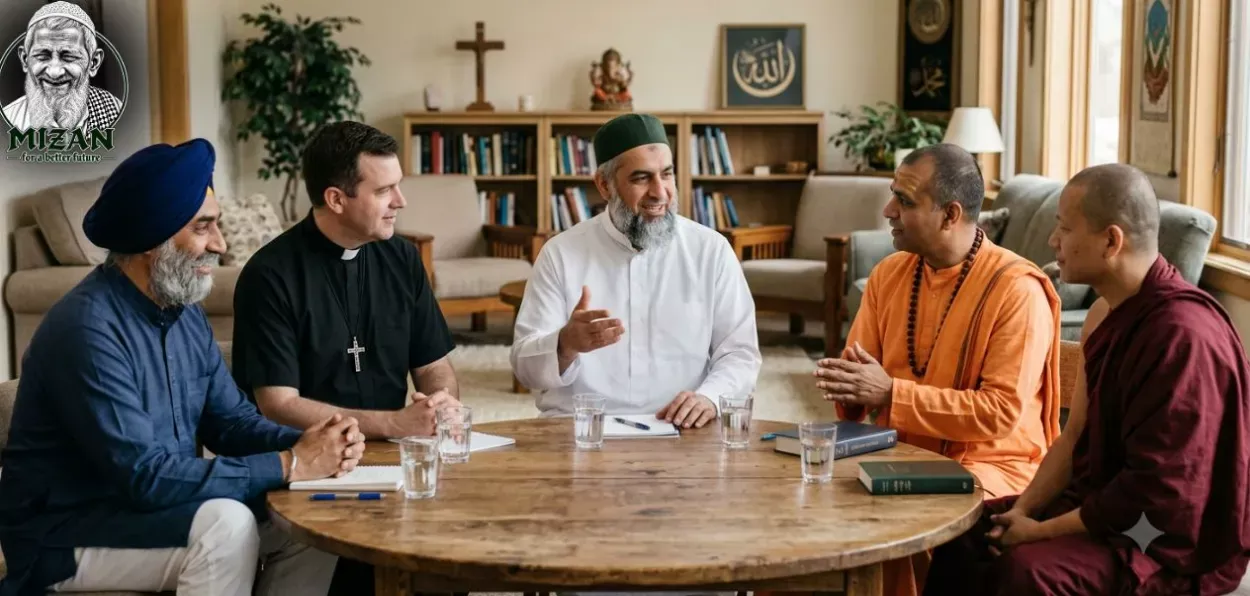
The Seerah also offers a powerful lesson in coexistence and respect for others. The Prophet lived in a religiously plural environment and entered into agreements with communities that did not share his faith. The Constitution of Medina, whatever its precise historical interpretation, remains an important example of an attempt to organize a politically diverse community around shared obligations and mutual security.
His interactions with Christians, Jews, polytheists and others demonstrate that theological disagreement need not automatically become social hostility.
For contemporary humanity, this is crucial. Pluralism cannot survive merely through tolerance in the narrow sense of "putting up with" someone else's existence. It requires respect, fairness and recognition that one's neighbour possesses the same fundamental human dignity that one claims for oneself. In a country as religiously and culturally plural as India, this principle has particular practical importance.
Another remarkably modern dimension of the Prophetic example is its encouragement of reason, reflection and intelligent engagement with circumstances. Islam's intellectual vocabulary gives an important place to aql—human reason—and the Qur'an repeatedly asks human beings to think, reflect, observe, deliberate and learn from history. The Prophet himself did not treat every worldly question as though it had only one predetermined answer. He consulted his companions, listened to advice and, in matters of worldly expertise, recognized the value of human experience.
The well-known incident concerning date-palm pollination is instructive. When his companions acted on an initial suggestion and the agricultural result was disappointing, the Prophet clarified that matters of worldly technical expertise belonged to those who knew them best. The larger principle is important: faith does not require intellectual paralysis. Religious conviction and rational inquiry need not be enemies.
The Prophetic practice of shura, or consultation, reinforces this point. The Qur'an praises those whose affairs are conducted through mutual consultation, while the Prophet himself consulted his companions even though he was the recipient of revelation. This offers a valuable lesson for contemporary societies: good decisions require listening, evidence, experience, deliberation and openness to correction.
The broader Islamic tradition of ijtihad is also significant. At its best, ijtihad represents an effort to apply enduring principles to historically new circumstances. The world of the seventh century did not contain modern medicine, artificial intelligence, constitutional democracy, environmental crises, digital communication or modern financial systems. Yet Muslims today must address these questions. Fidelity to principles does not mean refusing to think about new circumstances; it means carrying those principles intelligently into changing realities.
The Prophetic emphasis on knowledge is therefore inseparable from the contemporary importance of critical thinking. The Qur'anic instruction not to follow that of which one has no knowledge, along with its repeated invitation to reflection, establishes an intellectual ethic that is especially relevant in an age of misinformation, conspiracy theories and social-media outrage. A religious person should not become less careful about evidence simply because the subject is religious. Truthfulness demands greater intellectual responsibility.
The question of women's dignity and rights provides another important dimension of the Seerah. The Prophet emerged in a society where women could face severe social and economic disadvantage. The Qur'anic reforms associated with his mission established women's rights to inheritance, property and financial entitlement and prohibited treating women as inheritable possessions. Qur'an 4:19 explicitly rejects the practice of inheriting women against their will, while Qur'an 4:11 establishes defined inheritance rights for women.
The Prophet also insisted upon consent in marriage. A well-known hadith in Sahih al-Bukhari states that a woman should not be married without being consulted. These principles remain relevant when societies across the world continue to confront forced marriage, domestic violence, denial of education and economic dependence.
The Prophetic example also demonstrates that women were not intended to be passive recipients of religious knowledge. Aisha became one of the most important authorities in Hadith, jurisprudence and interpretation of the Prophet's life. Women in the earliest Muslim community participated in intellectual, economic and social life. The contemporary Muslim world therefore has considerable resources within its own tradition for affirming women's dignity, education, intellectual participation and agency.
The value of Ihsan perhaps brings all these qualities together. Ihsan means doing what is beautiful, excellent and morally generous. It goes beyond the minimum requirements of justice. Justice asks us to give another person what is due; ihsan asks us to go beyond the minimum and act with grace.
This principle can transform public as well as private life. A society governed only by legal obligation may remain technically just while becoming emotionally harsh. Ihsan introduces kindness into law, generosity into economics, civility into disagreement and dignity into human relationships. It is the difference between merely avoiding injustice and actively doing good.
The relevance of the Seerah ultimately lies in this integration of values. The Prophet did not separate spirituality from social responsibility, worship from ethics, reason from faith, or personal morality from public conduct. His life demonstrates that religion becomes meaningful when it produces better human beings and healthier societies.
ALSO READ: 10 recent English books on Prophet Muhammad
These are not exclusively Muslim concerns. They are human concerns. And in a plural, democratic and culturally diverse society such as India, they possess special contemporary relevance. The Seerah can become a bridge between faith and citizenship, tradition and modernity, identity and coexistence, provided it is approached not merely as a catalogue of historical events but as a living ethical example.

_(1).jpg "Visitors gather at the Santosh Mitra Square Durga Puja pandal, themed on the 150th anniversary of Vande Mataram and its historic role in India's freedom movement, ahead of the festival, in Kolkata")

.jpg "Gujarat’s women entrepreneurs bring their craftsmanship to life during Navratri")






_(4).webp)
_(2).webp)