Uzma Khatoon
Do Muslims read the Qur’an directly, or do we read it through layers of interpretation? This question is important today. Most of us do not approach the Qur’an alone. We read translations, listen to sermons, and study explanations written by scholars. For many centuries, these scholars were almost always men. As a result, our understanding of the Qur’an has largely been shaped by male perspectives.
The Quran addresses all humanity. It speaks to believing men and believing women together and repeatedly emphasises justice, mercy, and moral responsibility. Yet the tradition of tafsir developed in societies where religious authority, education, and legal scholarship were mostly controlled by men. This social reality naturally influenced interpretation. Women’s lived experiences were often missing from formal scholarship, not because the Qur’an excluded them, but because historical structures did.
A key principle must be clearly understood: the Qur’an is divine revelation, but tafsir is a human effort to understand it. Revelation is sacred and unchanging; interpretation is shaped by language, culture, and history. Classical scholars were sincere and knowledgeable, but they were also products of their time. Some of their explanations reflected the social norms of patriarchal societies.
Recognising this distinction does not weaken faith. In fact, it strengthens it. It allows Muslims to remain loyal to the Qur’an while revisiting interpretations that may have been influenced by historical assumptions. If tafsir is human, then it can be re-examined. This understanding opens space for women to participate in interpretation without rejecting tradition.
The Qur’an itself presents women as moral and spiritual agents. Maryam is described as chosen and purified (3:42–43). The Queen of Sheba appears as a thoughtful and wise political leader (27:23–44). The Qur’an repeatedly pairs believing men and believing women in responsibility and reward (33:35). It also describes them as allies who support one another in promoting good and preventing wrong (9:71).
Actor Yami Gautam as Bano in Haq, a movie based on the rights of women in Quran speaks eloquently on the Quran and Constitution being in sync on rights of Muslim women:
‘Haq’ is a beautiful movie on the issue of talaq and the provision of maintenance allowance to a divorced woman in Islam. Yami Gautam Dhar who played the role of Shazia Bano has acted superbly. Wish divorce were not a stigma for women and the laws were not tilted in favour of… pic.twitter.com/VCSgqJhCl9
— Abdul Majeed Khan Marwat (@koolkopper) January 22, 2026
These verses show moral equality before God. Despite this, many classical discussions about women focused mainly on marriage, modesty, inheritance, and family law. Broader themes such as leadership, public participation, and social justice were often discussed from male-centred viewpoints. Over time, this limited framework shaped Muslim societies and sometimes gave religious authority to unequal power structures.
This approach does not reject classical scholarship but re-examines it critically. It assumes that while revelation is divine, interpretation is human. When we apply this model to verses related to gender, we are not changing the Qur’an; we are reassessing inherited explanations.
The importance of women’s perspectives becomes clearer when we examine contested verses, especially Qur’an 4:34, which states that “men are qawwamun over women.” This phrase has often been interpreted to mean that men have authority or superiority over women. Some classical interpretations even allowed a form of physical discipline within marriage based on the word daraba. Such readings have had deep social consequences.
However, when we apply careful and contextual interpretation, the meaning becomes more nuanced. The word qawwamun comes from the root q-w-m, which relates to responsibility, maintenance, and support. The verse itself connects this role to financial responsibility: “because they spend from their wealth.” In seventh-century Arabia, men were generally the economic providers. The verse addressed that social structure. Reading qawwamun as permanent superiority goes beyond what the text directly states. The verse links responsibility to economic obligation, not to inherent male worth.
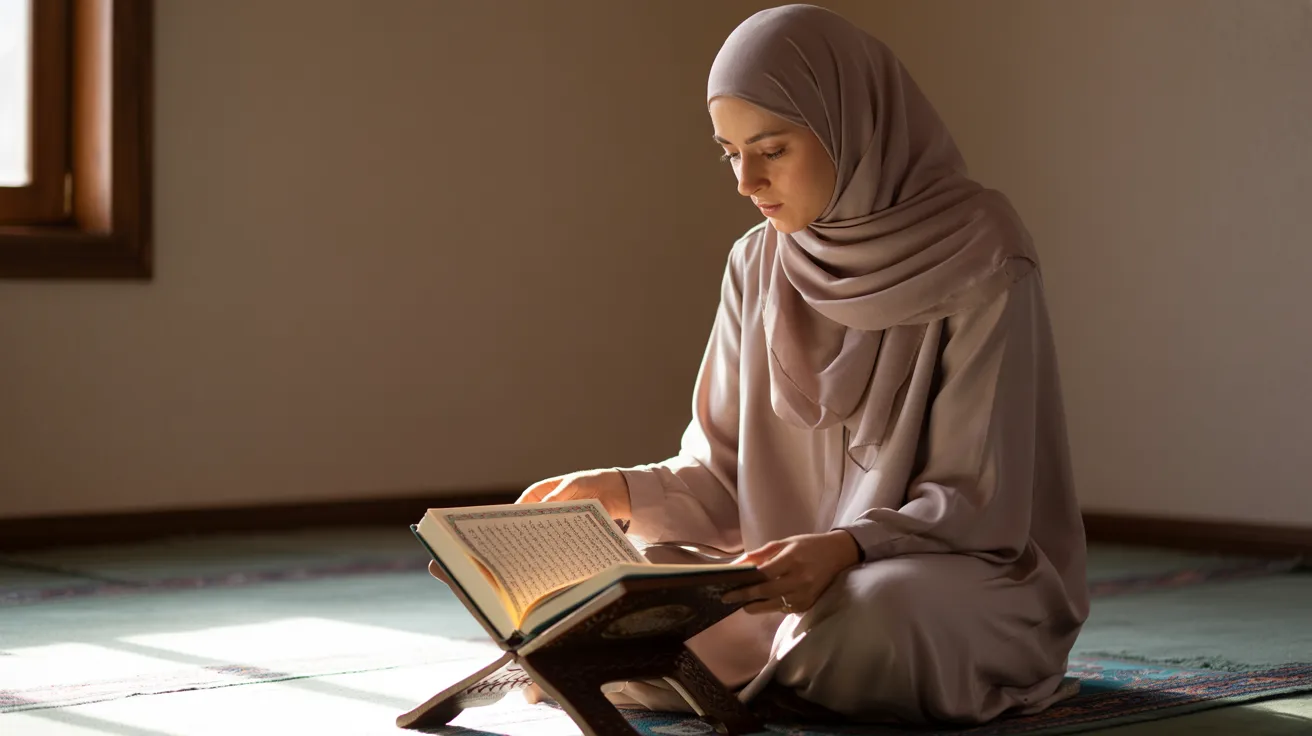
A woman reading Quran (AI-generated image)
Moreover, the Qur’an must be read as a whole. Any interpretation of 4:34 must align with its broader ethical vision. The Qur’an emphasises justice (adl), mercy (rahma), and kindness in marriage. It says, “Live with them in kindness” (4:19) and describes marriage as a relationship of tranquillity, affection, and mercy (30:21). An interpretation that justifies domination or violence contradicts these wider principles. The example of the Prophet Muhammad also matters. Historical reports consistently show that he treated his wives with respect and did not practice violence against them. Interpretations that normalise harm must therefore be questioned in light of both Qur’anic ethics and Prophetic practice.
Re-examining such verses does not mean rewriting the Qur’an. It means distinguishing between divine revelation and inherited explanations. Muslim scholars have always engaged in interpretation according to their context. Today’s scholars, including women, continue that same intellectual effort. Women were not completely absent from Islamic history. ‘A’ishah was a major authority in hadith and legal matters, and many women transmitted knowledge in early Islamic centuries. However, over time, institutional religious authority became more restricted. This exclusion was historical, not scriptural.
In recent decades, scholars such as Amina Wadud, Asma Barlas, and Fatima Mernissi have argued that patriarchal readings should not be confused with divine intent. They emphasise that the Qur’an is built on the principle of tawhid. If God alone is supreme, no human being, male or female, can claim inherent superiority over another. Moral equality flows naturally from belief in one God. Some critics worry that reinterpretation may become subjective or driven by modern trends. This concern deserves attention. Interpretation must remain disciplined, rooted in the Arabic language, historical awareness, and coherence with the Qur’an’s overall message. Including women’s voices does not mean abandoning scholarship. It means enriching it with experiences that were previously overlooked.
Modern societies face realities that earlier jurists did not encounter in the same way: awareness of domestic violence, women’s education, economic independence, and public leadership. These changes require thoughtful engagement with the Qur’an. If half of the Muslim community is excluded from interpretation, the intellectual growth of the ummah remains incomplete. The Qur’an invites all believers to reflect and use reason. It does not restrict this call to one gender. If believing men and believing women share moral responsibility, they should also share interpretive responsibility. Throughout Islamic history, new contexts have produced new understandings. This has always been part of the tradition’s dynamic nature.
The Qur’an itself does not change, but human understanding develops over time. Recognising women’s role in interpretation is not a break from tradition; it is a continuation of its living spirit. A community that listens to both men and women will understand the divine message more fully. If the Qur’an is a universal guidance for all times and people, its interpretation must reflect the diversity of the community.
By clearly distinguishing revelation from interpretation and by reading contested verses within the Qur’an’s broader moral framework, Muslim society can remain faithful to the text while allowing intellectual renewal. A balanced future requires shared scholarship, ethical seriousness, and humility before the word of God. Only then can the Qur’an’s message of justice and mercy shine completely in our time.
Dr Uzma Khatoon, former faculty at Aligarh Muslim University, is a writer, columnist, and social thinker.

.webp "Union Home Minister Amit Shah")