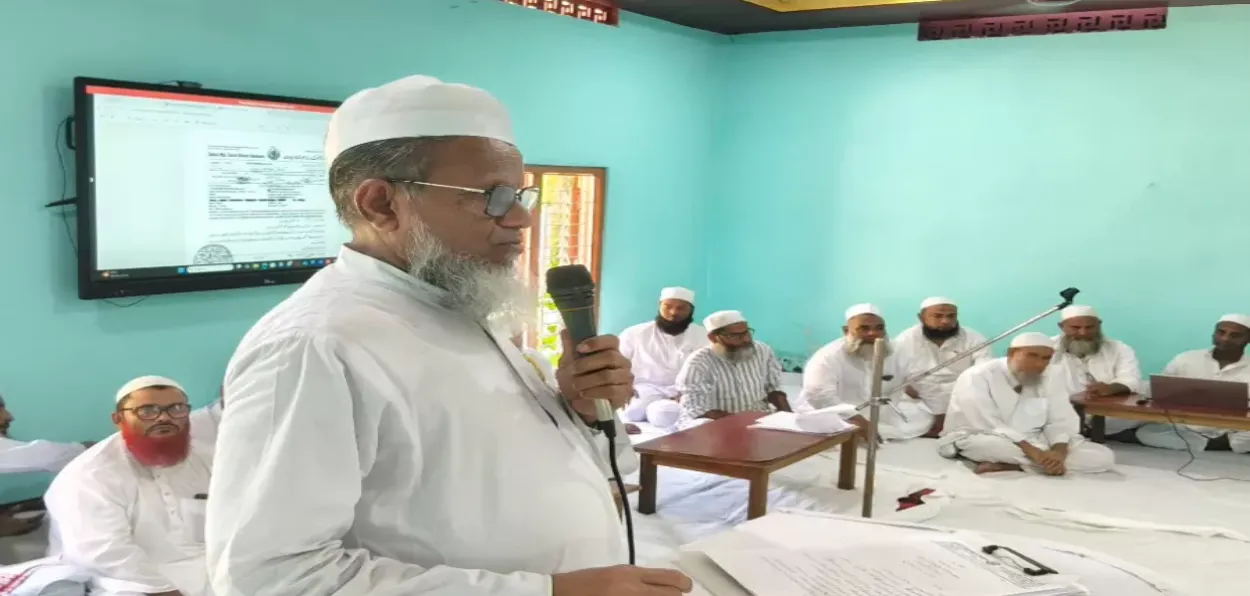
.webp "Haji Syed Salman Chishty, 26th-generation Gaddi Nashin of Ajmer Sharif and Chairman of the Chishty Foundation")
Touba (Senegal)
India's Sufi heritage received a significant international platform as Haji Syed Salman Chishty, 26th-generation Gaddi Nashin of Ajmer Sharif and Chairman of the Chishty Foundation, represented India at the 132nd Grand Magal of Touba in Senegal, following an official invitation from the country's Board of Religious Affairs.
The Grand Magal, one of Africa's largest spiritual gatherings, brought more than 2.5 million pilgrims to Touba this year. The 2026 edition was held under the theme "The Virtues" and commemorated the 1895 exile of Shaykh Ahmadou Bamba Mbacke (RA), founder of the Mouride Sufi Order.
Chishty was received as an official guest of the Khadim ur-Rasool (Servant of the Messenger) and met the Caliph General of the Mourides, Shaykh Serigne Mountakha Bassirou Mbacke, along with the Caliph General's Spokesperson and President of the Grand Magal Organising Committee, Shaykh Serigne Bassirou Mbacke Abdou Khadre.
During his visit, Chishty also engaged with senior Senegalese leaders, resident ambassadors, members of the diplomatic corps, Sufi masters, scholars and delegations from West Africa, the Maghreb and the wider Afro-Arab world.
The visit highlighted longstanding spiritual parallels between Ajmer Sharif and Touba, two major centres of Sufi tradition separated by thousands of kilometres but united by an emphasis on service, hospitality, learning and peaceful coexistence.
Khwaja Moinuddin Chishty, whose shrine at Ajmer has for centuries attracted devotees from different faiths, is widely associated with the message of generosity, affection and hospitality. Shaykh Ahmadou Bamba, meanwhile, established the Mouride tradition around spiritual discipline, education, labour and peaceful resistance to colonial persecution.
Speaking on the occasion, Haji Syed Salman Chishty said the meeting represented a convergence of two spiritual traditions with a shared message of service and humanity.
"Eight hundred years and eight thousand kilometres separate Ajmer Sharif from Touba, yet the message is identical: the highest worship is service to humanity," Chishty said.
He added that the gathering demonstrated how faith communities could promote peace and coexistence in an era increasingly marked by conflict.
"Love towards All, Malice towards None is not a slogan. In Ajmer and in Touba, it is a lived constitution," he said.
The engagement also carries wider significance for India-Senegal and India-Africa relations, particularly in the context of people-to-people and civilisational diplomacy.
The Mouride Order has a major social and spiritual influence in Senegal and a substantial diaspora in countries including France, Italy, Spain and the United States.
Engagement with Touba therefore provides India an opportunity to deepen ties with influential religious, cultural and community networks across West Africa.
The visit also comes against the backdrop of India's expanding engagement with the Global South and Africa. India has backed the African Union's membership in the G20 and has sought to strengthen partnerships with African nations through platforms such as the Voice of Global South Summits.
The shared Sufi heritage of Ajmer Sharif and Touba could further provide a foundation for cooperation in areas including scholarly exchanges, manuscript preservation, youth engagement, cultural programmes and pilgrim exchanges.
The visit also underscored the potential role of traditional Sufi institutions in promoting social cohesion and countering extremist narratives in regions facing the threat of violent extremism.
READ MORE: Sufiya Khan sets Kanyakumari to Karakoram world record!
The meeting at Touba was thus presented not merely as a religious encounter but as an example of civilisational and people-to-people diplomacy, connecting two influential Sufi traditions from Asia and Africa through a common emphasis on peace, pluralism, service and human dignity.

_(1).webp "The Khanqah of Pandua, Malda, West Bengal")


.webp "Shrine of Bulbul Shah, Srinagar, J&K")











_(1).webp)