.webp "Iran Supreme Leader Mojtaba Khamenei")
Tehran
Iran has carried out a sudden reshuffle at the top of its political and national-security establishment, with Supreme Leader Mojtaba Khamenei moving former Supreme National Security Council (SNSC) Secretary Mohammad Bagher Zolghadr into the role of his political adviser while appointing veteran Islamic Revolutionary Guard Corps (IRGC) commander Mohsen Rezaei as his representative on the powerful security council.
In a series of posts on X on Sunday, Khamenei announced the appointments, saying, "In consideration of your valuable experience, I hereby appoint you to be my Political Advisor." Addressing Zolghadr, he added, "I hope that in carrying out this responsibility and in advancing the ideals of the Islamic Revolution, you will be successful and your actions will be accepted under the auspices of the attention of our Master, Imam Mahdi (aj)."
The moves come just days after Iran issued sweeping conditions for reopening the Strait of Hormuz and as Tehran and Washington continue to communicate indirectly through intermediaries, adding a new layer of uncertainty to Iran's decision-making structure at a particularly sensitive moment as the West Asia crisis continues.
The reshuffle is significant because Zolghadr, a former senior IRGC commander, had only taken over as SNSC secretary in March after the killing of Ali Larijani and had emerged as one of the most prominent hardline voices in Tehran's security establishment.
His transfer does not necessarily diminish his influence; instead, his elevation to become a direct political adviser to Khamenei could place him closer to the centre of strategic decision-making.
At the same time, the appointment of Rezaei -- another veteran of the Revolutionary Guards and a former IRGC commander -- as Khamenei's representative on the SNSC ensures that a highly experienced military figure remains directly embedded in the country's top security deliberations. The result is a reshaped leadership architecture in which Zolghadr moves from the formal security machinery into Khamenei's political inner circle, while Rezaei assumes the institutional security role.
Announcing Rezaei's appointment, Khamenei said, "Considering your valuable experience, I am hereby appointing you, who were one of the first commanders in the triumphant 8-Year Sacred Defense, to be my representative in the Supreme National Security Council."
Khamenei also expressed appreciation for Zolghadr's work, saying, "Meanwhile, I would like to appreciate the round-the-clock efforts of our dear brother, Dr. Mohammad Baqer Zolghadr."
The change is likely to fuel speculation over where real power is accumulating in Tehran.
Zolghadr is no ordinary political bureaucrat. A former IRGC officer with decades of experience in Iran's military, security and political institutions, he was appointed SNSC secretary in March following Larijani's death.
At the time, his selection was widely interpreted as strengthening the influence of the Revolutionary Guards over Iran's strategic decision-making.
His political views have also attracted attention. Reports earlier this year said Zolghadr argued that the IRGC should exercise greater influence over Iranian politics.
Rather than simply disappearing from the security establishment after leaving the SNSC, Zolghadr is moving closer to the Supreme Leader himself.
That has prompted speculation that the reshuffle could represent an attempt to concentrate strategic political and security decision-making around a smaller circle of trusted figures with deep IRGC backgrounds.
But the picture is more complicated than a simple "Zolghadr takeover".
The appointment of Rezaei simultaneously creates another powerful IRGC-linked channel into the SNSC.
The move could therefore reflect an effort by Khamenei to balance, coordinate and consolidate competing security and political centres, rather than hand unilateral authority to any single commander.
The timing is striking. The leadership changes were announced after Khamenei met President Masoud Pezeshkian, with the meeting taking place as the Iranian president entered the third year of his presidency.
According to a post by the Supreme Leader on X, the discussions covered the country's economic and military situation, basic needs of the population, the future of the ongoing conflict, military developments, resource mobilisation and management of spending in domestic currency, foreign currency and energy. Economic relations with international partners were also discussed.
Khamenei said the meeting took place "coinciding with the start of the third year of Dr. Pezeshkian's Presidency" and that the two discussed "the country's issues, meeting the people's basic needs in particular, the current situation of the Third Imposed War with a look to the future, developments in the military, and measures for securing resources and managing spending in terms of 'domestic currency, foreign currency, and energy'."
He added that there was also "an exchange of ideas on the topic of economic relations with international partners."
The sequence -- Khamenei's meeting with Pezeshkian followed by the restructuring of the national-security leadership -- is likely to attract particular attention because of the long-running tension between Iran's elected government and its powerful security establishment.
Pezeshkian's government has faced the difficult task of dealing with economic pressure while simultaneously navigating the military and diplomatic consequences of the regional conflict. The latest appointments suggest that the Supreme Leader's office wants strategic security policy to remain firmly anchored in the leadership's trusted military-political network.
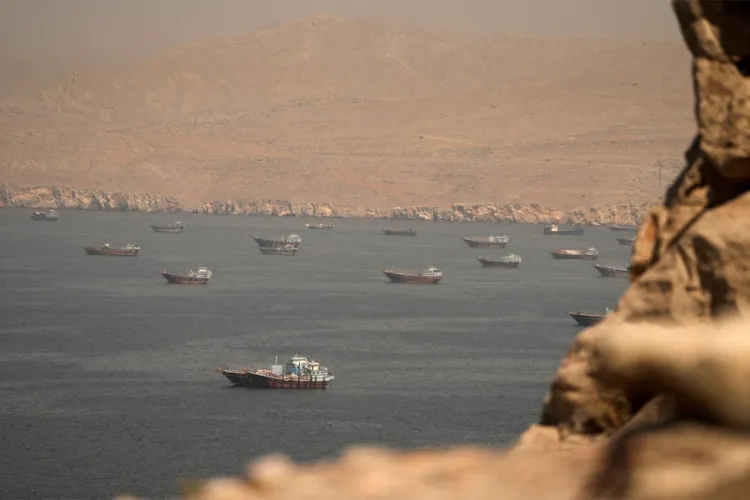
The reshuffle comes at a moment when the Strait of Hormuz has become the most important bargaining chip in Tehran's confrontation with Washington.
Iran has said that the strategic waterway will not fully reopen until Washington meets a series of conditions, including an end to military pressure, the lifting of sanctions, the release of frozen Iranian assets and compensation for war damage.
At the same time, Iran and Oman have been working on arrangements to manage maritime traffic through the waterway, with the possibility of a temporary framework for shipping.
That creates a delicate contradiction at the heart of Tehran's strategy.
US President Donald Trump has signalled that Washington is currently pursuing a lower-profile approach while discussions over the waterway continue.
Reports by Axios indicated that a potential maritime arrangement involving Iran, Oman and the US remains under discussion.
Iranian Foreign Minister Abbas Araghchi has maintained that Tehran is not currently engaged in direct negotiations with Washington.
Instead, messages are being exchanged through intermediaries as countries attempt to create conditions for a possible resumption of talks. Iranian officials have linked any renewed negotiations to Washington addressing what Tehran describes as violations of an earlier understanding.
Araghchi said, "We are not currently negotiating with the United States; the exchange of messages takes place through intermediaries."
He added, "Some intermediary countries are still trying to re-establish the ground for negotiations. In our opinion, there is no possibility of resuming negotiations until the US's violation of the Islamabad Memorandum of Understanding ends and the US makes up for what it has violated."
The leadership changes therefore need to be read against three simultaneous pressures: war, economic strain and diplomacy.
On one side is Pezeshkian's political establishment, which has an interest in stabilising the economy and restoring international economic links. On the other is a powerful security establishment shaped by the IRGC, whose commanders have pushed for maintaining Iran's military leverage and resisting concessions under pressure.
Above both sits Mojtaba Khamenei, whose role is increasingly central to coordinating the country's strategic response.
The decision to move Zolghadr directly into the Supreme Leader's advisory circle while placing Rezaei inside the SNSC creates a structure that appears designed to keep both political and security channels tightly aligned with the Leader's office.
It also means that the man who only days ago was delivering Iran's toughest demands on Hormuz will now advise the Supreme Leader directly on political matters.
That does not automatically mean Zolghadr has acquired unchecked power. But it does indicate that his influence within the post-war Iranian power structure may be far from over.
For Washington and its regional partners, the most immediate question is whether the changes will make Iran more flexible or more hardline in the coming days.
For Oman and other intermediaries, the challenge is even more immediate: securing an arrangement that allows commercial shipping to resume while satisfying Tehran's security demands and avoiding a renewed military confrontation.
For global energy markets, the stakes are enormous. Hormuz is one of the world's most strategically important maritime chokepoints, making any prolonged disruption a global economic concern.
READ MORE: Sufiya Khan sets Kanyakumari to Karakoram world record!
And for Iran itself, the reshuffle may ultimately reveal something larger than a personnel change: who controls the country's war-and-peace decisions as Tehran attempts to navigate the narrow passage between confrontation and negotiation.
For now, the signal from Tehran is unmistakable. The diplomatic door remains open -- but the men increasingly positioned around that door are veterans of Iran's security establishment.
_(1).webp "The Khanqah of Pandua, Malda, West Bengal")
.webp "Shrine of Bulbul Shah, Srinagar, J&K")






_(1).webp)