.webp "Dr Fareeda Rahmathul")
Saniya Anjum/Bengaluru
“My birthplace is heaven for me,” says Dr Fareeda Rahmathulla, her voice carrying both pride and reflection. Born in the land of coffee, pepper, rolling hills, and endless greenery, Gullanpet in the Chikmagalur district of Karnataka shaped her earliest understanding of dignity and belonging. It was a place where daughters were loved, cared for, and honoured within their homes and villages. Yet, beneath this warmth lay a quiet contradiction.
At one time, education for girls was often cut short after puberty, and schooling beyond a certain point was denied, except in rare cases. This early contrast between care and constraint planted the first seeds of questioning in her mind.
Marriage marked a turning point in her life, bringing her from a rural landscape to the urban sprawl of Bengaluru. With this shift came exposure to a harsher reality. Freedom existed, but so did deep inequality. In many Muslim families living below the poverty line, conditions were heartbreaking. Girls were denied education, boys worked long hours in cycle repair shops, women sat in dark rooms rolling incense sticks, and many men were trapped in unemployment or alcoholism.
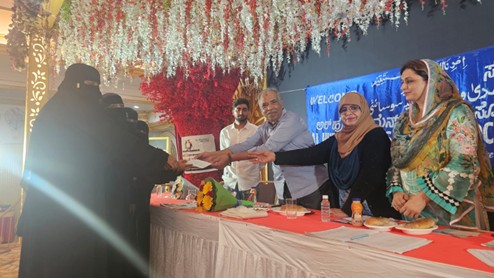
Dr Fareeda Rahmathulla ditributing cheques to the needy Madrasa students
“That was the day I decided to work and bring change in the situation,” she recalls. It was not a moment of anger, but of resolve. A decision rooted in empathy and responsibility.
Education became her most potent weapon against despair. “Education is my passion and my priority,” Dr Fareeda says firmly. She believes that when a child is educated with the right guidance and values, transformation happens naturally. Children begin to care for themselves, their families, and eventually society. For her, social service is inseparable from education.
“Service to mankind, service to humanity, is the biggest service,” she says, a principle that continues to guide every initiative she undertakes.
After moving to Bengaluru, she completed her Bachelor of Arts from NMKRV College, followed by a Master’s degree in Political Science from Bangalore University and another Master’s in Urdu from Dharwad University.
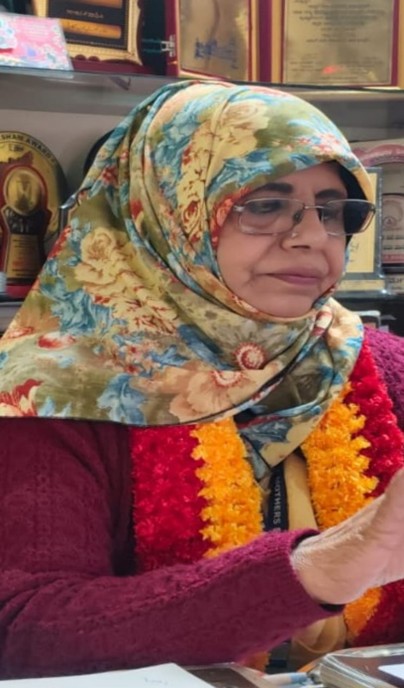
Literature became both her refuge and her voice. She went on to write two novels and three short story collections, addressing social realities with sensitivity and courage. For thirty years, she served as the creator and editor of Zarrin Shuwayen, an Urdu monthly magazine that became a cultural and intellectual platform for countless readers.
Yet, it was through institutions that her vision took physical form. As the founding Principal of Holy Mother's English School, Dr Fareeda ensured that education remained inclusive and compassionate. Nearly forty per cent of the children studying there receive free education, and the school welcomes students from all faiths. Later, she included the underserved communities in the mission by establishing another Holy Mother's School in the Avalahalli slum area. There, she provides free education to students.
The COVID pandemic became another defining chapter in her journey. During and after the lockdowns, she realised that children in slums had no access to online classes. Even where online education existed, its negative impact was visible. Many children lost concentration, screen addiction increased, and dropout rates rose sharply.
Disturbed by this, she strengthened her efforts at the Holy Mother's School in JP Nagar 5th Phase, an institution that has now been running successfully for over thirty-five years. “I am trying to impart education to dropout students to make them the best citizens of India,” she says. The results speak for themselves, with students today leading stable, meaningful lives.
Beyond classrooms, Dr Fareeda’s work extends into community welfare. She founded the Al Huda Women’s Welfare Organisation to support women’s empowerment, the educational needs of deprived children, and families facing medical and social emergencies. She has also played a crucial role in counselling mothers about drug abuse and its repercussions, believing that informed mothers can protect entire generations. Her message is clear. “Use your finances and your talents to reach people in need.”
Her contributions have not gone unnoticed. In 2008, she received the Karnataka Rajyotsava Award for her literary work, a recognition that remains deeply close to her heart. She has received KUA awards on two occasions, received a Successful Entrepreneur Award, and served as a contributor member of UNICEF for eight years.
She was also nominated to the Karnataka Hajj Committee. Outdoor hoardings across Bengaluru celebrating her work stand as rare public acknowledgements of a woman whose service often speaks quietly. “When people recognise my work, it proves that Allah is happy with what I am doing,” she says with humility.
An Honorary Doctorate was conferred upon her by St. Mother Theresa University in 2019, and her life and contributions became the subject of an M Phil research work at Kuvempu University. With nearly a hundred awards to her credit, she remains grounded, measuring success not in trophies but in transformed lives.
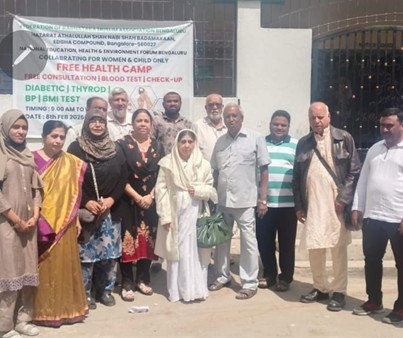
Dr Fareeda Rahmathulla at a health camp
When asked what message she wants to leave behind, Dr Fareeda speaks not as an award winner, but as a guide. “Love yourself, love your language, love your people. Respect other languages and people from different communities.” Her life embodies coexistence, compassion, and courage.
ALSO READ: Dr Asima Banu chose the roads less taken in medicine and leadership
From the green hills of Chikmagalur to the crowded lanes of Bengaluru, Dr Fareeda Rahmathulla’s journey is a testament to what sustained purpose can achieve. She did not wait for change. She became it.
Police Inspector Malurraj, during his visit to Holy Mother's School, interacted with students and appreciated the institution’s commitment to inclusive education.

.webp "Representational Image")








.webp)