New Delhi
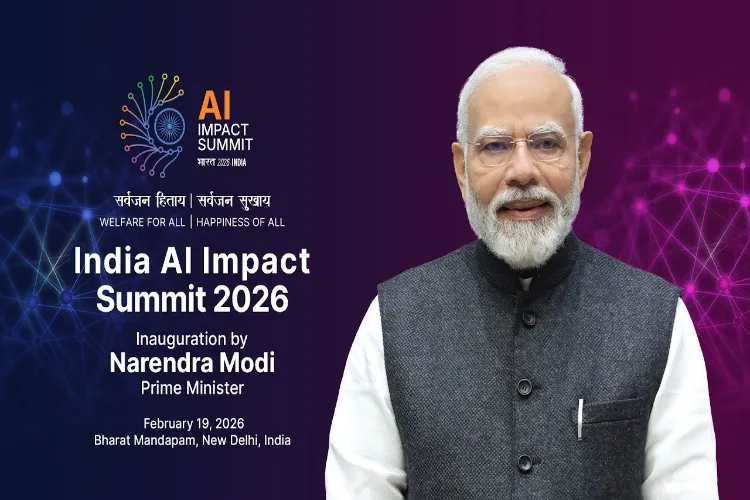
Prime Minister Narendra Modi on Monday inaugurated the India AI Impact Summit 2026 at Bharat Mandapam, highlighting India’s push for responsible, inclusive and development-driven artificial intelligence.
Billed as the first major global AI forum to be hosted in the Global South, the summit has drawn participation from more than 20 Heads of State, 60 ministers and over 500 international AI leaders. The gathering brings together policymakers, technology firms, startups, researchers, academics and industry representatives to translate global AI discussions into practical outcomes under the IndiaAI Mission and the Digital India programme.
The Prime Minister is set to deliver the formal inaugural address on February 19, outlining India’s approach to trusted and inclusive AI and calling for deeper global collaboration in the sector.
Following the opening ceremony, Modi toured the exhibition area, interacting with startups, innovators and technology leaders demonstrating AI applications across sectors. He was accompanied by Union Minister for Information and Broadcasting and Electronics and IT Ashwini Vaishnaw and Minister of State for Electronics and IT Jitin Prasada.
According to an official statement, AI is seen as a critical driver of India’s development trajectory, strengthening governance and transforming public service delivery in line with the vision of Viksit Bharat@2047. The government described AI as a powerful catalyst for economic expansion, improved governance and enhanced quality of life, anchored in the principles of “People, Planet and Progress.”
Under the “People” theme, AI-powered tools are expanding healthcare access through telemedicine and diagnostic support, personalising education via adaptive learning systems, and bolstering financial security through fraud detection technologies.
For the “Planet,” AI is supporting sustainable agricultural practices with crop forecasting, precision farming and drone-based monitoring.
Under “Progress,” AI applications are improving governance by enabling translation of court judgments into multiple languages, streamlining service delivery and enhancing efficiency in sectors such as mobility, food distribution and digital public services, benefiting both rural and urban communities.
The Expo component of the summit spans 10 arenas across more than 70,000 square metres and features participation from global technology companies, startups, academic institutions, research bodies, Union ministries, state governments and international partners. Thirteen country pavilions showcase cross-border collaboration, with participation from nations including Australia, Japan, Russia, the United Kingdom, France, Germany, Italy, the Netherlands, Switzerland, Serbia, Estonia and Tajikistan, along with representatives from African countries.
More than 300 curated exhibition spaces and live demonstrations are organised around the three thematic pillars. Over 600 high-potential startups are taking part, many of which are already deploying AI solutions at population scale. Organisers expect the Expo to attract more than 2.5 lakh visitors, including global delegates, while the broader summit will host over 500 sessions featuring upwards of 3,250 speakers and panellists.
As part of the IndiaAI Mission, the government is also unveiling 12 indigenous foundation models developed by domestic startups and research consortia. These models are trained on extensive Indian datasets and designed to operate across the country’s 22 official languages.
READ MORE: Neerja Mattoo for popularising Kashmiri mystic poets
With India’s AI market projected to exceed USD 17 billion by 2027, the summit signals the country’s ambition to play a central role in shaping the global AI ecosystem. Backed by over 800 million internet users, a rapidly expanding startup ecosystem and strong digital public infrastructure, India aims to position itself as a bridge between technological innovation and large-scale societal impact.

_(1).jpg "Visitors gather at the Santosh Mitra Square Durga Puja pandal, themed on the 150th anniversary of Vande Mataram and its historic role in India's freedom movement, ahead of the festival, in Kolkata")

.jpg "Gujarat’s women entrepreneurs bring their craftsmanship to life during Navratri")





.jpg "Google Gemini Logo")
.jpg "iPhone 18")




_(4).webp)
_(2).webp)