New Delhi
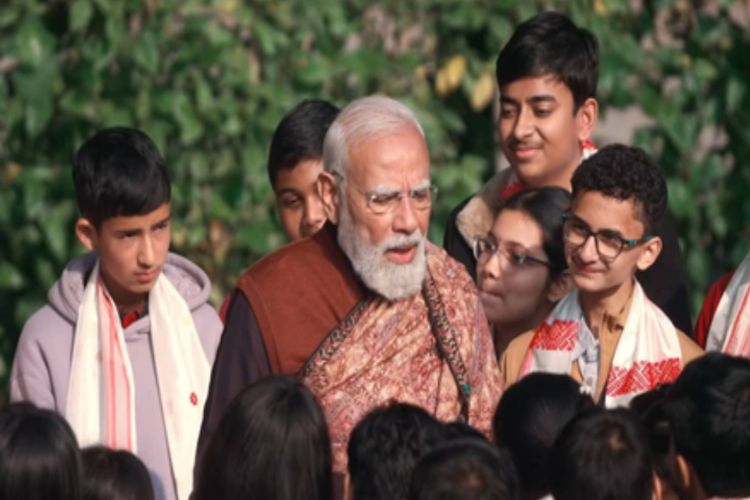
Prime Minister Narendra Modi on Monday cautioned students against becoming overly dependent on technology, stressing that artificial intelligence should serve as a tool for guidance and value addition, not as a replacement for learning.
Interacting with students during the second episode of the ninth edition of Pariksha Pe Charcha, Modi observed that mobile phones have become “masters” for some children, who struggle to eat or function without a screen in front of them.
“Every era has witnessed anxiety over new technologies, whether it was computers earlier or mobile phones later. Fear is unnecessary, but technology should never become the master of human life. You must resolve that you will not let technology enslave you,” the prime minister said while engaging with students from Coimbatore, Raipur, Guwahati and Gujarat.
Urging students not to fear emerging technologies such as artificial intelligence, Modi said AI should be used intelligently to sharpen skills. “AI and mobile phones should not dominate us. AI can be used effectively for guidance and value addition, but it should never become a substitute for learning,” he said.
Drawing a parallel with changes in modes of transport, the prime minister noted that jobs will continue to evolve with technological advancements. “The shift from bullock carts to aeroplanes did not stop life. Similarly, understanding technology, expanding one’s capabilities and integrating its strengths into work will ensure progress without fear,” he said.
On exam preparation, Modi advised students to practise previous years’ question papers and prioritise adequate sleep. “Proper preparation removes stress. A good night’s sleep keeps you energetic and cheerful throughout the day,” he said, also urging parents to avoid comparing their children with others.
Responding to a question on leadership, the prime minister said fearlessness is the most important quality of a leader. “Leadership begins the moment you take initiative without waiting for others. Even picking up litter can inspire people around you,” he said.
“Leadership is not about elections or speeches. It is about the ability to explain, communicate and convince others. A true leader first understands people before guiding them,” Modi added, emphasising the importance of clear communication.
On career aspirations, he said frequent changes in ambition can confuse families but are natural, as students often draw inspiration from successful individuals. However, he urged students to look beyond visible achievements and understand the discipline and effort behind success. “True success speaks for itself. When someone becomes number one, recognition follows naturally,” he said.
Addressing concerns about balancing studies with personal interests, Modi said both can complement each other. He cited examples of combining creativity with academic learning, such as using art in science experiments, to reduce fatigue and improve understanding. He suggested allocating regular time for hobbies while keeping education a priority.
On entrepreneurship, the prime minister said students should first identify what they genuinely want to pursue—whether technological innovation or practical problem-solving. He encouraged forming small teams with friends skilled in different areas such as technology or finance.
“There is no age barrier to starting a venture. Even small startups can make a meaningful impact. Visit existing startups, prepare a project report and present it honestly as a school project. This will help you gain guidance and real-world exposure,” he said.
Expressing satisfaction that students from Classes 10 and 12 are already thinking about Viksit Bharat 2047, Modi said discipline must be embedded in daily life. “We should adopt habits seen in developed countries—switch off engines at red lights, avoid food wastage and minimise waste. Discipline is essential for progress,” he said.
Recalling his student days, the prime minister highlighted the influence of teachers and the importance they placed on physical fitness. “If you ask any great personality, they will acknowledge the role of their mother and teachers in shaping their life,” he said.
The first episode of the ninth edition of Pariksha Pe Charcha aired last week, during which Modi advised students to listen to advice but adopt changes only when they felt ready. He also stressed that education should not feel like a burden and should focus on life skills beyond marks.
READ MORE: Why reviving Ganga-Jamuni culture is the need of the hour
Launched in 2018, Pariksha Pe Charcha began as a townhall-style interaction and has grown into one of the country’s largest education outreach programmes. Registrations rose from about 38.8 lakh in 2023 to 2.26 crore in 2024 and 3.53 crore in 2025, earning a Guinness World Record. The ninth edition surpassed previous records with over 4.5 crore registrations.








.webp "Representational image")
.webp)