 Rajeev Narayan
When Ajit Doval spoke after receiving the Lokmanya Tilak National Award 2026, he did not dwell on the milestones that make him such an acclaimed Indian intelligence and security professional. Instead, he spoke of the 'window of opportunity' India enjoys today; urged the youth to work towards building a stronger nation. His words were characteristically understated, coming from a man who has spent six decades safeguarding India from threats seen and unseen.
Awards often celebrate the past. This one invited a look into the future. As Ajit Doval received the award, people expected customary words of gratitude. Instead, India’s National Security Advisor chose not to speak of personal achievement but of national purpose. “Every generation is judged by how it responds to opportunities life presents. Today’s moment demands commitment, discipline and a collective sense of responsibility,” Doval said.
The audience was speechless. As the words sank in, the hall reverberated with applause.
Decisions can change your life.
— Shani Mishra | शनि मिश्रा (@mishra_shani) August 2, 2026
Ajit Doval shares valuable advice for the youth on making the right choices at the right time. 👇 pic.twitter.com/FDdrGSkdwV
Doval follows in the celebrated footsteps of this Award’s hall of fame, including Narendra Modi, Sudha Murty and Nitin Gadkari. His inclusion in this distinguished list is significant, and the reasons stand him apart. His career has unfolded away from public view; for intelligence officers do not always become public figures. Their work is measured not by what citizens know, but by what they never need to know. Some careers transcend anonymity.
Home Minister Amit Shah, who presented the award, observed that the armed forces had witnessed a complete transformation in defensive and offensive capability during the NSA’s tenure. Few would dispute that the country’s security architecture now looks very different from what it was a decade ago. Much of that evolution bears the imprint of the man sitting beside the Prime Minister in countless Cabinet Committee on Security meetings.
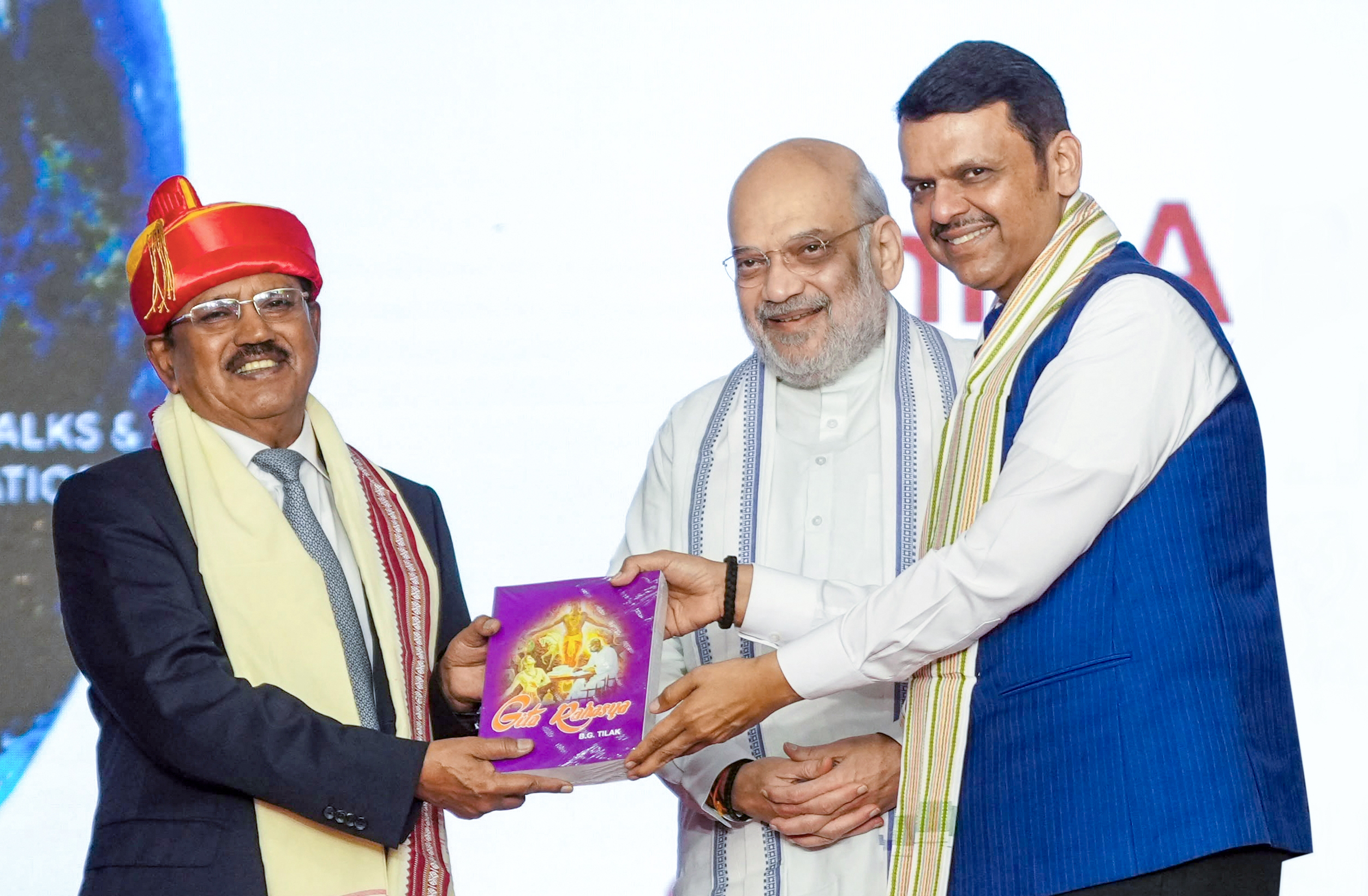 Maharashtra Chief Minister Devendra Fadnavis gifting a book to NSA Doval at the ceremony
Changing Doctrine
If Doval’s years in intelligence established his credentials, his tenure as NSA altered India’s strategic vocabulary. For decades, India was seen as a nation that absorbed provocations with restraint, relying on diplomatic protest and global opinion. Over the past decade, that perception has changed. India’s responses have become calibrated, integrated and assertive.
The surgical strikes across the Line of Control in 2016 (following the Uri attack) and the Balakot air strike (after Pulwama in 2019) came to symbolise this shift. While these were military operations executed by armed forces under political leadership, they reflected a broader doctrine in which intelligence, diplomacy, military planning and political decision-making functioned in close concert.
Coordination among intelligence agencies, focus on counter-terror financing, border surveillance, infrastructure protection and integration between civilian and military establishments were key too. These did not dominate TV debates, but formed the backbone of a credible national security system.
The Philosopher Spy
Of the many epithets bestowed upon Ajit Doval over the years, perhaps none captures him better than ‘The Philosopher Spy’. For a man who spent much of his career in the shadows, Doval has been remarkably candid whenever he has chosen to speak in public. Through lectures and addresses at strategic forums over the last decade, India’s NSA has revealed a worldview that stretches well beyond intelligence operations and military strategy.
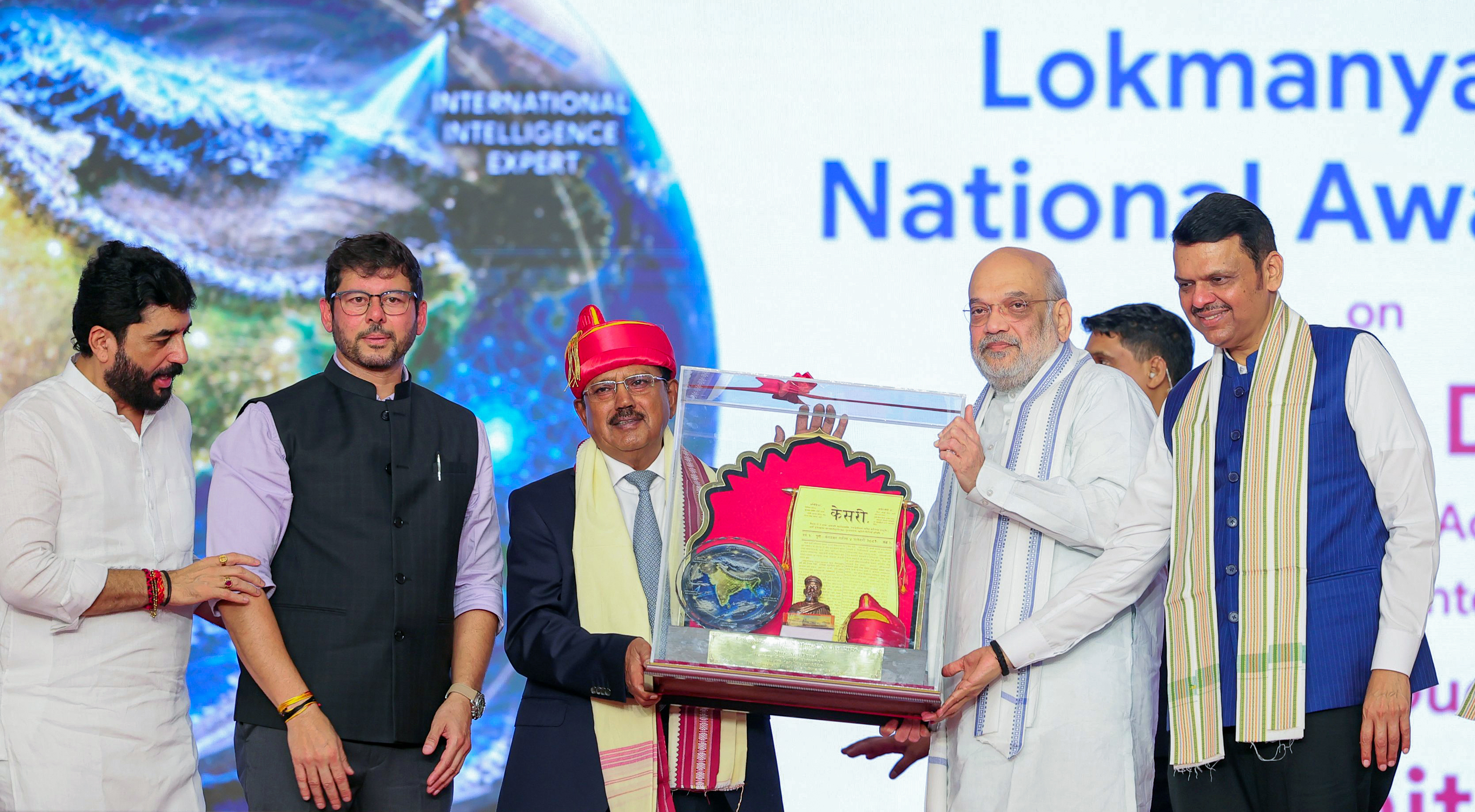 Home Minister Amit Shah conferring the Lokmanya Tilak National Award 2026 on NSA Ajit Doval
“India is a civilisational state. Do we have something which is our collective unique common consciousness?” he once asked. The question reflected his conviction that a nation’s greatest strength lies not merely in its borders, but in the values, identity and shared consciousness that bind its people together. To Doval, national security begins with national confidence.
In his worldview, power is no longer measured only in soldiers or missiles. “Those who can make you think in a manner that’s in their interest enjoy the real power,” he observed, underlining the growing importance of ideas, information and influence in an era being defined by cyber warfare, artificial intelligence and digital manipulation. It is perhaps why he has also cautioned that democracy depends on citizens being “rightly informed and rightly educated”, warning that false narratives can alter the destiny of nations as profoundly as conventional conflict.
🚨 NSA Chief, Ajit Doval —
— World Decode (@ItsWorldDecode) August 2, 2026
"India faces many challenges from INSIDE as well as OUTSIDE. India's development is still a THREAT for many powers." 🎯#India #AjitDoval #Defence pic.twitter.com/2DLAOoKifl
Equally consistent has been Doval’s belief that security is a shared national enterprise. “National security is the responsibility of the entire country, not just of the armed forces, police or intelligence,” he once said. In that single sentence lies a larger philosophy: resilient institutions, informed citizens and social cohesion are as vital to a nation’s defence as military preparedness. It also explains his repeated assertion that enduring national power rests as much on economic strength, technological capability and sustained development as it does on military strength.
Perhaps no observation better sums up the man than this: “The biggest mistake in assessing a nation’s strength is to ignore the willpower of its people.” Beyond the steely resolve lies a thinker who has consistently viewed statecraft through a wider civilisational lens – one that places equal faith in character, capability and collective purpose.
For all the operations he conceived, the crises he helped navigate and the strategic doctrines he shaped, Doval may ultimately be remembered as much for the ideas -- that a nation’s first line of defence is not merely its military, but the confidence of its people, the strength of its institutions and the resilience of its civilisation, etc. – and not merely by operations he led. In that belief, perhaps, lays the real Ajit Doval.
The writer is a veteran journalist and communications specialist.