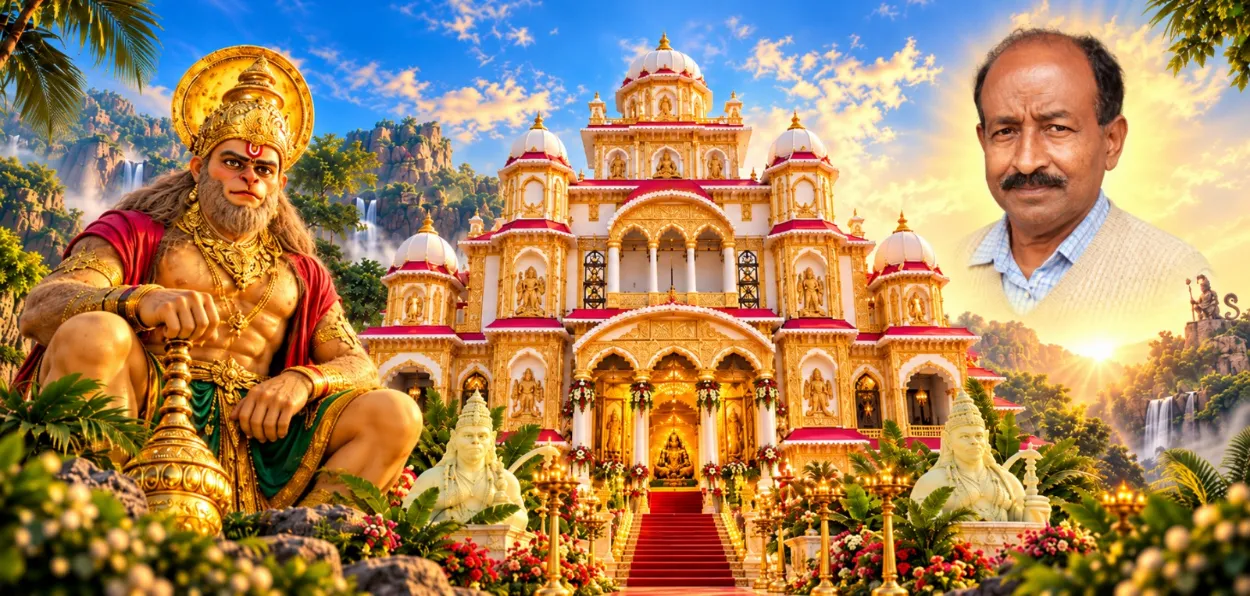
.webp "Ai-generated image of Allama Iqbal and Swami Ram Tirath")
Ghaus Siwani
Urdu poets have often composed verses in praise of great personalities belonging to different faiths, and Allama Muhammad Iqbal is perhaps one of the finest examples of this tradition. Although his poetry is deeply rooted in Islamic thought, he also wrote with admiration about several revered Hindu figures. Swami Ram Tirath was among those whom Iqbal held in particularly high esteem.
Iqbal praised Lord Rama, Guru Nanak, Gautama Buddha and Sri Krishna. But his relationship with Swami Ram Tirath was distinctive: unlike the other figures, he knew Ram Tirath personally. The two were friends, colleagues and intellectual companions, and their association had a profound influence on Iqbal.
Swami Ram Tirath was a Hindu philosopher and a prominent exponent of the Vedanta tradition. Iqbal not only admired his ideas but also wrote a moving poem in his memory after his untimely death.
Who Was Swami Ram Tirath?
Swami Ram Tirath was born on October 22, 1873, into a Brahmin family in the Gujranwala district of present-day Pakistan. Exceptionally bright from an early age, he nevertheless had to struggle against poverty and financial hardship to pursue his education.
He studied in Lahore and stood first in the B.A. examinations across Punjab at the University of the Punjab. His academic achievement earned him a monthly scholarship of Rs 90. He later completed an M.A. in Mathematics and became a professor.
Having received his early education at a madrasa, Ram Tirath was proficient in Urdu and Persian. He subsequently learned Sanskrit as well. Despite becoming a college professor, he continued to live a simple life and devoted part of his income to helping the poor, particularly by supporting the education of needy students.
While in Lahore, he heard Swami Vivekananda speak, an experience that profoundly influenced him. He also became associated with the Sanatan Dharma Sabha of Punjab.
Spiritual Journey
Ram Tirath's spiritual quest extended far beyond the study of Hindu scriptures. He read the works of Tulsidas and Surdas and studied the teachings of Guru Nanak, Shams Tabrizi, Maulana Jalaluddin Rumi and other Sufi saints. He immersed himself in the Gita, the Vedas and the Upanishads, while also engaging with the writings of Western philosophers.
He launched an Urdu magazine, Alif, and in 1901 resigned from his professorship. He subsequently moved to the Himalayas with his family. Sometime later, following the advice of the Shankaracharya of Dwarka Peeth, he embraced sanyas and renounced worldly life.
During his stay in the Himalayas, the Maharaja of Tehri-Garhwal became one of his devotees. With the Maharaja's assistance, Swami Ram Tirath travelled to Japan to attend a religious conference. He later visited the United States and Egypt, where he delivered lectures on spirituality and Vedanta.
One of his central messages was:
“Know thyself; your true essence is connected to the light of the Divine.”
His words and personality had a magnetic appeal. Those who encountered him often described experiencing a sense of peace and tranquillity in his presence, and his circle of followers gradually expanded.
Swami Ram Tirath believed in bringing people together rather than dividing them. When he returned to India in 1904, his followers urged him to establish a separate religious sect. He refused.
.jpg) A statue of Swami Tirath
A statue of Swami Tirath
For him, creating yet another sect was less important than fostering unity. He believed society needed discipline, harmony and a sense of common purpose rather than further divisions.
He emerged as a prominent exponent of Vedanta philosophy and the Advaita doctrine of Adi Shankaracharya, which emphasises the essential oneness of existence. He studied extensively on Vedanta and Yoga and delivered lectures on these subjects.
Ram Tirath believed that the entire universe was a manifestation of a single universal soul. He urged people to rise above the narrow confines of religion, caste, family and social divisions.
In his view, people often searched for happiness in wealth, material possessions or other individuals, whereas lasting happiness lay within one's own mind and soul. Narrow-mindedness, he argued, resulted from confining oneself to a limited social or intellectual world. True humanity required transcending such boundaries and seeing all people as one's own.
He also regarded Rashtra-Dharma—service to the nation—as the supreme duty of his age. Every citizen, he believed, should devote his or her talents and labour to the progress of the country and society.
Ram Tirath predicted that India would achieve independence by the middle of the 20th century. In a letter to revolutionary thinker Lala Har Dayal, he reportedly advised him to spread his ideas in Hindi, which he believed would become the national language of an independent India.
Swami Ram Tirath maintained a deep spiritual connection with Tehri-Garhwal and returned there during the final phase of his life.
On Diwali in 1906, he wrote a message addressed to death and set it afloat on the waters of the Ganges. He died on October 27, 1906, at the age of 33 according to these dates. Some accounts describe his death as a voluntary surrender to the river, although the circumstances remain a matter of historical interpretation. He was survived by his wife and two children.
Iqbal and Swami Ram Tirath
The bond between Allama Iqbal and Swami Ram Tirath was more than an intellectual acquaintance. Their friendship is reflected not only in Iqbal's poetry but also in accounts of their correspondence and personal interactions.
The two had known each other since their student days and later taught at the same college. They shared an interest in literature, philosophy, religion and poetry, and their conversations often continued for hours.
One of Ram Tirath's biographers wrote:
“In Lahore, Swami Ram formed a deep friendship with the 'Poet of the East,' Allama Iqbal. They studied together and spent their youth in each other's company. Both were poets, philosophers, and scholars. Both harboured a sincere desire to serve humanity. Both achieved great renown in the field of writing, gaining fame not only in India but across the globe. They left behind a vast treasure trove of poetry and prose.”
The closeness of their friendship is illustrated by an oft-repeated anecdote. If someone came to meet Sir Muhammad Iqbal and did not find him in his room, they might assume he had gone to visit his friend Tirath Ram. Likewise, those looking for Tirath Ram could sometimes find him at Iqbal's home.
The two would spend hours discussing literature, history, philosophy, religion and poetry, exchanging ideas and reflecting on the larger questions of life. Their intellectual companionship allowed each to look at familiar questions from new perspectives.
Their friendship also extended into moments of personal difficulty.
One night, Swami Ram suffered severe stomach pain while Iqbal was with him. Iqbal advised him to take medicine, but Ram Tirath refused. Despite the pain, he continued to smile and maintained that the discomfort would subside on its own. The pain lasted throughout the night, but by the following morning he had recovered—and still refused to take any medicine.
As Indrajit Lal records in Swami Ram Tirath: “Swami Ram suffered from severe stomach pain. Allama Iqbal was with him at the time. He advised him to take medicine, but Swami Ram refused.”
Swami Ram Tirath's life was remarkably brief. In little more than three decades, he completed his education, became a professor of mathematics, abandoned his academic career to embrace sanyas, and travelled abroad to spread his spiritual message.
Iqbal found considerable affinity between Ram Tirath's ideas and his own philosophical concerns. He was also deeply impressed by the Swami's commitment to social service. Some scholars have suggested that Ram Tirath's teachings may have contributed to the intellectual development of Iqbal's concept of Khudi, or Selfhood.
Iqbal was reportedly devastated by the news of his friend's death.
The depth of his loyalty to Ram Tirath can also be gauged from his response when the Swami left his job. Many people mocked him, and some even claimed that he had lost his mind. Iqbal, however, defended his friend and reportedly said:
“If Swami Ram Tirath is mad, then there is no such thing as wisdom or intellect in the world. This is the very madness that elevated a great philosopher like Spinoza and made prophets great.” (Iqbal: Poet and Politician, Dr Rafiq Zakaria, p. 66)
Iqbal's Poem on Swami Ram Tirath
The news of Swami Ram Tirath's death plunged his followers and friends into grief. Iqbal, who shared a close personal and intellectual bond with him, was deeply shaken.
Out of this grief emerged his poem, Swami Ram Tirath. The poem is both an elegy for his friend and a profound meditation on spirituality, selfhood and the ultimate union of the individual with the Divine.
The poem opens:
O restless drop, you have now merged with the river;
Once a mere gem, you have now become a priceless, unique jewel.
Alas! With what grace you unveiled the secret of form and fragrance,
While I remain a captive to the distinctions of form and fragrance.
Upon dissolution, the clamour of life transformed into the tumult of the Day of Judgment;
This spark, once extinguished, became the very hearth of Azar.
The negation of the self is a miracle of the enlightened heart;
Hidden within the ocean of 'La' (No/Negation) lies the pearl of 'Illallah' (Except God).
The meaning of the ultimate end remains hidden from the sightless eye;
When the restless agitation ceases, the quicksilver turns into solid silver.
Love—like Abraham—shatters the idol of the self;
Love's intoxication is the true remedy for the intellect's sobriety.
In the opening couplet, Iqbal directly addresses his departed friend as a “restless drop” that has finally merged with the “river”. The imagery suggests the individual's ultimate union with the Divine or with the Ultimate Truth. The metaphor is especially poignant in the context of Ram Tirath's association with the Ganges.
Iqbal contrasts the restless individual with the tranquillity that comes when the self finds its ultimate destination. The man who was already precious in life, he suggests, has attained an even higher spiritual state after death.
The second couplet turns to the spiritual stature of Ram Tirath. Iqbal suggests that his friend had understood the superficial nature of worldly distinctions—of colour, caste, religion and other identities—and had learned to see humanity as one. Iqbal, by contrast, portrays himself as still entangled in these external distinctions.
It is a striking tribute to Ram Tirath's ideals of equality, humanity and spiritual oneness.
An Unusual Meeting of Traditions
Perhaps the most remarkable feature of the poem is Iqbal's use of Islamic imagery to express his admiration for a Hindu ascetic.
References to La ilaha illallah, Prophet Ibrahim, Azar and other Islamic symbols are woven into his portrayal of Ram Tirath's spiritual journey. Rather than presenting spirituality as the exclusive possession of one religious tradition, Iqbal uses these images to express a broader idea: that the quest for truth, self-knowledge and union with the Divine belongs to humanity as a whole.
His poem for Swami Ram Tirath therefore represents more than personal grief. It is also a meeting point between two intellectual and spiritual traditions.
The friendship between Iqbal and Ram Tirath—and the poem that emerged from it—offers a remarkable example of how intellectual companionship can transcend religious boundaries. Their relationship reflected mutual respect, a shared pursuit of knowledge and a common concern for humanity.
ALSO READ: Allama Iqbal's Nanak is an ode to the founder of Sikhism
In an era when religious identities were increasingly politicised, their friendship stood as a reminder that India's intellectual and spiritual traditions had long been enriched by interfaith dialogue.