Amir Suhail Wani
The birthday of Dr. Sarvepalli Radhakrishnan, the philosopher, educationist and former President of India, however, should not be reduced to ceremonies, felicitations and formal expressions of gratitude to teachers. The day’s purpose is to remind us of what a teacher can accomplish when he makes it a mission to awaken curiosity, nurture imagination and enlarge the intellectual horizons of the learner.
In this context, the story of Urfana Amin, an educator from Kashmir, becomes particularly significant. Urfana Amin represents an inspiring model of contemporary teaching in which creativity, resourcefulness and empathy become instruments of education. Her work demonstrates that educational innovation does not necessarily depend upon sophisticated laboratories, expensive equipment or abundant resources. Sometimes, it begins with something as simple as a teacher looking at the ordinary world with extraordinary imagination.
Her educational philosophy, captured in the expression “Learn Big from Small,” is a powerful example of this approach.
One of the most striking aspects of Urfana Amin's pedagogy is her ability to transform everyday objects into instruments of learning. Materials that would ordinarily be discarded—cardboard, bottles, wrappers, newspapers and other household items—can acquire a new purpose in the classroom. A piece of cardboard can become a scientific model. A discarded bottle can help demonstrate a concept. A food packet can become an entry point into discussions about nutrition, mathematics and everyday science.
What appears to be waste suddenly becomes a resource. But the importance of this approach goes far beyond saving money or finding substitutes for expensive teaching aids. Its real value lies in changing the student's relationship with knowledge. Instead of encountering knowledge only through textbooks, children are encouraged to discover it in the world around them. Learning ceases to be something confined between the covers of a book and becomes an activity of observation, experimentation and creation.
This is one of the central challenges of modern education. Children often learn to reproduce information without necessarily learning to engage with it. They can remember definitions and formulas but may struggle to see their relevance in ordinary life. Urfana Amin's approach attempts to bridge this gap. It asks the child to look at an everyday object and wonder: What can I learn from this?
A good teacher does not merely transfer information from one mind to another. The teacher creates conditions in which the learner begins to discover knowledge independently. This distinction separates teaching from mere instruction.
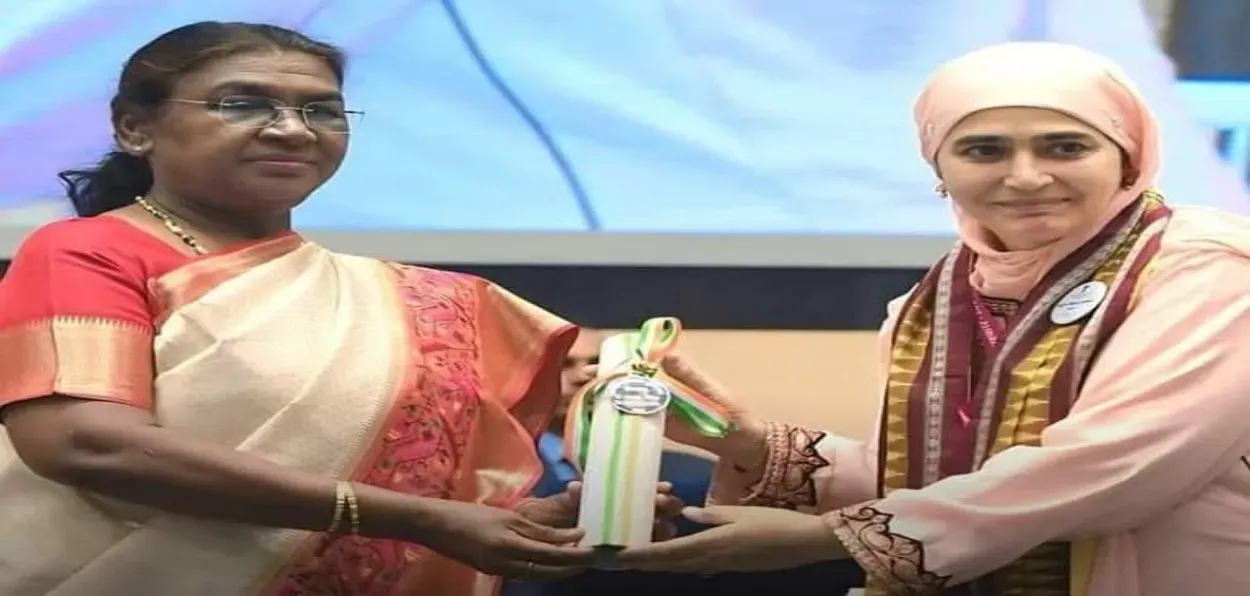
Dr Urfana Amin, a teacher at BHSS Soura Srinagar received National Teachers award 2024 presented by President of India pic.twitter.com/U3syATC4MR
— Asian News Hub (@AsianNewsHub) September 5, 2024
Instruction can tell a child that a particular scientific principle is true. Experiential learning allows the child to encounter that principle through observation or activity. Instruction can provide a mathematical formula. Creative pedagogy can make the learner discover why that formula matters. Urfana Amin's classroom philosophy belongs to the latter tradition.
By encouraging students to create models and learning materials themselves, she makes them participants in the educational process. The child is no longer merely a recipient of knowledge but becomes a maker, explorer and problem-solver.
When a student constructs something with their own hands and then uses it to explain a concept, the experience creates a sense of intellectual ownership. The lesson is no longer something imposed upon the student; it becomes something the student has helped create.
This is particularly valuable for children who may not initially see themselves as academically gifted. Creativity can provide another route into learning.
The modern educational world increasingly recognises the importance of experiential, activity-based and interdisciplinary learning. But these ideas become meaningful only when translated into classroom practice.
Urfana Amin's work illustrates how this can happen. A simple object can simultaneously become an instrument for learning science, mathematics, environmental awareness and health. A discarded package, for instance, can lead to discussions about ingredients and nutrition while also providing opportunities to explore numbers, measurements, percentages and comparisons.
Such an approach breaks down the artificial walls between subjects. Life itself is not divided into separate chapters called physics, mathematics, biology or environmental studies. The world is interconnected, and education becomes more meaningful when students are encouraged to recognise those connections. This is why the principle of “Learn Big from Small” is more than a clever teaching technique. It represents a philosophy of seeing. It teaches children that knowledge is everywhere—if one learns how to look.
There is an important lesson here for the teaching profession as a whole. Educational innovation is often associated with technology. Smart classrooms, artificial intelligence, digital boards, tablets and sophisticated learning platforms undoubtedly have their place. But technology by itself does not create good education. A technologically equipped classroom can still produce passive learners. Conversely, a modest classroom can become intellectually vibrant when it has a teacher capable of stimulating curiosity.
Another important dimension of her work is its emphasis on inclusive education. A truly effective educational system cannot be designed only for the child who learns quickly, speaks confidently or excels in conventional examinations. Classrooms contain children with different abilities, learning styles, interests and circumstances. The teacher's challenge is therefore not simply to teach the average student, but to create an environment in which different kinds of learners can participate and flourish.
Urfana Amin's engagement with inclusive education and children with special educational needs reflects this broader understanding of the teacher's responsibility. Education becomes meaningful when it expands participation rather than creating new forms of exclusion. This is particularly important in our time, when educational inequality can take many forms—not only differences in school infrastructure, but also differences in access, confidence, language, technology and opportunity. The story of a Kashmiri teacher receiving national recognition therefore deserves to be seen as part of a larger narrative: the Kashmir of classrooms, teachers, scholarship and intellectual creativity.
ALSO READ: Shehnaz Rahman gives up lucrative legal practise for love of classroom
Urfana Amin's receipt of the National Teachers’ Award in 2024 is undoubtedly an important recognition of her contribution. But the award should be understood as the recognition of a larger educational journey rather than merely an individual distinction. Awards celebrate teachers, but the real measure of a teacher lies elsewhere—in the questions students begin to ask, in the confidence they acquire, in the curiosity they develop and in the intellectual habits they carry into adulthood.


_(1).jpg "Visitors gather at the Santosh Mitra Square Durga Puja pandal, themed on the 150th anniversary of Vande Mataram and its historic role in India's freedom movement, ahead of the festival, in Kolkata")

.jpg "Gujarat’s women entrepreneurs bring their craftsmanship to life during Navratri")








_(4).webp)
_(2).webp)