Eman Sakina
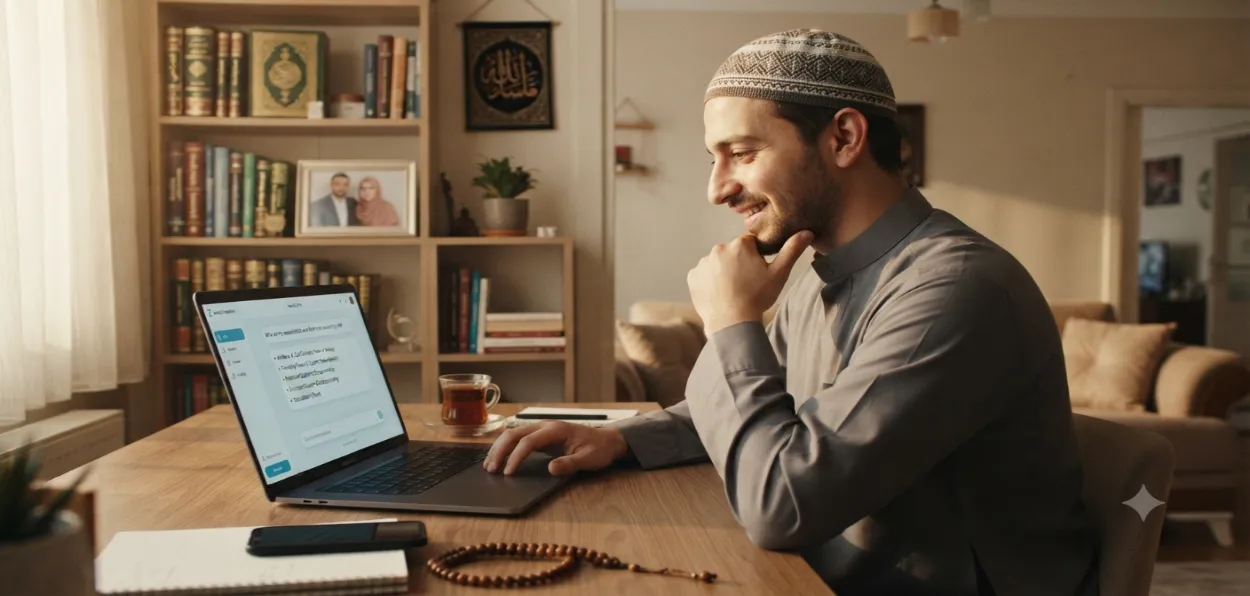
Artificial intelligence has quietly entered almost every part of modern life. We use it to write emails, translate languages, search for information, plan our day and even learn new skills. It was only a matter of time before Muslims began asking an important question: “Can AI also help us understand and practise Islam?”
Friday Musings
The answer is neither a simple yes nor a complete no.
Islam does not reject useful technology merely because it is new. The Quran reminds us that Allah has made many things in creation available for human benefit. But Islam also teaches responsibility, verification and respect for knowledge. This becomes especially important when technology enters the world of the Quran, Hadith and Islamic law.
AI and Quran Study
AI can be a useful ‘study assistant’. A person can ask it to explain the general theme of a Surah, compare translations, identify recurring Quranic subjects, create a revision plan or help locate verses dealing with patience, gratitude, justice or forgiveness.
It can also help students organise large amounts of information. Recent Islamic scholarship recognises that AI may assist Quranic research, recitation practice and memorisation. Egypt's Dar al-Ifta, for example, has said that AI-assisted electronic Qurans and artificial recitation tools can be permissible for helping with reading and memorisation, provided the Quranic text and recitation are properly reviewed.
But there is an important line that should not be crossed: ‘AI should not become our independent authority for Tafsir.’
In January 2026, Egypt's Dar al-Ifta specifically warned against relying completely on AI applications for Quranic interpretation. The concern is simple: an AI system can produce an answer that sounds confident while mixing sources, misunderstanding context or presenting an interpretation without the scholarly tools required for Tafsir.
The Quran itself gives us a principle of careful verification: “So ask the people of knowledge if you do not know.” (Quran 16:43)
AI can help us find the door. It should not pretend to be the scholar standing behind that door.
What About Fatwas?
This is where even greater caution is required. A fatwa is not simply an answer produced by searching religious information. A qualified scholar takes into account the Quran, Sunnah, Islamic jurisprudence, differences among scholars, circumstances, intention and the particular details of the person's situation.
The International Islamic Fiqh Academy has highlighted AI's usefulness in research and collecting evidence, but stressed that AI cannot independently perform the scholarly reasoning required for issuing fatwas.
Egypt's Dar al-Ifta has gone further, stating that relying on AI-generated answers as fatwas is impermissible because AI lacks the qualifications and contextual judgment required of a mufti.
So, if someone asks AI “What does Islam say about this?” Its answer may be useful as a starting point for research. But when the question involves marriage, divorce, inheritance, financial obligations, medical circumstances or another serious matter, the final word should come from a trustworthy qualified scholar.
And What About Daily Dua?
This area is somewhat different.
Using AI to ‘find, organise or remember established duas’ can be beneficial. A person might ask for duas from the Quran and authentic Hadith for travelling, anxiety, gratitude, parents, protection or starting a new task.
But verification still matters. Not every dua circulating online is from the Quran or Sunnah, and AI can sometimes confidently attribute words to the Prophet that have no reliable source.
There is also a deeper question: are we using AI to ‘help us remember Allah, or to replace the personal relationship we should have with Him?’
A beautifully written AI-generated dua cannot replace sincere conversation with Allah. Technology can remind us to make dua; it cannot create sincerity for us.
The healthiest approach, therefore, is to treat AI as a ‘tool’, not a religious authority. Use it to search, organise, revise, translate and learn. Verify its Quranic quotations and Hadith references. Return to reliable Tafsir and authentic sources. And for matters requiring a fatwa, consult qualified scholars.
AI can make religious knowledge easier to reach. But accessibility must never be confused with authority.
The future of Islam and technology should not be a competition between humans and machines. It should be about using human knowledge, conscience and faith to ensure that powerful technology remains a servant of truth rather than becoming a substitute for it.


















.webp)