

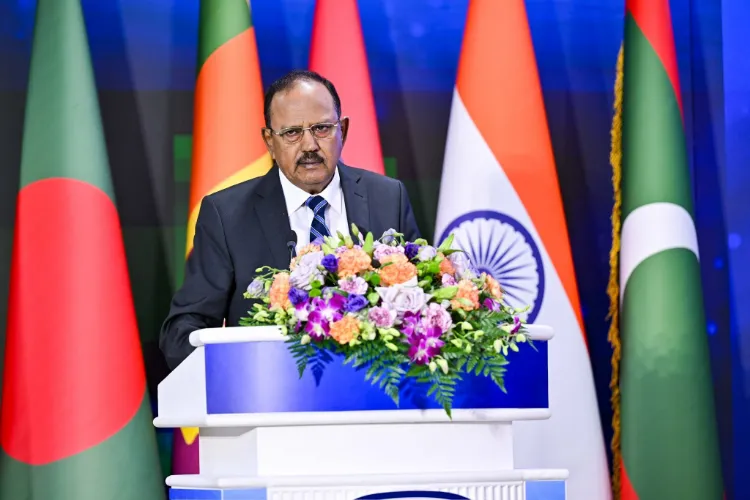
Male (Maldieves)
National Security Advisor Ajit Doval emphasised the shared maritime and civilisational ties among Indian Ocean littoral states, saying the seas must remain a space that connects nations rather than divides them.
Addressing the 8th National Security Advisors' Meeting of the Colombo Security Conclave (CSC) in Male, Doval called for sustained cooperation among countries in the region to ensure maritime security, regional stability and economic prosperity.
“We the littoral states of the Indian Ocean region share a common maritime space and are connected by civilisational heritage shaped over a long period of history,” Doval said.
Recalling the legacy left by previous generations, he said the seas had historically connected communities and countries, and urged participating nations to preserve this tradition for future generations.
NSA Ajit Doval Speaks at the National Security Advisors' Meeting of Colombo Security Conclave 🇮🇳 https://t.co/WzXYpOuQ50
— IADN (@NewsIADN) November 25, 2026
Doval said the formation of the Colombo Security Conclave in November 2020 was guided by a collective vision to ensure the safety, security and stability of the Indian Ocean Region.
“The formation of the Colombo Security Conclave in November 2020 was anchored by our collective vision for a safety, security, and stability of the Indian Ocean region,” he said, adding that the grouping had made considerable progress but still had a long journey ahead.
He also underlined India's commitment to strengthening the regional grouping, linking the CSC to New Delhi's neighbourhood-first policy and its broader MAHASAGAR vision.
“For India, the Colombo Security Conclave represents the intersection of our neighbourhood-first outlook and the Mahasagar vision, which stands for mutual and holistic advancement in security and growth areas. We are committed to continue working closely with the CSC countries to enhance our collective capacities in dealing with the evolving serious security challenges,” Doval said.
Assuring participating countries of India's continued support, he said New Delhi would extend necessary assistance to achieve the common objectives of the conclave.
“I assure all of you here that India, as one of the partner countries here, as one of the Speaker countries that initiated the idea of the Colombo Security Conclave, will give its best and will try to give all necessary help and assistance, and we assure you of our fullest commitment to achieve our common objectives,” he added.
Member states of the Colombo Security Conclave (CSC) have signed the Agreed Minutes and adopted a Roadmap of Cooperation for 2026–2027 following the conclusion of the 8th National Security Advisor (NSA) Level Meeting hosted by the Maldives at Villa Nautica Paradise Island on November 25, the Ministry of External Affairs (MEA) announced on Thursday.
According to a joint press statement released by the MEA, the high-level delegations were led by Maldives' National Security Advisor Lt. Col. (Retd.) Ibrahim Latheef, Indian National Security Adviser Ajit Doval, Sri Lanka's Defence Secretary Air Vice Marshal (Retd.) Sampath Thuyacontha, and Bangladesh's National Defence College Commandant Lieutenant General Md Faizur Rahman. Mauritius joined the proceedings virtually.
“Indian Ocean countries share common maritime space, connected by civilisational heritage, shaped by long period of history.” - NSA Ajit Doval at Colombo Security Conclave https://t.co/vkekjhiz0O
— News Arena India (@NewsArenaIndia) November 25, 2026
Australia and Malaysia participated in the conclave as guest nations. Australia was represented by Sarah Storey, First Assistant Secretary in the Department of Foreign Affairs and Trade, while Malaysia was represented by Khairul Azhar (Nik) bin Abu Bakar from the Maritime Security and Sovereignty Division at the Prime Minister’s Department.
During the deliberations, the Conclave's first Secretary General, Vice Admiral (Retd.) S N Ghormade, presented a comprehensive review of the progress made in implementing decisions from the 7th NSA-level meeting held in New Delhi on November 20, 2025.
The newly adopted 2026–2027 roadmap outlines key deliverables and planned activities across the grouping's five core pillars of cooperation: maritime safety and security; countering terrorism and radicalisation; combating trafficking and transnational organised crime; cyber security and protection of critical infrastructure and technology; and humanitarian assistance and disaster relief.
"The Meeting further reaffirmed the collective commitment of Member States to promote regional peace and security through sustained cooperation," the MEA statement noted, adding that participants "placed emphasis on strengthening collaboration across the five pillars of cooperation, particularly through training, sharing best practices and capacity-building initiatives, while underlining the importance of continued collective efforts towards advancing the objectives of the Colombo Security Conclave."
Earlier on Wednesday, in his address at the meeting, National Security Advisor (NSA) Ajit Doval noted that nations across the Indian Ocean Region (IOR) occupy a shared maritime domain and are bound by civilisational ties forged over centuries.
"We, the littoral states of the Indian Ocean region, share a common maritime space and are connected by civilisational heritage shaped over a long period of history... Let us leave for our progeny also a heritage, a tradition that will bind them together and not divide them through the seas," he said.
NSA Doval welcomed the appointment of Admiral S N Ghormade (Retd.) as the inaugural Secretary General of the CSC, noting that the grouping had evolved into an action-oriented mechanism driven by cooperation that prioritises mutual benefit for all CSC member states.NSA Doval further remarked that, for India, the Colombo Security Conclave embodies the convergence of its 'Neighbourhood First' policy and the 'Mahasagar' vision.
ALSO READ: After prayers, the huge premises of mosques must be used for society
"For India, the Colombo Security Conclave represents the intersection of our Neighbourhood-First outlook and the Mahasagar vision, which stands for Mutual and Holistic Advancement for Security and Growth Areas. We are committed to continue working closely with the CSC countries to enhance our collective capacities in dealing with the evolving serious security challenges," he said.