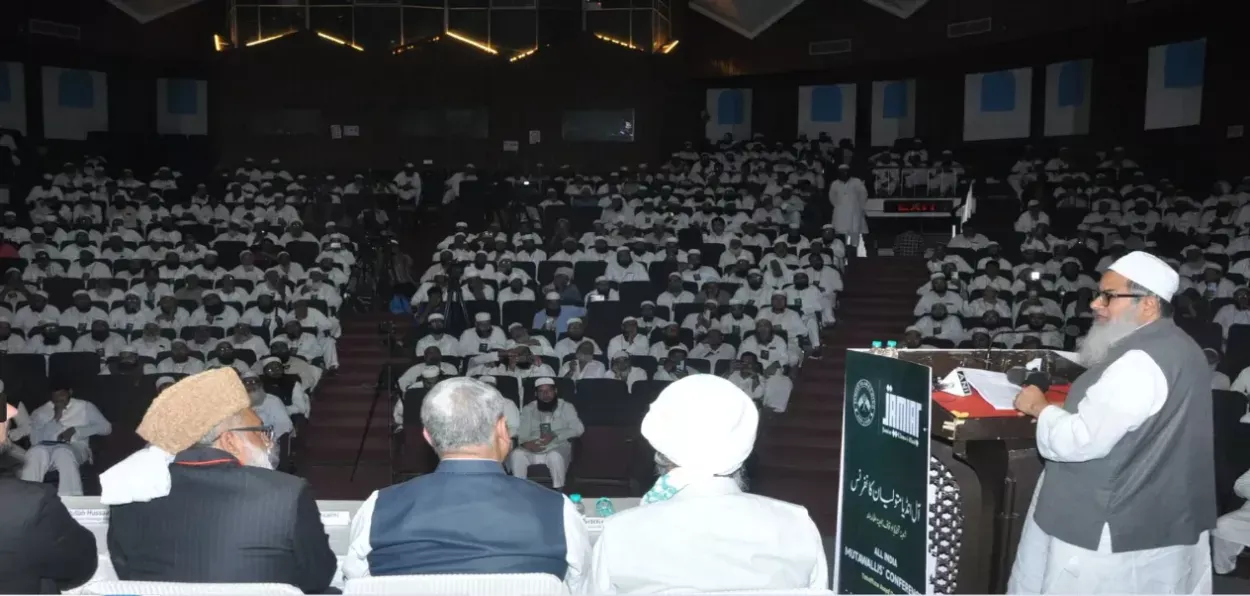
.webp "Union Education Minister Dharmendra Pradhan")
New Delhi
Union Education Minister Dharmendra Pradhan on Thursday said that Vidya Bharati has played a significant role in influencing the development of the National Education Policy 2020, with several of its teaching practices now reflected in the national curriculum.
Speaking at an event organised by Vidya Bharati at the start of the academic session, Pradhan described the organisation as a small yet impactful part of India’s education system. Though it represents only about one per cent of the overall ecosystem, he said its contribution has been exemplary in setting benchmarks for quality education, teaching methods, and value-based learning.
Drawing from his experience over the past five years in the education sector, the minister noted that Vidya Bharati has consistently served as a guiding model in policy decisions related to curriculum design, language of instruction, and broader educational development.
He credited the organisation as one of the inspirations behind NEP 2020, highlighting that its emphasis on value-based education, skill development, and innovative teaching approaches has been incorporated into the policy framework.
Pradhan pointed out that several initiatives now promoted nationally—such as “bagless school days”, emphasis on learning in the mother tongue, and ongoing teacher training—have long been practised by Vidya Bharati institutions.
Emphasising the importance of mother tongue education, he said the policy encourages early learning in regional languages to enhance comprehension and critical thinking. He added that Vidya Bharati’s multilingual approach, which includes Hindi, Sanskrit, and English alongside the mother tongue, further strengthens students’ intellectual development.
The minister underlined that India’s education system is gradually shifting away from rote memorisation towards a focus on creativity, analytical thinking, and practical learning—changes that require more than just textbook reforms.
He also called on Vidya Bharati to collaborate with voluntary organisations, NGOs, and other educational groups to expand the reach of learning beyond classrooms. Education, he said, should be a shared responsibility involving families, communities, and institutions.
Highlighting recent developments, Pradhan said that new textbooks prepared by the NCERT for Classes 1 to 8 are ready, while those for Class 9 will be released soon. He also noted that subjects like computational thinking and artificial intelligence have been introduced for students from Classes 3 to 8 to prepare them for future challenges.
According to him, India’s evolving curriculum is becoming globally competitive, particularly with its early integration of emerging technologies such as AI.
He further added that co-curricular areas like sports, music, dance, and vocational skills have now been formally included in the education system under NEP 2020 and are expected to gain greater academic importance over time.
Concluding his remarks, Pradhan expressed appreciation for Vidya Bharati’s role in shaping educational reforms, calling it a responsible and guiding force in the country’s journey towards a more holistic and forward-looking education system.

_(1)_(1).webp "Jagannath Rath Yatra")











.webp)