




Gandhinagar (Gujarat)
Gujarat, under the leadership of Chief Minister Bhupendra Patel, has set new benchmarks in renewable energy, contributing significantly to Prime Minister Narendra Modi's national target of achieving net-zero emissions by 2070, introducing key initiatives to reduce dependence on conventional fuels, aiming for 50 per cent of India's electricity to come from renewable energy by 2030, according to an official release.
As of Dec 31, 2025, Gujarat had become the first largest contributor to the country's renewable energy capacity, with cumulative installations reaching 42.583 GW, accounting for 16.50% of India's total.
Gujarat ranks first in several renewable energy segments. It ranks 1st in total installed renewable energy capacity (42.583 GW). 1st in installed wind power capacity (14820.94 MW); 2nd in installed solar power capacity (25529.40 MW); and 1st in rooftop solar installations (over 11 lakh rooftop solar installations with 6412.80 MW, highlighting the state's diverse renewable energy portfolio, added the release.
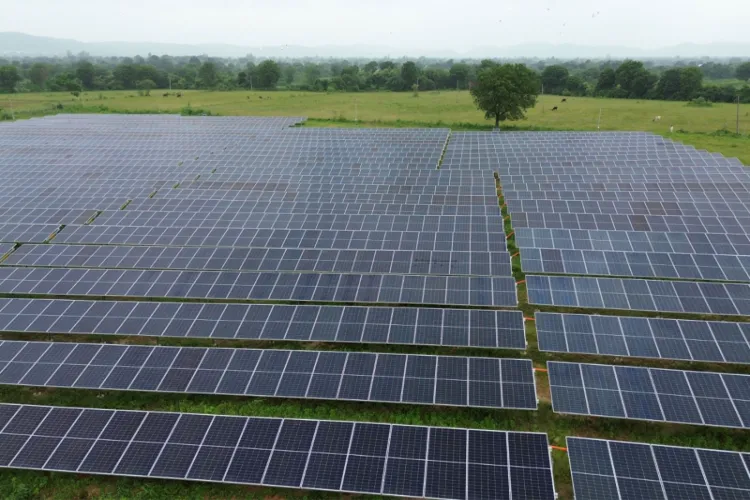
Gujarat has emerged as a leader in solar energy, with 25529.40 MW of installed capacity as of Dec 2025. This includes 17771.21 MW from ground-mounted projects, 6412.80 MW from solar rooftop (Surya Gujarat 2073.65 MW, PM Surya Ghar Yojana 1913MW, Others 2267.04 MW), 1172.38 MW from hybrid projects, and 173.01 MW from off-grid systems, including PM KUSUM.
Key solar parks include Charanka (749 MW), Radhanesda (700 MW), and Dholera (300 MW). The Khavda Renewable Energy Park in Kutch, planned for 37.35 GW, has already achieved 11.33 GW, making it the world's largest renewable energy park.
Gujarat has also crossed 11 lakh rooftop solar installations, generating 6412.80 MW across residential, commercial and industrial segments.
Since 2016, Gujarat has actively incentivised residential rooftop solar, providing continued support until the launch of the PM Surya Ghar scheme, contributing to over 25% of the country's total rooftop solar installations. In agriculture, 12700 standalone off-grid solar water pumps were installed under Component B of PM KUSUM, generating 89.54 MW (as of Dec 2025).
Gujarat has been at the forefront of India's wind energy development since launching the country's first Wind Power Policy. As of Dec 2025, the State's installed wind capacity stands at 14820.94 MW, with Kutch contributing 7476.73 MW.
Other key districts include Jamnagar (1867.65 MW), Devbhumi Dwarka (1281.26 MW), Amreli (973.85 MW), Rajkot (874.9 MW), Bhavnagar (618.8 MW), Morbi (568.6 MW), Surendranagar (456.6 MW), and Patan (208.20 MW). Gujarat has also commissioned 2398.77 MW of wind-solar hybrid projects under the 2018 Hybrid Policy and the Gujarat RE Policy 2023.
Over 80% of turbines are installed on government-allotted land, supported by robust infrastructure and evacuation systems. Based on Gujarat's installed capacity across the renewable energy sector, an estimated 2.37 lakh direct and indirect jobs have been created.
The Government of Gujarat has introduced a transparent and streamlined process for grid connectivity through the Akshay Urja Setu online portal, improving ease of doing business and enabling faster project implementation. Under the net metering regulations, the state has installed over 6.40 GWp of rooftop solar capacity, making it a national leader in this segment.
Gujarat's renewable energy expansion is backed by a comprehensive policy framework. Since the first Wind Power Policy in 1993, the state has introduced landmark policies, including the Solar Power Policies (2009, 2015, 2021), Waste-to-Energy and Small Hydel Policies (2016), and the Wind-Solar Hybrid Policy (2018). The updated Waste-to-Energy Policy (2022), Gujarat Integrated Renewable Energy Policy-2025 (Effective 24 December 2025 to 31 December 2030) provide a unified framework for solar, wind, hybrid, distributed projects and BESS.
The 2023 policy has removed capacity restrictions, covers all project categories, outlines tariffs, grid charges, energy accounting, cross-subsidy and banking charges, and introduces the DREBP scheme, reinforcing Gujarat's leadership in clean energy.
The 2025 policy aims to accelerate large-scale and distributed renewable energy by enabling on-demand connectivity, flexible commissioning timelines, repowering of old wind projects, and seamless integration of battery storage with solar, wind, and hybrid systems.
The policy promotes innovation through emerging RE technologies, private sector participation, RE manufacturing and recycling, and digital facilitation via the Akshay-Urja-Setu portal. It also strengthens consumer participation and sustainability through group/virtual net metering, rooftop and agricultural solar, circular-economy measures, and green jobs and skills development.
ALSO READ: A boy's journey from Kupwara to India’s top labs as scientist
Gujarat continues to innovate and expand its renewable energy landscape with ongoing and upcoming projects. As of Dec 2025, 5203 projects are underway, including 4992 solar projects (32.22 GW), 72 wind projects (15.00 GW), and 139 hybrid projects (21.15 GW), totalling 68.37 GW in the pipeline.
At RE-INVEST 2024 in Gandhinagar, the state set ambitious targets, aiming to reach 105 GW by 2030 and contribute 20% to India's 500 GW non-fossil energy goal.












_(1)_(1).webp)



_(1).webp)