.webp "Representational Image")
Ghaus Sivani
"Unwavering faith, ceaseless action, and love that conquers the world—
These are the swords of men in the struggle of life." (translated)
Allama Iqbal’s couplet reflects the core teachings of the Bhagavad Gita. This may surprise many who regard Iqbal primarily as an Islamic philosopher and the Poet of the East. Yet the sources from which he drew ideas and inspiration included the Bhagavad Gita.
Iqbal was among the great thinkers of the Indian subcontinent who studied Eastern and Western philosophies, religious traditions and diverse intellectual currents of human civilisation. The core pillars of his thought were Khudi(Selfhood) and Amal (Action). According to Iqbal, the secret of life lies in dynamism, struggle, creation and ceaseless action. He viewed human beings not as helpless creatures at the mercy of destiny or as ascetics fleeing the world, but as active and creative personalities endowed with strong willpower.
In this context, researchers have drawn attention to parallels between Iqbal’s philosophy of action and Karma Yoga, the path of selfless action described in the Bhagavad Gita. Although Iqbal’s intellectual foundation rested on the Quran and Islamic teachings, he studied numerous religious and philosophical texts, including the Gita, and appreciated ideas that emphasised moral responsibility and action.
Iqbal’s family was originally of Kashmiri Brahmin lineage and had converted to Islam during the Mughal era. He was familiar with Sanskrit and studied Hindu scriptures, including the Vedas and the Gita. The Gita’s philosophy of action subsequently became a significant theme in his poetry.
Iqbal and the Philosophy of Action
For Iqbal, life was not about comfort, stagnation or passivity but constant movement and struggle. He viewed the universe as being in perpetual motion, with human beings as active participants in this dynamic process. His poetry therefore repeatedly conveys the message of action, dynamism and ceaseless effort.
Amal se zindagi banti hai jannat bhi jahannam bhi
Yeh khaki apni fitrat mein na noori hai na nari hai
(Through action, life becomes either paradise or hell; by nature, this earthly being is neither purely angelic nor purely demonic.)
The couplet expresses Iqbal’s belief that a person’s identity and status are shaped by actions. Through their deeds, individuals can rise to great heights or fall into degradation.
Elsewhere, he writes:
Khudi ko kar buland itna ki har taqdeer se pehle
Khuda bande se khud pooche bata teri raza kya hai
(Elevate your selfhood to such a height that, before decreeing any destiny, God Himself asks the individual: “Tell Me, what is your will?”)
This couplet encapsulates Iqbal’s philosophy of Khudi. The human being is portrayed not as a slave to destiny but as an individual capable of shaping his or her path through will and action.
Iqbal did not favour asceticism or withdrawal from the world. He criticised the passivity that, in his view, had spread in the name of Sufism. At the same time, he respected genuine Sufis, studied their works and visited their shrines. He regarded Jalaluddin Rumi as his spiritual mentor and admired figures such as Ghazali, Mansur Hallaj, Sheikh Ahmad Sirhindi and Shah Hamadan.
The Bhagavad Gita and the Doctrine of Karma
The Bhagavad Gita occupies a significant place in Indian philosophy. In it, Lord Krishna instructs Arjuna on the battlefield about the fulfilment of his duties and responsibilities. One of its central teachings is that a person should perform his duty without attachment to its outcome.
Before the Mahabharata war began, Arjuna was overcome with distress after seeing his relatives, teachers and friends in the opposing army. He told Krishna that he did not wish to kill his elders, gurus, brothers, sons, friends and kinsmen. What use were victory, a kingdom or happiness if they required the blood of his own people? He declared that he desired neither victory nor a kingdom nor the pleasures for which the war was being fought.
According to the Mahabharata, Arjuna said:
"O Krishna! I desire neither victory, nor a kingdom, nor happiness. The very people for whom we seek a kingdom and happiness are the ones standing before us today, ready for battle."
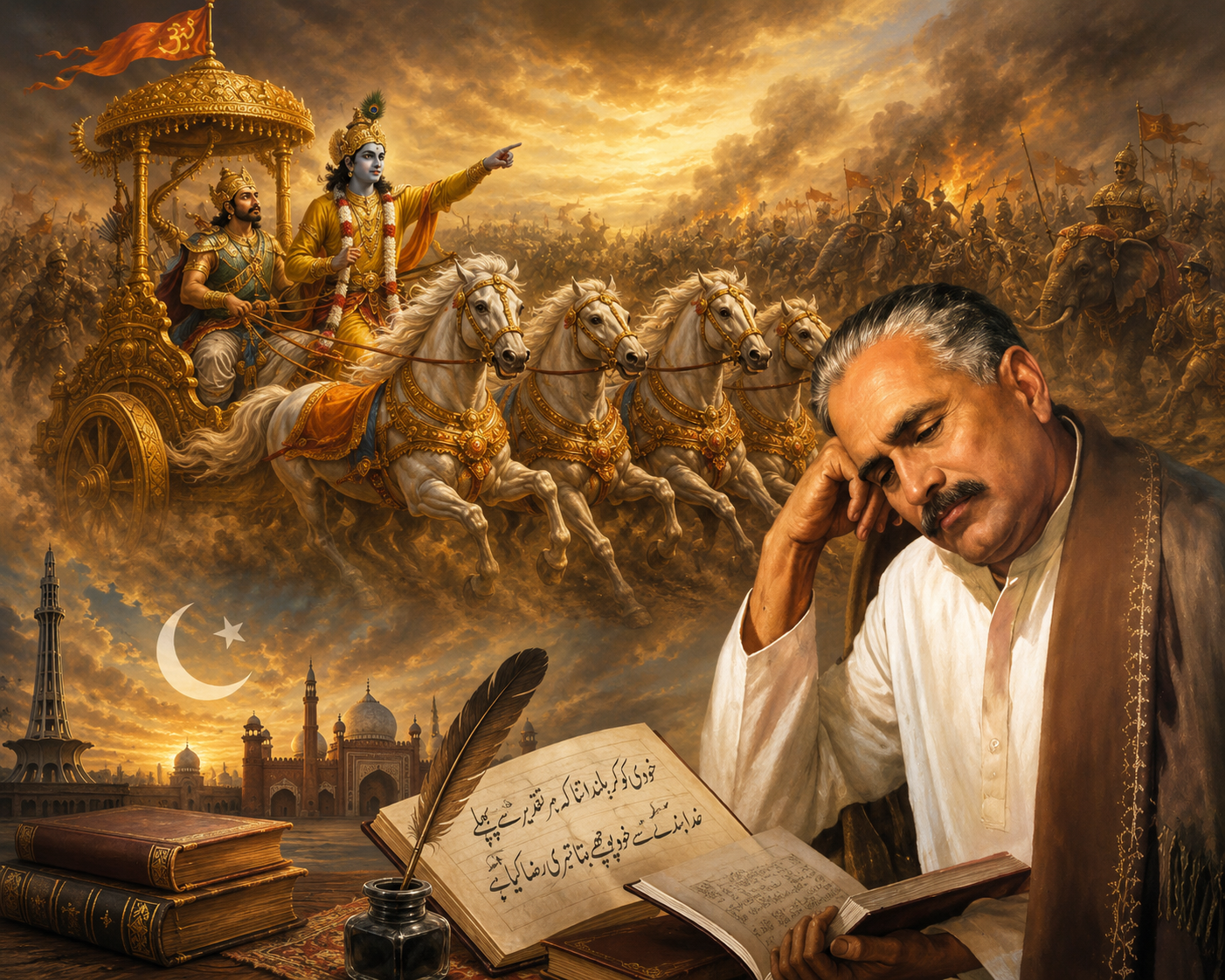
Krishna responded by imparting the teachings of the Gita, emphasising Dharma (duty), Karma(action), the immortality of the soul, and the importance of performing one’s duty without attachment to its fruits.
The Gita therefore teaches not the abandonment of action but spiritual progress through the performance of one’s duties. Krishna urges Arjuna not to flee the battlefield but to stand firm and fulfil his responsibility.
This idea closely resonates with Iqbal’s philosophy. He too urged individuals to participate actively in the arena of life rather than withdraw from it.In the preface to Asrar-e-Khudi (The Secrets of the Self), Iqbal examined Hindu philosophy, particularly the doctrine of Karma and the concept of renunciation:
"A unique synthesis of action and philosophy has taken place in the mind and intellect of Hindu society. The profound thinkers of this society deeply contemplated the power of action and ultimately concluded that the continuous unfolding of human life—which is also the source of one's sorrows and sufferings—is determined by one's actions. In other words, a person's present state is the natural consequence of past deeds. As long as this law of action persists, corresponding consequences will continue to manifest.
When 'Faust'—the protagonist created by the renowned nineteenth-century German poet Goethe—reads the word 'Action' instead of 'Word' in the opening line of the Gospel of John—' In the beginning was the Word, and the Word was with God, and the Word was God'—he is, in fact, perceiving through his deep insight the very truth that Hindu philosophers had grasped centuries earlier."
Iqbal observed that Hindu philosophers had attempted to address the fundamental problem of fate versus human free will—the conflict between destiny and liberty. He admired the depth of this philosophical inquiry and noted that Hindu thinkers had accepted the consequences arising from their theory of Karma.
However, he believed that the interpretation of renunciation posed a danger to both the individual and society. In his view, there was a need to clarify that renouncing action did not mean abandoning activity altogether.
After Sri Krishna, Sri Ramanuja also followed this path. Regrettably, however, Iqbal believed that the truth that Sri Krishna and Sri Ramanuja sought to reveal was once again obscured by the arguments of Adi Shankaracharya, depriving the followers of Sri Krishna of the benefits of his reform. (Preface to Asrar-e-Khudi)
Through this analysis, Iqbal demonstrated that his engagement with Hindu philosophy was not merely critical. He recognised the intellectual achievements of Hindu thinkers, particularly their attempt to understand the relationship between human action, destiny and free will.
Iqbal’s Philosophy of Action
Iqbal opposed any idea that rendered human being passive. He particularly urged Muslims to embrace action and ceaseless effort so that they could regain their lost prestige. In one of his lectures, he states:
"For the past five hundred years, Islamic thought has remained virtually stagnant. There was a time when Western thought drew light and inspiration from the Islamic world."
(Urdu translation of Allama Muhammad Iqbal’s English lectures, page 13, Iqbal Academy Pakistan)
Iqbal’s primary objective was the renaissance of Islamic thought. He wanted Muslims to regain their intellectual vitality and engage creatively with the challenges of their time. His engagement with Hindu and Western thought was part of this broader intellectual quest.
The Relationship Between Khudi and Action
A major similarity between Iqbal’s philosophy of Khudi and the Gita’s Karma Yoga is their emphasis on active engagement with life. For Iqbal, Khudi was not a static entity but a force that developed through continuous action and struggle. The more an individual engaged with life, the stronger the Khudi became.
There are worlds beyond the stars;
There are yet more trials of love to face.
The couplet conveys the message of moving ever forward, seeking new horizons and persisting in the struggle.
In the same vein, he writes:
Your abode is not upon the dome of a sultan's palace;
You are a Shaheen (royal falcon)—make your home amidst the mountain crags.
This couplet, from Iqbal’s poem To a Young Man, advocates lofty goals, freedom and ceaseless struggle rather than comfort, luxury or stagnation. In his speeches, too, he urged the youth to abandon a love of ease and embrace hard work.
Iqbal and the Critique of World-Renunciation
Iqbal was critical of ideologies that severed human beings from the world, rendered them passive or encouraged dependence solely on fate. He also criticised certain Sufi tendencies and philosophical interpretations that, in his view, weakened the resolve to act.
In particular, he disagreed with Adi Shankaracharya’s philosophy of Maya (illusion) and interpretations of Advaita (non-dualism) that regarded the world as merely illusory or unreal, although he held Shankaracharya in high regard.
For Iqbal, this world was a realm of action in which human personality was forged. Consequently, individuals had to strive until their very last breath.
Iqbal’s Connection to Hindu Tradition
Although Iqbal’s ideological and spiritual allegiance lay firmly within the Islamic tradition, his intellectual engagement extended beyond it. He drew upon Hindu knowledge and philosophy whenever he found ideas that could contribute to his understanding of human existence, morality and action.
This broad intellectual engagement is particularly evident in Javidnama, his great Masnavi, which takes the form of a spiritual journey through encounters with historical, philosophical and religious figures. Its recurring themes include dynamism, progress and the rejection of stagnation.
In the work, his spiritual mentor, Maulana Rumi, repeatedly urges humanity to break free from passivity and mere contemplation and instead follow the path of action and creation.
Dynamism was therefore fundamental to Iqbal’s philosophy. For him, life was synonymous with movement, while stagnation signified death. The individual who continually moved forward through action was, in his view, in harmony with nature.
Iqbal’s Life and His Interest in the Gita
Iqbal’s own life reflected his philosophy of action and struggle. His father, Sheikh Noor Muhammad, was a tailor who stitched caps. Coming from such circumstances, travelling to Europe for higher education was not easy, but his determination and hard work made it possible.
His appreciation of the philosophy of Karma in the Bhagavad Gita was therefore consistent with his broader belief in action and self-development. He read the Gita in Sanskrit and wished to translate it so that a wider audience could benefit from its teachings.
ALSO READ: Allama Iqbal faced fatwa for writing Gayatri Mantra in Urdu
With this aim, he expressed his desire to translate the Gita in a letter to Maharaja Kishan Prasad Shad. Although he was not a professional translator and had never translated another book, the text moved him so deeply that he felt compelled to undertake the task.


_(1).jpg "Visitors gather at the Santosh Mitra Square Durga Puja pandal, themed on the 150th anniversary of Vande Mataram and its historic role in India's freedom movement, ahead of the festival, in Kolkata")

.jpg "Gujarat’s women entrepreneurs bring their craftsmanship to life during Navratri")










_(4).webp)
_(2).webp)