Ghaus Sivani
When Allama Iqbal rendered the Gayatri Mantra into Urdu poetry, some religious scholars considered it an un-Islamic act and a fatwa declaring the celebrated “Poet of the East” (Shayar-e-Mashriq) a kafir (heretic) was issued. Ironically, Iqbal, who was not universally accepted as a Muslim by some of his critics during his lifetime, is today widely revered in Muslim circles as a philosopher and poet of Islam.
The controversy eventually compelled Iqbal to explain the intent behind his verses.
Iqbal is generally remembered as a poet who championed Islamic thought, the concept of Khudi (Selfhood), Millat-e-Islamia (the Muslim community), and the idea of Islamic renaissance. Yet, another important dimension of his intellectual personality was his deep engagement with and respect for diverse civilisations, religions and philosophical traditions.
He studied Hindu philosophy, Vedanta, Buddhism, Iranian Sufi thought and Western philosophy extensively. His poetry therefore occasionally reflects admiration for the spiritual and philosophical traditions of other faiths.
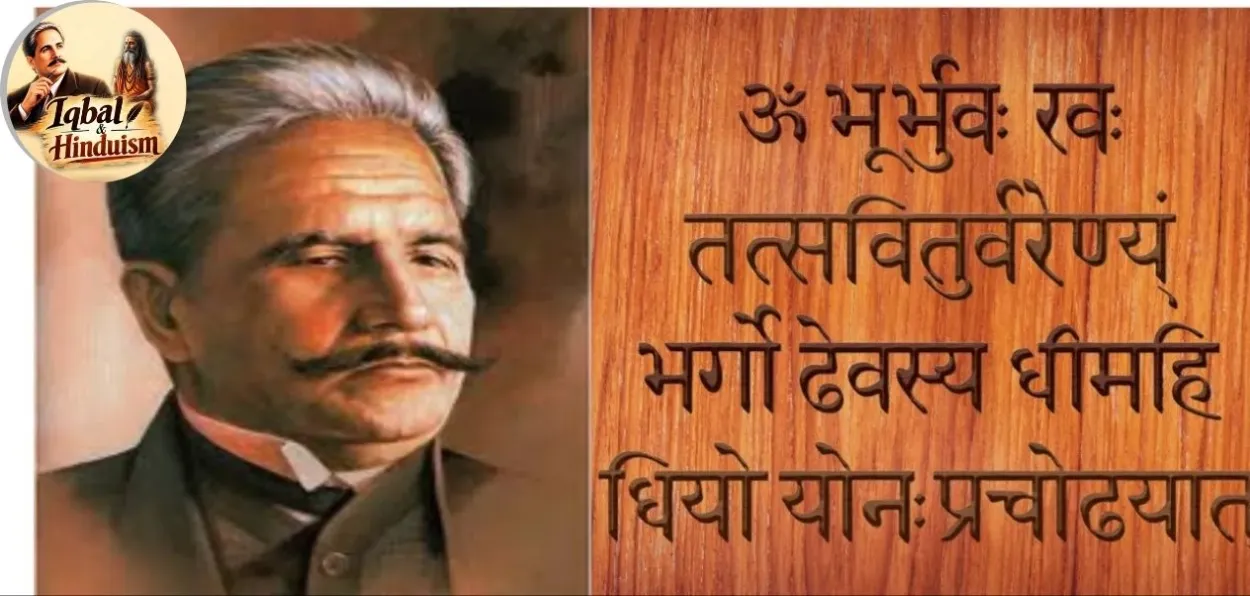
One such work is Aftab, regarded as Iqbal’s poetic adaptation of the Gayatri Mantra.
The Gayatri Mantra
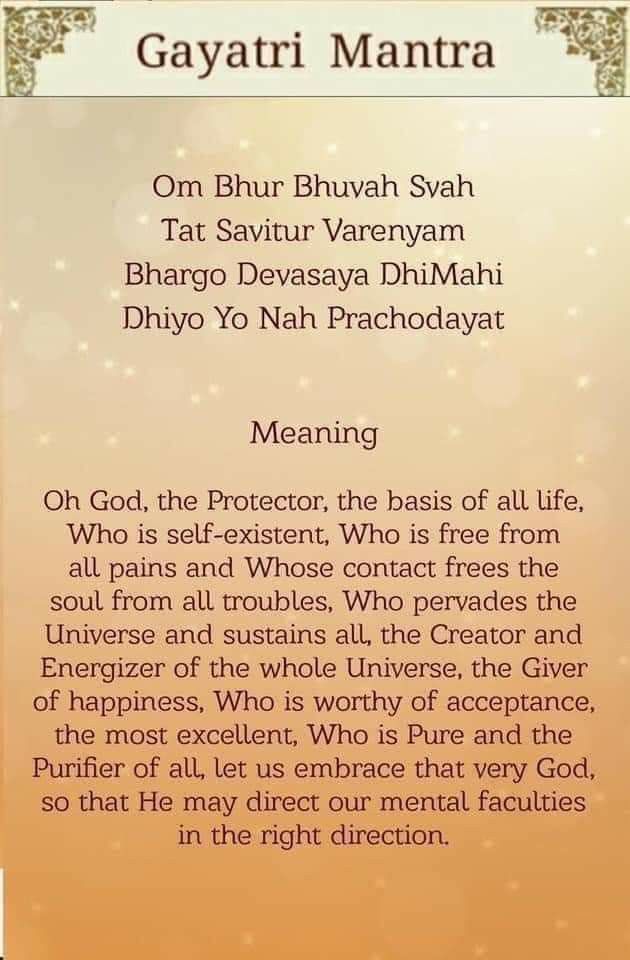
The Gayatri Mantra is among the most ancient and revered mantras in Hinduism. Found in the Rigveda, it is traditionally understood as a prayer for spiritual awakening, self-realisation, divine grace and the illumination of the intellect.
The mantra invokes the Divine and seeks guidance towards the right path. It is particularly revered for its emphasis on divine light, knowledge and wisdom.
Its essence may be rendered as:
“O Divine One! You are omnipresent; You possess supreme power and authority. You are the embodiment of perfect light and the source of knowledge, self-realisation and bliss. You dispel fear and are the Creator and Supreme Being. We meditate upon Your divine light. May You guide our intellect towards the right path.”
The prayer thus centres on the idea of a supreme divine light that illuminates the universe and guides human intellect.
Several Urdu poets, including Iqbal, drew inspiration from this theme. By adapting the central idea of the Gayatri Mantra into his own poetic idiom, Iqbal created a distinctive literary interpretation that continued to attract readers for generations.
In Aftab, Iqbal refers to the “light of truth” and the source of life. The sun becomes a metaphor for divine illumination, while other images in the poem—such as the ocean and dark clouds—are used to evoke beauty and mystery.
In the opening stanza, Iqbal presents the sun not merely as a celestial object but as a symbol of life, consciousness and the cosmic order:
O Aftab! O soul, wherever you are,
You are the one who binds together the scattered pages of existence.
Here, Aftab is more than the physical sun. It symbolises the light that gives order, movement and vitality to the universe.
Similarly, he writes:
Every aspect of life derives its essence from You;
Every entity owes its permanence to the radiance of Your manifestation.
These lines convey the idea that the entire universe is connected to a supreme source of light and that life itself is sustained by divine grace.
He further writes:
O Sun, grant us the light of wisdom;
Illumine the eye of intellect with Your radiance.
The appeal for wisdom, knowledge and true guidance closely echoes the central spiritual impulse of the Gayatri Mantra.
Iqbal’s Objective
Iqbal’s purpose in rendering the Gayatri Mantra into verse was not to promote another religion or abandon his own beliefs. Rather, he sought to explore universal values shared by different spiritual traditions—knowledge, enlightenment, morality, self-realisation and the search for divine truth.
He opposed narrow-mindedness and was deeply interested in the intellectual and spiritual heritage of different civilisations.
Aftab is therefore an example of how Iqbal could draw upon the spiritual traditions of another faith while retaining his own religious and philosophical identity. Through his poetic interpretation of the Gayatri Mantra, he highlighted ideals that transcend religious boundaries.
The Fatwa of Kufr Against Iqbal
Several fatwas were issued against Iqbal’s poetry and ideas, both during his lifetime and subsequently. Objections were raised against the themes and language of several of his poems, including Aftab.
His long poem Shikwa, for instance, was considered objectionable by some on religious grounds. His philosophical concept of Khudi also attracted criticism. Iqbal’s attack on superstition, passivity and certain practices that had developed in the name of Sufism led some critics to portray him as an opponent of Sufism itself.
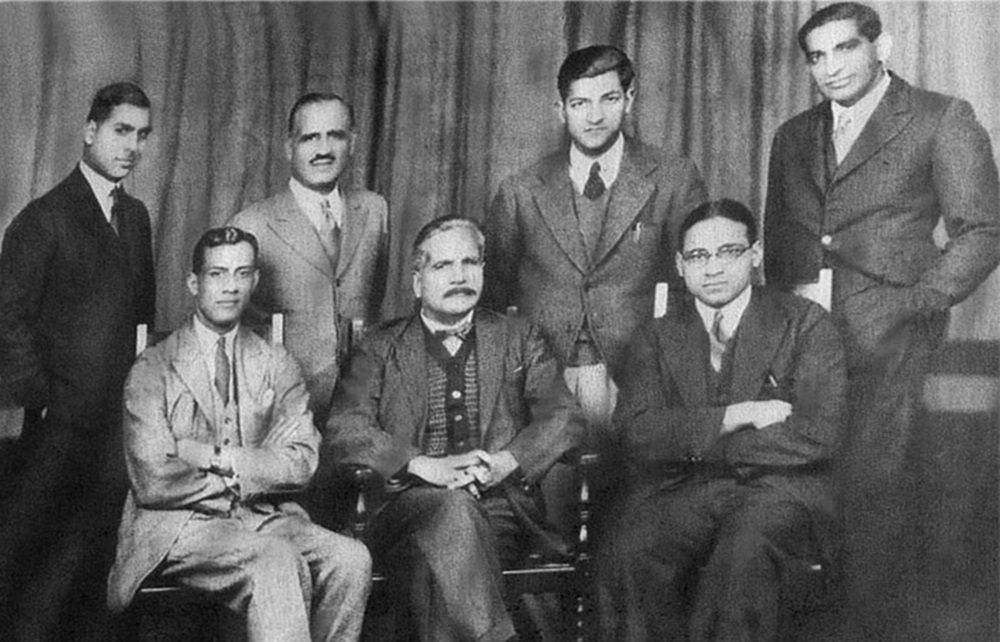 Allama Iqbal with others
One of the most widely discussed religious rulings against him was issued by Maulvi Didar Ali Alwari, the khatib (sermon-giver) of Lahore’s Wazir Khan Mosque. He declared certain verses by Iqbal, along with aspects of his philosophy of Khudi, to be kufr.The controversy was also discussed in contemporary periodicals.
The religious inquiry put before the Maulvi described a poet who allegedly attributed divine qualities to the Aftab (Sun) and prayed to it. The inquiry further accused him of denying the Hereafter, disrespecting the Prophet Musa (Moses) and ridiculing the Ulama-e-Kiram (religious scholars).
At the same time, it pointed out that the poet had referred to a revered Hindu figure, regarded by Hindus as an incarnation of God, with titles such as Imam and Charagh-e-Hidayat (Beacon of Guidance).
The question posed was: What does Sharia prescribe regarding such a person? Could he still be regarded as a Muslim, and what should be the community’s attitude towards him?
Several of Iqbal’s verses were cited in the religious inquiry, including:
O Sun, grant us the light of consciousness,
Illumine the eye of intellect with Your radiance.
This is no unique distinction of yours, O Kaleem (Moses),
For even trees and stones converse with God.
These self-serving spiritual guides are a calamity; may God save your community,
They build their own prestige by corrupting your Muslims.
Hindustan takes pride in the existence of Ram,
The discerning recognise him as the Imam-e-Hind (Leader of India).
Such is the miracle of this Beacon of Guidance,
That the evening of Hind shines brighter than the dawn of the world.
In response, Maulvi Didar Ali issued a fatwa written in a mixture of Persian and Arabic. Its central argument was that the poet had referred to the Aftab as Yazdan and Parvardigar—terms associated with God and the Creator—and that such statements amounted to kufr.
The ruling argued that attributing divine qualities to created beings, or suggesting that God could be born, constituted disbelief. It also treated alleged disrespect towards the Prophet Musa as kufr. The ruling concluded that unless the person repented, social and religious ties with him should be severed.
The fatwa naturally caused considerable controversy. People began asking: if a poet and intellectual of Iqbal’s stature could be declared outside the fold of Islam, then who could be considered a Muslim?
A Question of Metaphor and Context
The controversy, however, was based largely on a literal reading of Iqbal’s poetry.
Iqbal had made it clear that Aftab was a poetic rendering of an idea from the Rigveda, particularly the Gayatri Mantra. The sun in the poem was not simply the physical object visible in the sky; it was a symbol of the supreme source of light, power and life.
The imagery can also be understood within the broader Islamic tradition, where divine light is a powerful spiritual metaphor. The Quran itself describes Allah as “the Light of the heavens and the earth” (24:35).
Seen in this context, Iqbal’s use of the sun as a symbol of divine illumination was poetic and metaphorical rather than an act of worshipping the physical sun.
Iqbal did not respond to the controversy with an aggressive public rebuttal. Nor did ordinary Muslims appear to attach lasting significance to the cleric’s ruling.
More than a century later, the irony is striking. Iqbal’s poetry continues to be read, quoted and celebrated across the world, particularly in the Muslim world. His ideas on selfhood, spiritual awakening, social reform and human dignity remain influential.
ALSO READ: Iqbal saw Gautama Buddha as a saint, seeker and voice of humanity
The fatwas issued against him, meanwhile, have largely faded into obscurity.

_(1).jpg "Visitors gather at the Santosh Mitra Square Durga Puja pandal, themed on the 150th anniversary of Vande Mataram and its historic role in India's freedom movement, ahead of the festival, in Kolkata")

.jpg "Gujarat’s women entrepreneurs bring their craftsmanship to life during Navratri")










_(4).webp)
_(2).webp)