.webp "Iqbal and Adi Shankaracharya (Representational image)")
Ghaus Sivani
The mere mention of Allama Iqbal often brings to mind his celebrated poem Saare Jahan Se Achha Hindostan Hamara (“Better than the entire world is our Hindustan”). Yet that poem represents only one facet of his vast intellectual world. Iqbal was not merely a poet but a thinker whose intellectual horizons extended across religions, civilizations and philosophical traditions. He engaged seriously with ideas and personalities beyond his own religious tradition and acknowledged intellectual and spiritual excellence wherever he found it.
Although Iqbal is often described as the “Poet of Islam” (Shair-e-Islam), his intellectual universe was far broader. He studied different religions, civilizations and schools of philosophy, appreciating ideas that embodied humanity, spirituality and the search for truth. His poetry and prose contain references to Hindu, Buddhist, Sikh and Iranian religious and philosophical traditions, as well as to Islamic thought.
Among the Indian thinkers who attracted Iqbal’s attention was Adi Shankaracharya, the great philosopher who gave systematic form to the doctrine of Advaita Vedanta.
Iqbal wrote poems on Lord Rama, Guru Nanak Dev Ji and Swami Ram Tirath. He expressed admiration for Gautama Buddha and referred respectfully to Zoroaster, Jesus Christ and Buddha in his celebrated philosophical poem Javid Nama. In the preface to his Asrar-e-Khudi (The Secrets of the Self), he also discussed the ideas of Krishna, Adi Shankaracharya and Ramanujacharya.
His English work, The Development of Metaphysics in Persia, likewise demonstrates his deep engagement with different religious and philosophical traditions and his interest in tracing their intellectual development.
Shankaracharya’s Philosophical Contribution
Iqbal regarded Shankaracharya’s Advaita philosophy as a remarkable intellectual achievement, even though he did not ultimately agree with its central conclusions.
.jpg)
At the heart of Shankaracharya’s philosophy is the idea that ultimate reality is Brahman, while the apparent multiplicity of the phenomenal world is a transient and illusory manifestation. Iqbal, by contrast, placed Khudi, or selfhood, at the centre of his philosophy. For him, the individual possesses an independent, dynamic and creative personality that must be strengthened rather than dissolved.
This difference explains Iqbal’s simultaneous admiration and disagreement with Shankaracharya. He respected the philosopher’s intellectual power and logical depth, even while objecting to what he saw as the negation of the individual self in Advaita.
Interestingly, Iqbal viewed the thought of Ibn Arabi more positively, despite the similarities often drawn between Ibn Arabi’s Wahdat-ul-Wujud (Unity of Being) and Shankaracharya’s Advaita. Shankaracharya lived centuries before Ibn Arabi. Both developed ideas within very different intellectual and religious contexts, even when their philosophical formulations appear to converge.
Who Was Adi Shankaracharya?
Adi Shankaracharya was a major Indian philosopher and spiritual teacher, traditionally dated to the eighth century, who systematized and consolidated Advaita Vedanta. According to his philosophy, Brahman is the ultimate and absolute reality, while the diversity perceived in the phenomenal world does not constitute ultimate reality.
Shankaracharya is traditionally believed to have travelled extensively across India, engaging in philosophical debates, composing important works and establishing centres of learning and spiritual practice. Kashmir was among the important intellectual regions associated with his tradition and was, even then, a major centre of Sanskrit learning, metaphysics and spiritual inquiry.
The intellectual landscape of Kashmir already possessed a rich non-dualist tradition, particularly through Shaiva philosophical thought. While Advaita Vedanta and Kashmiri Shaivism share a broad emphasis on non-duality, their conceptions of ultimate reality differ. Shankaracharya identifies Brahman as the formless and attribute-less ultimate reality, while Kashmiri Shaivism places Shiva—understood as supreme consciousness—at the centre of its metaphysical vision.
It was against this rich philosophical background that Iqbal viewed Shankaracharya.
While Iqbal’s philosophy of Khudi, together with the Islamic concept of Tawhid, emphasizes the individual’s will, agency and creative potential, Shankaracharya’s philosophy sees the apparent distinction between the individual and ultimate reality differently. Yet this fundamental philosophical disagreement did not prevent Iqbal from acknowledging Shankaracharya’s intellectual stature and his place in India’s great spiritual and philosophical heritage.
Iqbal on Shankaracharya
In the preface to Asrar-e-Khudi, Iqbal writes: “The ‘Asrar-e-Khudi (Secrets of the Self)’—whom Sri Krishna, Sri Rama, and Ramanuja sought to unveil—was instead veiled by the logical enchantment of Sri Shankar; consequently, the community of Sri Krishna remained deprived of the fruits of that renewal.”
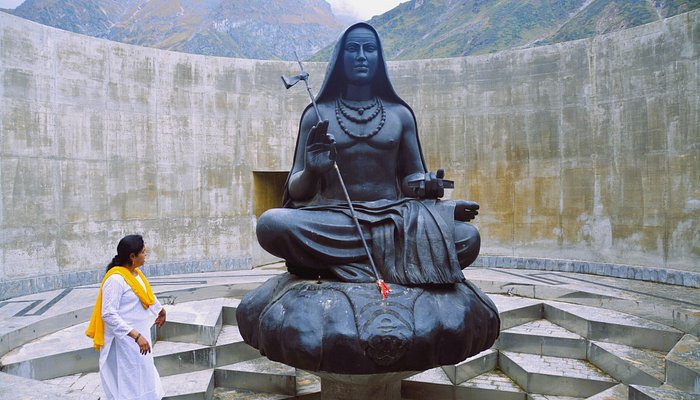 A woman walking past the statue of Adi Shankaracharya in Kedarnath
This observation reveals Iqbal’s appreciation of Shankaracharya’s formidable logical abilities, even as he criticised the philosophical consequences of his doctrine.
In the same preface, Iqbal draws an intriguing comparison between Shankaracharya and Ibn Arabi:
“The very perspective from which Sri Shankar interpreted the Gita is the same perspective from which Sheikh Muhyiddin Ibn Arabi Andalusi interpreted the Holy Quran—an interpretation that has deeply influenced the hearts and minds of Muslims.”
Iqbal was evidently struck by the parallels between Shankaracharya’s interpretation of the Gita and Ibn Arabi’s mystical interpretation of the Quran. Both traditions, in different ways, explore the relationship between the One and the many and the presence of the Divine in creation.
Iqbal’s engagement with these ideas developed over time. He studied Shankaracharya’s philosophy alongside the thought of Ibn Arabi and gradually came to distinguish between the two more sharply.
Scholar Maikash Akbarabadi, in Naqd-e-Iqbal (Maktaba Jamia Limited, New Delhi, 1964, p. 78), observes:
“In his early period, Iqbal stated that ‘Sufism is influenced by Neo-Platonism, and Ibn Arabi and Shankaracharya share a similar line of thought.’ This implied that he viewed these three schools of thought as aligned in the same direction regarding Wahdat-ul-Wujud. However, his stance on Wahdat-ul-Wujud shifted when he realized that Shankara’s philosophy leads to Nafi-e-Khudi (the negation of the self), whereas Sheikh Akbar (Ibn Arabi) regards the world not as an illusion but as Mazhar-e-Haq (a manifestation of God).”
Thus, Iqbal’s position was neither one of uncritical admiration nor outright rejection. At different stages, he acknowledged points of convergence with Shankaracharya while also articulating fundamental differences with his philosophy.
A Dialogue Across Traditions
Iqbal’s engagement with Shankaracharya illustrates an important feature of his intellectual personality: his willingness to study ideas outside his own religious tradition without abandoning his own philosophical convictions.
For Iqbal, engagement with other traditions was not necessarily an exercise in agreement. It could also involve respectful disagreement, comparison and intellectual dialogue. His writings on Shankaracharya, Krishna, Rama, Buddha, Guru Nanak and other figures demonstrate this breadth of inquiry.
What he admired in Shankaracharya was the depth of his philosophical inquiry and his relentless pursuit of ultimate reality. What separated the two thinkers was their understanding of the individual self and its relationship with ultimate reality.
Iqbal's Khudi seeks the strengthening and development of the individual through faith, action, creativity and moral discipline. Shankaracharya’s Advaita, by contrast, ultimately emphasizes the realization of the unity of Atman and Brahman. Their philosophical destinations were therefore different, even though both placed the search for ultimate truth at the heart of their thought.
Seen in this light, Iqbal’s engagement with Shankaracharya is more than an interesting footnote in the history of Indian philosophy. It is an example of intellectual dialogue across religious and philosophical boundaries.
ALSO READ: Allama Iqbal’s philosophy of Khudi is derived from Bhagavad Gita’s Karma Yoga
Iqbal and Shankaracharya belonged to different religious and intellectual traditions, yet both were deeply concerned with the nature of reality, the spiritual development of the human being and the quest for ultimate truth. Iqbal’s respectful engagement with Shankaracharya demonstrates that intellectual disagreement need not preclude admiration—and that the study of different traditions can become a means of widening, rather than narrowing, one’s understanding of humanity and spirituality.


_(1).jpg "Visitors gather at the Santosh Mitra Square Durga Puja pandal, themed on the 150th anniversary of Vande Mataram and its historic role in India's freedom movement, ahead of the festival, in Kolkata")

.jpg "Gujarat’s women entrepreneurs bring their craftsmanship to life during Navratri")










_(4).webp)
_(2).webp)